For European employers, navigating international recruitment comes with a non-negotiable requirement: legal certainty. Working with an unverified manpower provider can lead to visa rejections, project delays, fines, and reputational damage. That is why every EU company hiring Vietnamese workers must start by verifying the credentials of a Vietnam labor licensing company. This article explains the legal framework behind MOLISA licensing, how to verify a legitimate partner, and what compliance standards EU employers should demand. For a broader overview of working with Vietnamese manpower providers, see our Vietnam manpower agency guide.
Working with a verified Vietnam labor licensing company is not just about compliance—it directly impacts project continuity, worker retention, and long-term hiring stability. EU employers that prioritize licensed partners consistently report fewer disruptions during visa processing and onboarding, especially in regulated sectors like construction and manufacturing.

Why a Vietnam Labor Licensing Company Matters for EU Employers
Choosing an approved manpower agency Vietnam is not just a best practice — it is a legal safeguard. Unlicensed operators expose EU employers to significant risks that can derail projects and trigger penalties.
A properly verified Vietnam labor licensing company provides a clear legal foundation that protects both the employer and the worker throughout the recruitment lifecycle.
Risks of Working with Unlicensed Manpower Agencies
Partnering with an unlicensed approved manpower agency Vietnam can lead to:
- Visa rejections due to incomplete or falsified documentation
- Legal exposure from non-compliance with EU labor laws and bilateral agreements
- Worker disputes arising from unclear contracts or hidden fees
- Project delays caused by unreliable deployment timelines
- Reputational damage from association with unethical recruitment practices
The Vietnam labour export license list, maintained by MOLISA, is the authoritative record of companies legally permitted to recruit and deploy workers overseas[reference:0]. Consulting it before any contractual agreement is a vital due diligence step.
EU Employer Responsibility and Due Diligence
Under EU directives such as the Corporate Sustainability Due Diligence Directive (CSDDD), employers are expected to verify labor conditions throughout their supply chains. This includes confirming that overseas recruitment partners operate with valid licenses and respect worker rights. Failing to do so can expose your company to legal liability and exclusion from public tenders. As highlighted in recent legal analysis, aligning with EU standards enhances global market access and fosters long-term partnerships[reference:1].
📘 Want the full picture of how a compliant Vietnam manpower agency operates?
Explore the complete framework, selection criteria, and deployment process in our Vietnam manpower agency guide .
Vietnam Labor Licensing Company Legal Requirements in Vietnam
To operate legally, a Vietnam labor licensing company must meet strict government criteria under the Law on Vietnamese Guest Workers 2020 and Decree 112/2021/ND-CP. These requirements ensure financial stability, operational capacity, and worker protection.
MOLISA Licensing Criteria for Manpower Agencies
Under Vietnamese law, an approved manpower agency Vietnam must satisfy the following conditions[reference:2]:
- Minimum charter capital of 5 billion VND (approximately $200,000 USD) to ensure financial capacity for risk obligations
- Qualified legal representative: Vietnamese citizen with a university degree and at least five years of experience in labor export or employment services
- Clean criminal record for the legal representative, with no convictions for fraud, human trafficking, or related offenses
- Security deposit placed at a commercial bank as mandated by Article 24 of the Law on Vietnamese Guest Workers
- Dedicated training facilities owned or stably leased to provide worker orientation education
- Functional website and sufficient professional staff to carry out recruitment and deployment activities
These criteria are designed to ensure that only financially sound, operationally capable agencies receive a license to send workers abroad.
These requirements collectively define what qualifies as a legally compliant Vietnam labor licensing company, ensuring only capable agencies operate in international recruitment.
Contracts, Worker Protection, and Compliance Rules
A compliant Vietnam manpower agency provides bilingual employment contracts (Vietnamese and destination language) that clearly state wages, working hours, accommodation, insurance, and grievance procedures. Licensed agencies must also adhere to posting requirements: within 30 days of license issuance, they must display a copy at their headquarters and publish it on their website[reference:3]. Furthermore, they must comply with ILO fair recruitment principles, including a zero‑fee policy for workers. Under ILO guidelines, workers shall not be charged directly or indirectly any fees or related costs for their recruitment[reference:4].
How to Verify a Vietnam Labor Licensing Company Before Partnership
Before entering any agreement, EU employers should validate whether the Vietnam labor licensing company meets both local legal standards and EU compliance expectations.
Verification is a straightforward but critical process. EU employers should follow this checklist before signing any agreement with a Vietnam labor licensing company.
Key Documents to Request from a Vietnam Manpower Agency
Ask any potential Vietnam manpower agency for the following documents:
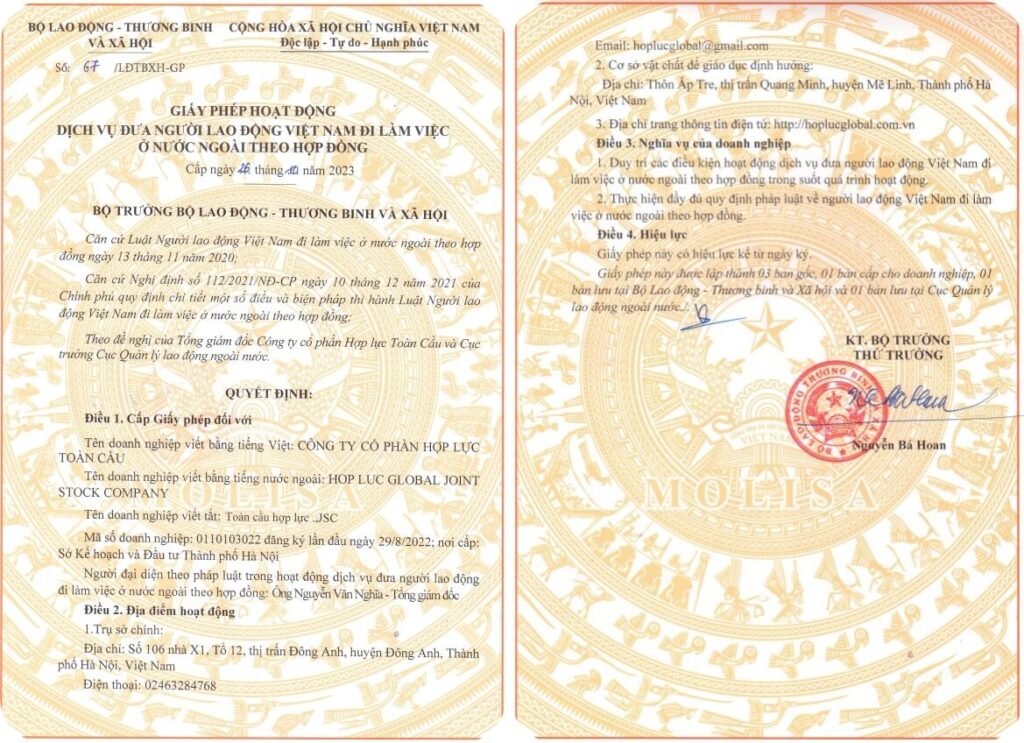
- Copy of the MOLISA license – verify the license number, issue date, expiry, and scope of permitted markets
- Vietnam labour export license list entry – a dated screenshot or PDF of the agency’s active listing on the official MOLISA registry[reference:5]
- Sample employment contracts in both Vietnamese and the destination language
- Training curricula and proof of facilities – documented hours, topics, and photos of training centers
- Client references and deployment records – evidence of past EU deployments, including roles, numbers, and timelines
A reliable Vietnam labor licensing company will proactively provide these documents without hesitation, demonstrating transparency and operational readiness.
Cross-check the agency’s legal name and tax code precisely with the registry to avoid fraudulent entities.
Red Flags to Avoid in Recruitment Partnerships
Be cautious if a provider exhibits any of these warning signs:
- No valid MOLISA license or refusal to share it
- Unrealistic deployment timelines (e.g., “workers in 2 weeks” without acknowledging visa processing)
- Unclear or evasive fee structures – reluctance to provide an itemized quotation
- No written zero‑fee policy for workers
- Vague answers about training or sourcing processes
- Lack of verifiable EU client references
If you encounter two or more of these red flags, consider the provider high‑risk. For a deeper evaluation framework, read our guide on how to choose a manpower partner.

How a Vietnam Labor Licensing Company Supports EU Compliance
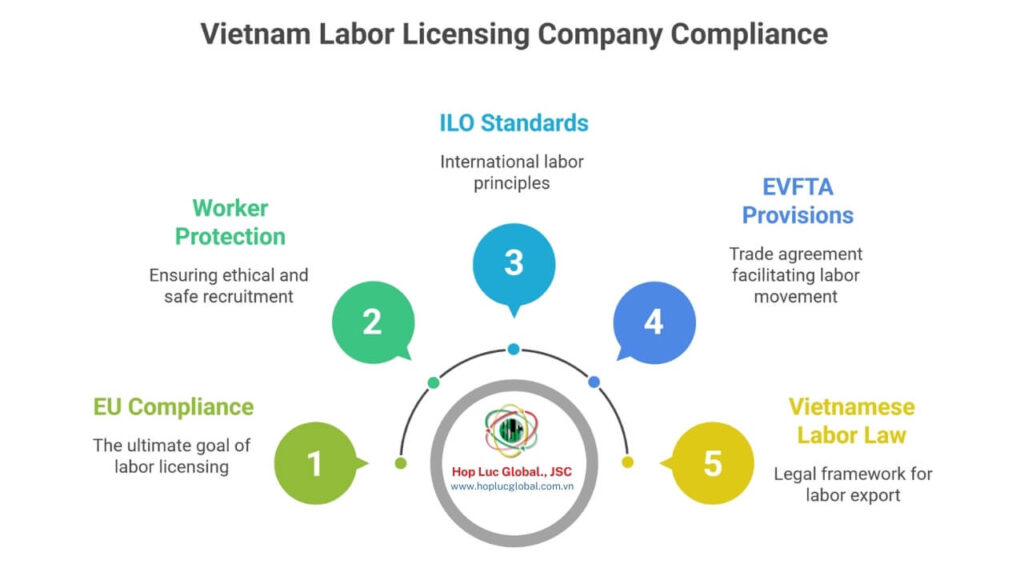
The legal framework for Vietnam labor licensing company operations is not isolated — it aligns with international standards and EU requirements, providing a solid foundation for cross‑border recruitment.
This alignment ensures that every Vietnam labor licensing company operating legally can support EU employers in meeting cross-border labor compliance requirements.
Alignment with EVFTA and ILO Standards
The EU‑Vietnam Free Trade Agreement (EVFTA) includes Mode 4 provisions that facilitate temporary movement of skilled professionals. Vietnamese law on labor export is designed to be compatible with these commitments, ensuring that licensed agencies can deploy workers legally to EU member states.
Additionally, Vietnam has adopted ILO fair recruitment principles, and many licensed agencies adhere to codes of conduct that align with international labor standards[reference:6]. This alignment gives EU employers confidence that workers are recruited ethically and legally.
Ensuring Worker Protection and Ethical Recruitment
An approved manpower agency Vietnam must operate under a transparent, ethical framework. This includes:
- Zero‑fee recruitment – workers pay no placement costs
- Clear contracts – wages, hours, accommodation, and rights clearly stated in both languages
- Pre‑departure training covering safety, language, and cultural orientation
- Post‑arrival support – 30/60/90‑day check‑ins and a grievance channel
For more on ethical practices, see our ethical recruitment framework.
How Hop Luc Global Operates as a Vietnam Labor Licensing Company
As a Vietnam labor licensing company with proven EU deployment experience, Hop Luc Global focuses on compliance, transparency, and long-term workforce stability.
Hop Luc Global JSC operates as a fully licensed Vietnam labor licensing company, holding MOLISA License No. 67/LĐTBXH-GP. Our compliance‑first approach provides EU employers with complete legal certainty.
Licensed Operations and Legal Credentials
As a Vietnam manpower agency, Hop Luc Global meets all legal requirements: minimum charter capital, qualified legal representatives, dedicated training facilities, and a functional website. Our active listing on the official Vietnam labour export license list is available for verification. We have successfully deployed thousands of workers to EU markets including Germany, Poland, Croatia, and Hungary, with documented compliance and client references.
Compliance Support for EU Employers
We provide EU employers with:
- Auditable documentation – license copies, training records, and contract samples
- Full visa and work permit handling – reducing administrative burden
- Regular compliance updates – keeping you informed of regulatory changes
- Post‑deployment support – 30/60/90‑day check‑ins and a replacement SLA
For more on our services, visit our about page or contact our team directly.

Need clarification before choosing a Vietnam labor licensing company?
If you are evaluating partners or verifying compliance requirements, our team can help you review key criteria and avoid common risks.
Frequently Asked Questions
What is a Vietnam labor licensing company?
It is a manpower agency that holds a valid license from Vietnam’s Ministry of Labour, Invalids and Social Affairs (MOLISA) to recruit and deploy Vietnamese workers overseas under legal contracts. Only licensed agencies are authorized to export labor.
How can EU employers verify a Vietnam manpower agency license?
Request the agency’s MOLISA license number and cross‑check it with the official Vietnam labour export license list maintained by MOLISA. Save a dated screenshot of the agency’s active listing as proof of verification.
Is it risky to work with an unlicensed manpower provider in Vietnam?
Yes. Unlicensed providers cannot guarantee legal work permits, visas, or worker protection. Risks include visa rejections, project delays, legal penalties, and reputational damage.
What legal requirements must a Vietnam labor licensing company meet?
Key requirements include minimum charter capital of 5 billion VND, a qualified legal representative with five years of experience, clean criminal record, security deposit, dedicated training facilities, and a functional website.
Does Vietnam labor licensing align with EU regulations?
Yes. Licensed agencies operate under EVFTA Mode 4 provisions and align with ILO fair recruitment principles, ensuring compliance with EU standards for ethical recruitment and worker protection.
Choosing a Vietnam labor licensing company is the first and most critical step in safe, legal international recruitment. By verifying licenses, demanding transparency, and partnering with compliant agencies, EU employers build workforce pipelines that are stable, ethical, and fully compliant with cross‑border labor laws.