This article is for informational purposes only and does not constitute legal advice. Immigration and work permit rules change frequently; always consult an official immigration specialist or legal advisor.
Europe’s manufacturing, construction, and logistics sectors face a persistent skilled worker deficit. Vietnamese technical labor export is increasingly discussed as a structured, compliance-aware channel to address these shortages, particularly under frameworks like EVFTA Mode 4 and bilateral agreements. This guide helps EU employers understand the landscape and how to proceed without unnecessary compliance risk. For a broader overview of Hop Luc Global’s manpower supply solutions, explore Vietnamese overseas manpower solutions.
For EU employers evaluating overseas sourcing, Vietnamese technical labor export should be assessed as a structured recruitment pathway rather than a simple labour-cost alternative. The key questions are practical: who recruits the workers, how skills are screened, and how the process aligns with destination-country requirements.
Why EU Employers Are Looking to Vietnam for Technical Talent
The Growing Skilled Worker Shortage Across Europe
Eurostat publishes official quarterly job vacancy data across the EU. Employers can use this data to assess labour-market pressure before evaluating international recruitment channels. Eurostat job vacancy statistics provide the relevant methodology and data context.
For companies with recurring technical hiring needs, Vietnamese technical labor export can be part of a broader workforce planning strategy. The relevant question is not simply where to find workers, but how to build a transparent recruitment process around specific roles, qualifications, and destination-country requirements.
EVFTA Mode 4: A Framework for Temporary Movement of Technical Staff
The EU-Vietnam Free Trade Agreement includes Mode 4 provisions that may facilitate the temporary movement of certain contractual service suppliers and independent professionals. While the exact applicability to technical trades such as welders or machine operators remains subject to member-state interpretation, the framework signals a direction toward greater EU-Vietnam labour mobility. Employers should view Mode 4 as a facilitative context, not a pre-approved route. Always verify eligibility for specific roles with an immigration specialist.
Employers should read the EU-Vietnam Free Trade Agreement alongside national immigration rules. The European Commission provides the official agreement texts and related information for EU-Vietnam trade relations. Review the official EU-Vietnam agreement texts before making assumptions about mobility or eligibility.
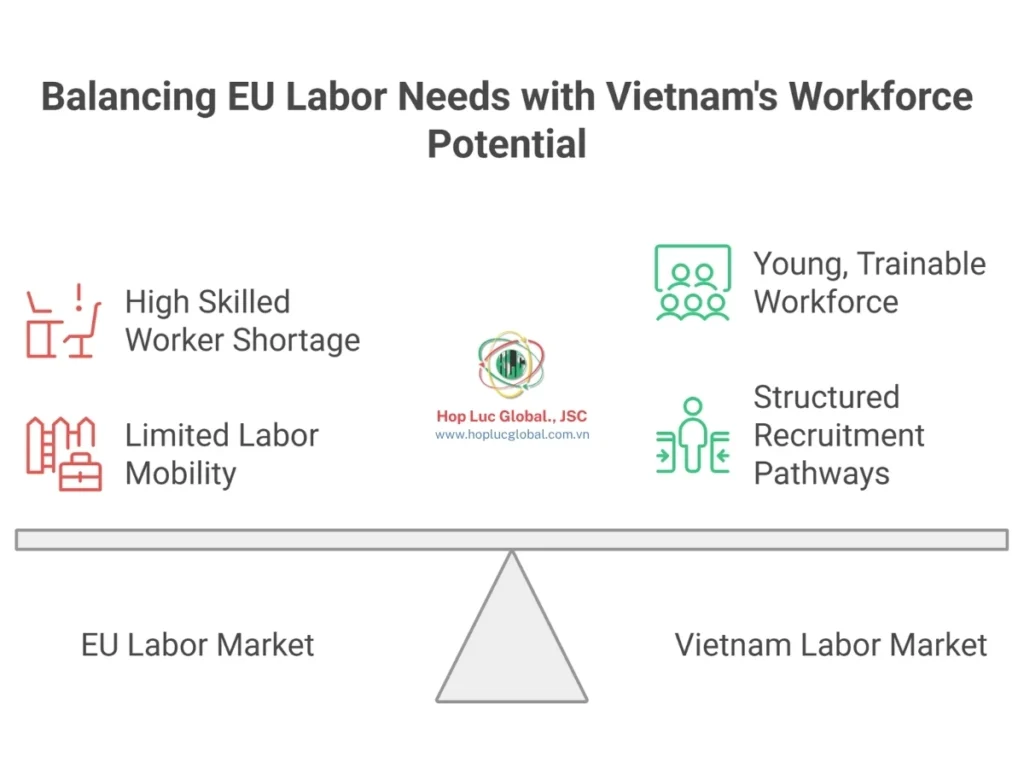
Why Vietnam? A Young Workforce with Structured Recruitment Pathways
Vietnam’s demographic advantage and growing network of technical vocational schools create a pipeline of trainable, disciplined workers. Legitimate overseas recruitment is regulated by MOLISA, Vietnam’s Ministry of Labour, Invalids and Social Affairs. Hop Luc Global Joint Stock Company holds MOLISA licence 67/LĐTBXH-GP (issued 2023-10-26), confirming its legal authority to supply workers abroad. This licence, combined with the company’s physical office in Hanoi, provides EU employers a verifiable starting point for due diligence.
Bilateral Labour Agreements: Country-Specific Mobility Options
Key EU-Vietnam Bilateral Agreements and Their Impact on Technical Workers
Several EU member states have entered into bilateral labour cooperation agreements with Vietnam. These agreements can create structured recruitment pathways and may simplify certain administrative procedures under defined conditions. However, their scope, occupation coverage, and active status vary by country and are subject to periodic revision. Employers should always check the current terms with the relevant national authority before relying on a bilateral framework.
Country Spotlight: How Different Member States Handle Vietnamese Worker Permits
Destination-country requirements differ significantly. For example, Germany and Poland have established policies that, in combination with bilateral understanding, can facilitate the hiring of Vietnamese technical staff under certain conditions. Finland and several Eastern European markets also maintain shortage occupation systems that employers can reference. The exact process—including documentation, processing times, and eligibility—must be confirmed with official immigration sources. No single pathway applies across all EU countries.
Compliance Essentials: MOLISA Licensing, Work Permits, and Visa Processes
The Role of MOLISA Licence 67/LĐTBXH-GP in Vietnamese Labour Export
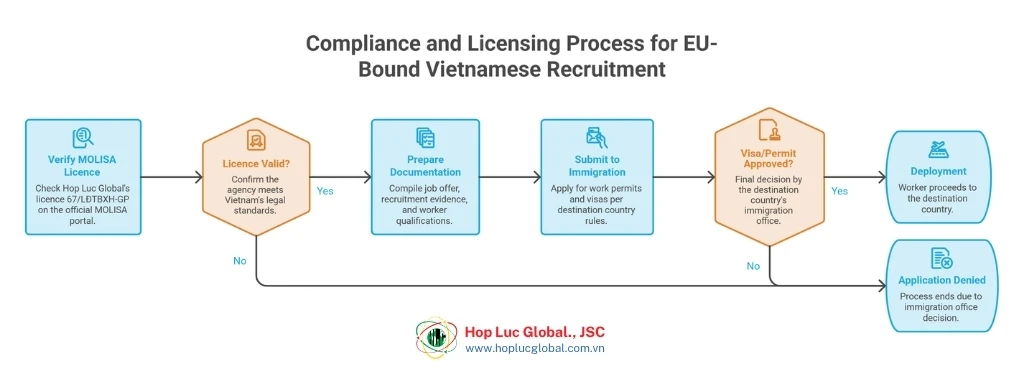
MOLISA licence 67/LĐTBXH-GP, issued to Hop Luc Global, certifies that the agency meets Vietnam’s legal standards for recruiting and deploying workers abroad. For EU employers, this licence is a critical trust signal: it confirms the Vietnamese-side export framework is in place. Employers can cross-check this licence on MOLISA’s online portal as part of their partner due diligence. It does not, however, guarantee any work permit or visa outcome in the destination country.
For EU employers, licensing is only one part of responsible international recruitment. The ILO fair recruitment principles provide an additional international reference for transparent recruitment, worker protection, and responsible recruitment practices.
EU Work Permits and Visa Types: A Practical Overview for Employers
Destination-country work authorization requirements are set by national immigration rules. Employers typically must prepare a job offer, provide evidence of recruitment efforts, and submit worker qualification documentation. The specific process and documentary requirements vary by member state and can change with little notice. Engaging a MOLISA-licensed agency early helps ensure the worker’s documentation aligns with what authorities expect, but the final decision always rests with the destination country’s immigration office.
How a Licensed Agency Reduces Your Compliance and Hiring Risk
Verifying a Recruitment Partner’s Credentials in Vietnam
Unlicensed intermediaries are a real risk. Red flags include demands for upfront payments without a clear contract and the absence of a verifiable office. Hop Luc Global’s physical address in Hanoi (Lot 01, TT6 – 2B, Thi Cam Street, Xuan Phuong Ward) and its MOLISA licence provide tangible proof points. Before engaging any Vietnamese partner, check their licence on MOLISA’s website and request documentation. A legitimate partner will welcome such scrutiny.
Transparent Processes: From Candidate Sourcing to Destination-Country Readiness
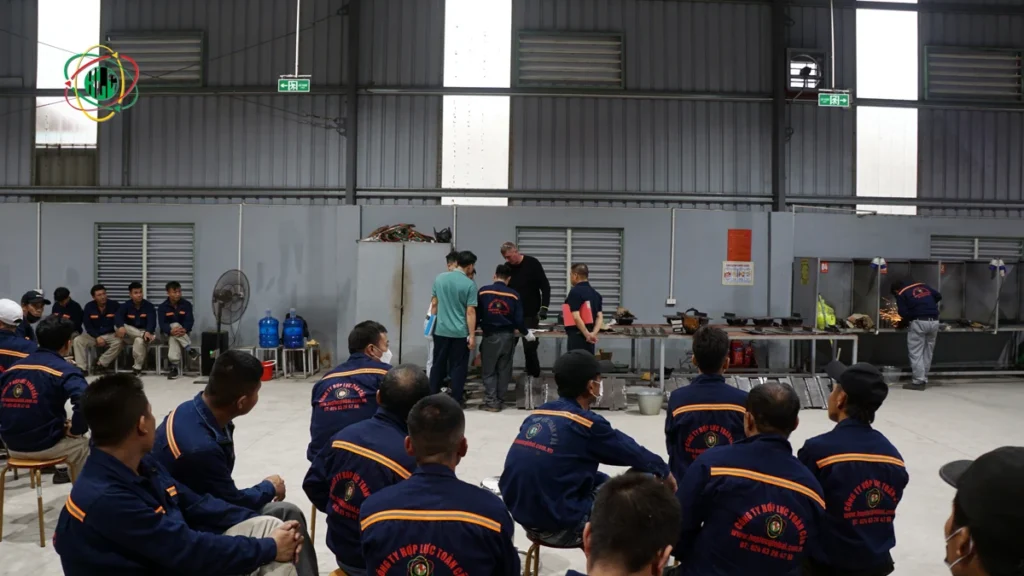
Hop Luc Global screens candidates based on the employer’s role specifications—technical skills, work experience, and any required qualifications. The agency then coordinates medical checks, documentation, and pre-departure orientation. Throughout, it aligns with destination-country administrative requirements without overstepping legal boundaries. The result is a compliance-aware recruitment process designed to reduce the employer’s administrative burden while keeping risk low.
In practical terms, Vietnamese technical labor export works best when recruitment starts with a defined role profile. The employer should clarify the trade, experience level, mandatory qualifications, and destination country before candidate sourcing begins. This gives the agency a clearer basis for screening and reduces avoidable mismatch during selection.
Your Roadmap to Hiring Vietnamese Technical Workers: A Step-by-Step Guide
From Role Definition to Candidate Selection: The Preparation Phase
- Define your technical roles and list any mandatory qualifications or certifications.
- Check the destination country’s work permit eligibility for those roles. This is an employer-side responsibility. Do not start a recruitment search until you understand what the immigration authorities require.
- Select a MOLISA-licensed agency and agree on candidate profiles. A reliable partner will advise on realistic timelines and documentation needs from the start. Avoid any commitment that sounds too fast or guaranteed—processing times vary.
- Review the recruitment pathway and confirm the role profile before candidate selection begins. A clear process is an important part of compliant Vietnamese technical labor export for EU employers.
Visa, Mobilisation, and Onboarding: Managing the Move Successfully
Once a candidate is selected, the agency assists with documentation preparation and submission. The actual work permit and visa decision is made by destination-country authorities. After approval, the agency supports pre-departure briefing, travel arrangements, and basic on-the-ground integration—orientation, language tips, and accommodation guidance. This holistic coordination helps workers settle faster and reduces the risk of early attrition.
For employers comparing overseas recruitment options, Vietnamese technical labor export is most relevant when the workforce need is clearly defined and the recruitment partner can explain the sourcing, screening, and documentation workflow. The right approach is role-based and country-specific rather than based on a generic worker profile.
Frequently Asked Questions
What is EVFTA Mode 4 and does it cover technical trades like welders or electricians?
Mode 4 facilitates the temporary movement of certain professionals and contractual service suppliers. It may cover technical roles under specific conditions, but the exact scope depends on member-state interpretation. Always verify with an immigration specialist.
What is a MOLISA licence and why is it important when hiring from Vietnam?
A MOLISA licence is issued by Vietnam’s Ministry of Labour to authorised manpower agencies. It confirms the agency can legally recruit and deploy workers abroad, providing a baseline of compliance and trust.
Do Vietnamese technical workers need EU-recognised certifications?
Certification requirements depend on the destination country and trade. Some roles may require skills assessments or recognition procedures. It is essential to check national regulations before finalising job descriptions.
How long does it typically take to recruit and deploy Vietnamese technical workers?
Timelines vary significantly by country and role, generally spanning several months. Early planning, clear role definitions, and prompt document submission help keep the process on track, but the final pace depends on immigration processing.
Which EU countries have the most streamlined pathways for Vietnamese technical workers?
Several countries, such as Germany, Poland, and Finland, have bilateral frameworks or flexible work-permit policies that can facilitate hiring. However, rules change frequently; always consult official sources or a knowledgeable recruitment partner.
Can Hop Luc Global supply workers for both manufacturing and construction sectors?
Yes. As a MOLISA-licensed agency, Hop Luc Global supplies technical workers for manufacturing, construction, and logistics roles, tailoring candidate searches to employer needs across its target European markets.
How does Hop Luc Global ensure compliance with EU destination-country rules?
Hop Luc Global follows a compliance-aware recruitment process: verifying worker credentials, preparing documentation to align with destination-country requirements, and coordinating with immigration processes. Final approval always rests with the relevant national authorities.
Ready to Explore Vietnamese Technical Labor Export?
Planning to recruit technical workers from Vietnam?
Share your role list, required headcount, and target start date with Hop Luc Global. Our team can review your workforce needs and outline a structured recruitment pathway for your target European market.