How a Staffing Agency Supports EU Employers Hiring Vietnamese Workers
Across Europe, employers in manufacturing, construction, logistics, hospitality, agriculture, shipbuilding, and technical services are facing a practical workforce challenge: local recruitment alone may not always fill the roles needed to keep projects, production lines, and operations moving. A professional staffing agency can help EU employers organize cross-border recruitment in a more structured way, especially when hiring trained Vietnamese workers for long-term workforce planning.
For HR Directors, CEOs, COOs, Plant Managers, Construction Managers, and recruitment agencies, the value is not simply “finding candidates.” The real value is having a clear process: role intake, candidate sourcing, screening, interview coordination, documentation preparation, worker orientation, and realistic communication between all parties.
This guide explains how a Vietnam-based staffing agency can support EU employers and recruitment partners with Vietnam manpower supply, EU labor recruitment, and compliance-aware workforce planning. For a deeper supporting guide, see our page on offshore staffing Vietnam for EU employers.

Why EU Employers Work with an International Staffing Agency
Many European employers are under pressure to fill practical roles that are difficult to source locally. These may include welders, CNC operators, machine operators, construction workers, warehouse staff, food processing workers, hospitality workers, agricultural workers, and selected support roles where country-specific requirements allow.
When local recruitment becomes slow or inconsistent, employers often need a wider talent channel. This is where an international staffing agency can support a more planned approach to hiring. Instead of relying on fragmented candidate searches, employers can work through a structured recruitment process with defined requirements, candidate screening, and documentation coordination.
For EU employers, the decision to work with a staffing agency is usually driven by several business needs:
- Production continuity: factories and plants need enough workers to maintain output and reduce disruption.
- Project delivery: construction and shipbuilding projects often require workers with specific trade experience.
- Seasonal workforce planning: agriculture, hospitality, food processing, and logistics may need planned recruitment before peak demand.
- Reduced recruitment uncertainty: employers need better visibility on candidate availability, screening, and documentation steps.
- Cross-border coordination: overseas hiring involves communication between the employer, candidate, agency, and relevant authorities.
A responsible staffing agency does not replace the employer’s legal obligations. Instead, it helps the employer organize the recruitment side of the process more clearly and prepare candidates according to the role requirements.
What a Staffing Agency Does in Cross-Border Recruitment
A staffing agency specializing in Vietnam-to-Europe recruitment should do more than forward CVs. EU employers need a partner that can translate a workforce requirement into a practical recruitment workflow.
The process usually starts with a detailed role intake. The employer provides job titles, number of workers needed, job descriptions, salary range or employment conditions, location, required skills, language expectations, accommodation plan if applicable, and target start date. This information allows the agency to assess whether the role can be sourced realistically from Vietnam.
After the intake stage, the agency may support the following recruitment activities:
- Candidate sourcing: identifying potential workers from relevant networks, training sources, or candidate pools in Vietnam.
- Profile screening: reviewing work experience, trade background, role suitability, and basic documentation readiness.
- Interview coordination: arranging online or in-person interviews between the employer and shortlisted candidates.
- Skill assessment: coordinating trade tests or practical checks where relevant to the role and confirmed by operations.
- Recruitment documentation support: helping candidates prepare required documents while coordinating with employer-side requirements.
- Pre-departure preparation: supporting orientation on workplace expectations, basic communication, safety awareness, and travel readiness where applicable.
Each destination country may have different employment, immigration, and documentation rules. A reliable agency should be transparent about what it can support and what must be handled by the employer, local partner, immigration authority, or legal adviser.
Need to check whether Vietnam is suitable for your roles?
Share your role list and target start date with Hop Luc Global JSC. Our team can review the basic workforce requirement and suggest a practical sourcing direction.
Why Vietnam Manpower Supply Matters for EU Workforce Planning
Vietnam is increasingly relevant for employers that need skilled, semi-skilled, and general workers for international recruitment programs. For EU companies, Vietnam manpower supply can be considered as part of a wider workforce planning strategy, especially when local hiring channels do not provide enough suitable candidates.
Vietnamese workers are often considered for practical industries where training, discipline, adaptability, and role preparation matter. This includes manufacturing, construction, mechanical trades, logistics, food processing, agriculture, hospitality, and shipbuilding. For regulated roles or healthcare-related support positions, employers should confirm all country-specific requirements before starting recruitment.
For EU employers, Vietnam should not be viewed only as a source of labor. It should be viewed as a recruitment market that requires careful planning. The quality of the hiring outcome depends on clear job descriptions, practical screening, employer interviews, skill assessment where needed, documentation preparation, and proper expectation setting before departure.
This is why working with an international recruitment partner can be useful. The partner helps bridge the gap between employer expectations in Europe and candidate preparation in Vietnam. When the process is structured from the beginning, both sides have a better understanding of what is required before selection, documentation, and deployment planning begin.
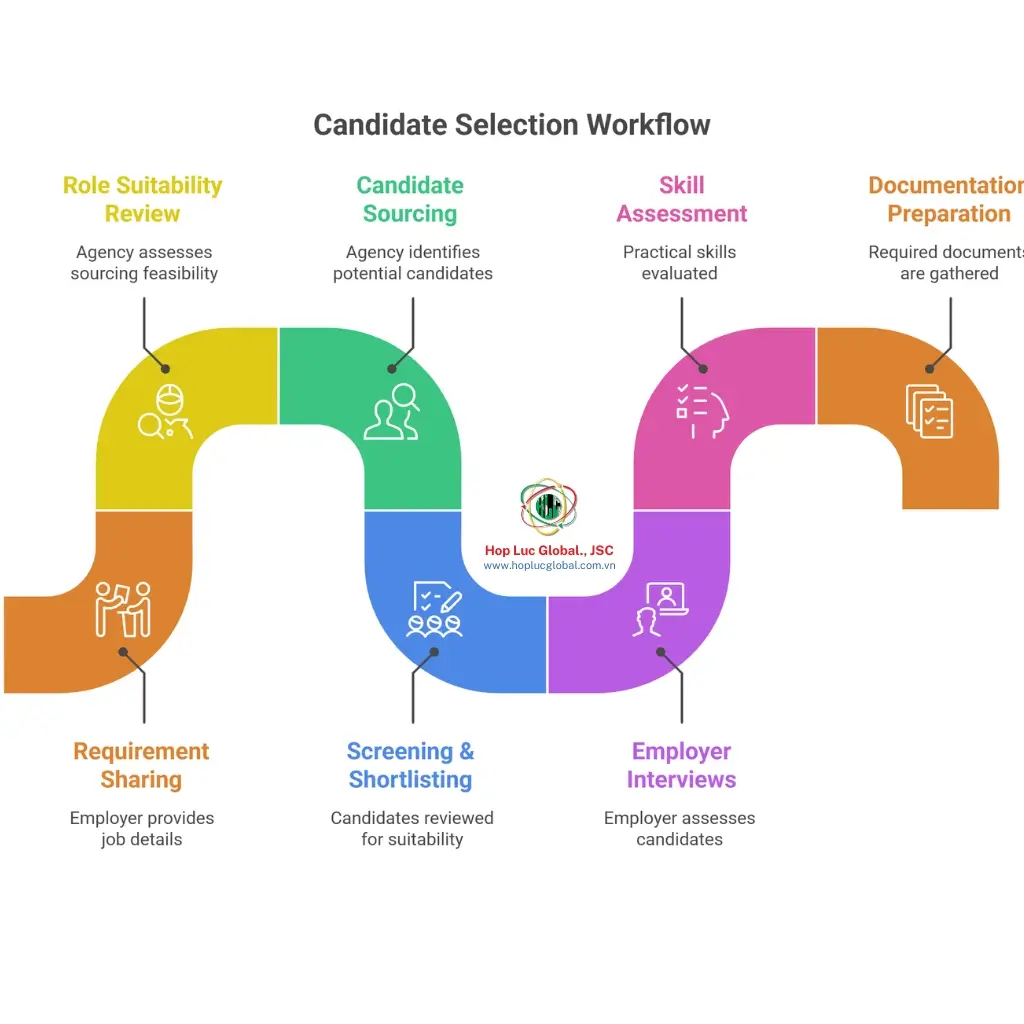
Recruitment Workflow from Role List to Candidate Selection
A professional staffing agency should be able to explain its recruitment workflow clearly. This helps employers understand what happens before candidates are selected and what information is needed to move the process forward.
Employer shares the workforce requirement
The employer provides job titles, worker quantity, job descriptions, required experience, certifications if applicable, location, working conditions, salary range or employment terms, language expectations, accommodation plan if relevant, and target start date.
Agency reviews role suitability
The agency reviews whether the requested roles are suitable for sourcing from Vietnam. This may include checking role complexity, skill requirements, candidate availability, documentation requirements, and any destination-country considerations. Details that require operational review should be confirmed with Hop Luc Global JSC’s operations team before recruitment starts.
Candidate sourcing begins
The agency starts identifying potential candidates based on the agreed role criteria. For technical or trade-based positions, sourcing should be aligned with actual job tasks rather than broad job titles alone.
Screening and shortlisting take place
Candidate profiles are reviewed for experience, suitability, basic documentation readiness, and willingness to work under the stated conditions. Shortlisted candidates can then be presented to the employer for review.
Employer interviews or selection process follows
Depending on the role, employers may conduct video interviews, review candidate profiles, request skill summaries, or ask for practical assessments. This stage helps both sides confirm expectations before moving toward documentation preparation.
Skill assessment may be arranged where relevant
For roles such as welders, CNC operators, machine operators, construction workers, and technical workers, trade testing or practical assessment may be useful. Any testing method, certificate requirement, or assessment standard should be confirmed with Hop Luc Global JSC’s operations team before recruitment starts.
Documentation preparation starts after selection
After the employer selects candidates, documentation preparation can begin. Requirements may vary by destination country, employer structure, role type, worker category, and current policy. Employers should always review the latest destination-country requirements before making final commitments.
Pre-departure orientation supports readiness
Worker preparation may include orientation on workplace discipline, safety expectations, basic communication, travel coordination, accommodation expectations, and cultural adjustment. The exact preparation scope should be confirmed with Hop Luc Global JSC before the project begins.
Worker Categories Supported by Vietnam Manpower Supply
EU employers and recruitment agencies may consider Vietnamese workers for a wide range of practical roles. Availability depends on the role, skill level, destination country, employer requirements, and current recruitment conditions.
| Worker Category | Example Roles | Planning Notes for Employers |
|---|---|---|
| Welding and metalwork | Welders, fitters, metal fabricators | Confirm trade test method, certificate expectations, and project standards. |
| Construction | Steel fixers, carpenters, scaffolders, general construction workers | Clarify site conditions, safety requirements, accommodation, and language expectations. |
| Manufacturing | CNC operators, machine operators, assembly workers, production workers | Provide machine type, shift system, quality expectations, and required experience level. |
| Logistics and warehousing | Warehouse workers, order pickers, forklift-related roles where applicable | Confirm license recognition, work environment, lifting requirements, and shift patterns. |
| Food processing and agriculture | Line workers, packers, greenhouse workers, seasonal workers | Plan early for seasonal demand, accommodation, health checks, and hygiene requirements. |
| Hospitality and support services | Housekeeping, kitchen support, cleaning, service support | Clarify language level, customer-facing duties, working hours, and accommodation support. |
Note: Role availability, certification requirements, and documentation rules vary by destination country. Confirm each project requirement with Hop Luc Global JSC before recruitment begins.
Compliance and Documentation Notes for EU Employers
Compliance is one of the most important parts of international recruitment. A responsible staffing agency should help employers understand the documentation flow, but it should not promise legal outcomes, visa approvals, or work permit approvals.
Requirements may differ depending on the destination country, employer structure, worker role, employment model, and current immigration or labor rules. Employers should verify the latest requirements with official authorities, local legal advisers, or relevant government channels before making final hiring decisions.
Typical documentation areas may include:
- Candidate identification documents and personal records.
- Employment contract or offer documents, depending on country requirements.
- Medical examination documents where required.
- Police clearance or background documentation where required.
- Trade certificates, skill records, or assessment results where applicable.
- Employer-side work permit or sponsorship documents.
- Accommodation or onboarding information where required by local rules.
Important employer-side notes:
- Work permit and visa decisions are made by relevant authorities, not by the staffing agency.
- Processing requirements and timelines may change and should be checked against the latest destination-country policy before submission.
- Country-specific employment and immigration requirements should be confirmed with the relevant official authority, local adviser, or employer-side legal representative.
- Employers should request and review relevant company registration or licensing information during the due diligence stage.
For official labor mobility and employment information in Europe, employers can consult the European Labour Authority. This external source should be used as a reference point, while country-specific rules should still be verified locally.

Want to review the recruitment workflow before starting?
Send your headcount plan and target country. Hop Luc Global JSC can help outline the sourcing, screening, and documentation coordination steps to review.
How EU Employers Should Prepare Before Contacting a Staffing Agency
The quality of the first recruitment discussion depends on the quality of information provided by the employer. A staffing agency can give better guidance when the employer shares clear, practical hiring details.
Before contacting Hop Luc Global JSC, prepare the following:
- Job titles: use specific role names, not only broad categories.
- Number of workers needed: separate urgent roles from future hiring needs.
- Job descriptions: include main tasks, tools, machines, work environment, and physical requirements.
- Required experience: clarify whether workers need prior overseas experience or specific sector background.
- Certificates or trade requirements: list required certificates, testing standards, or skill expectations.
- Employment conditions: provide wage range, working hours, overtime policy, and contract duration where applicable.
- Location: state the country, city, worksite type, and whether the role involves travel.
- Accommodation and transport: clarify whether housing, local transport, or support services are provided.
- Language expectations: define the required communication level for safety, supervision, and daily work.
- Employer-side documentation: confirm what the employer or local partner must prepare for work permit or onboarding procedures.
This preparation helps create a more realistic sourcing roadmap. It also reduces misunderstanding between the employer, agency, and candidates before selection begins.
How to Evaluate a Vietnam Staffing Agency
Not every agency works with the same level of structure, transparency, or compliance awareness. EU employers should evaluate a Vietnam staffing agency carefully before starting a recruitment project.
Key evaluation points include:
- Workflow transparency: the agency should explain each step from role intake to candidate preparation.
- Candidate screening method: employers should understand how experience, skills, and readiness are reviewed.
- Skill assessment process: for trade roles, the agency should clarify whether testing can be arranged and how results are shared.
- Documentation awareness: the agency should understand that requirements vary by destination country and should avoid overpromising.
- Communication discipline: clear updates, realistic planning, and written follow-up are important for B2B recruitment.
- Compliance language: the agency should not guarantee visa approvals, fixed timelines, or legal outcomes.
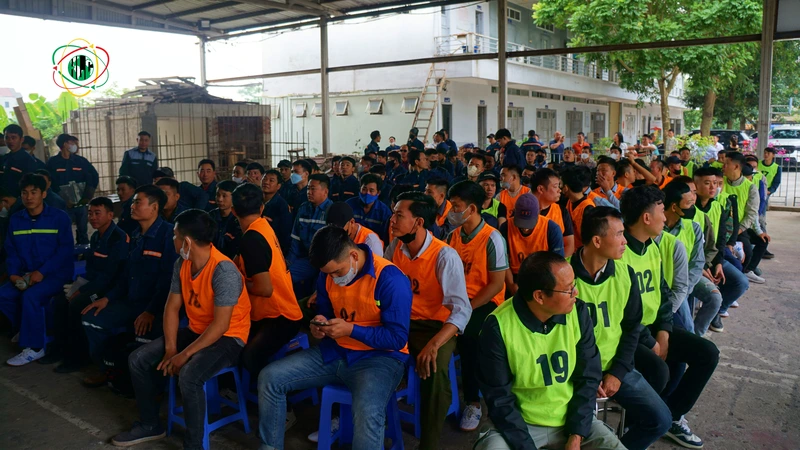
- Operational proof: where available, the agency may provide real photos of training, orientation, interview coordination, or candidate preparation.
A strong recruitment partner will help employers make informed decisions. A weak partner may create risk by promising speed without explaining the process. In cross-border recruitment, trust is built through clarity, documentation, and realistic planning.
How Hop Luc Global JSC Supports EU Recruitment Discussions
Hop Luc Global JSC is a Vietnam-based manpower supply and recruitment partner supporting European employers and recruitment agencies with structured sourcing, candidate preparation, and documentation coordination.
Our role is to help employers turn workforce needs into a practical recruitment plan. That begins with reviewing the role list and understanding the target country, job requirements, worker quantity, and expected start date. From there, Hop Luc Global JSC can discuss candidate sourcing, screening options, interview coordination, skill assessment where applicable, and documentation preparation steps.
Hop Luc Global JSC can support the discussion in the following ways:
- Reviewing the employer’s role list and headcount plan.
- Clarifying the recruitment workflow from Vietnam to the destination country.
- Discussing suitable worker categories based on verified requirements.
- Coordinating candidate shortlisting and employer interviews.
- Supporting trade testing or skill assessment where applicable and confirmed.
- Helping candidates prepare recruitment documents according to the agreed process.
- Maintaining compliance-aware communication without promising immigration outcomes.
Employers and recruitment partners may request relevant company information, process details, and documentation guidance during the due diligence stage before starting a recruitment project.
For related reading, visit our supporting page on Vietnam offshore staffing process. Additional supporting content can also cover skilled Vietnamese workers for EU employers and international recruitment workflow.
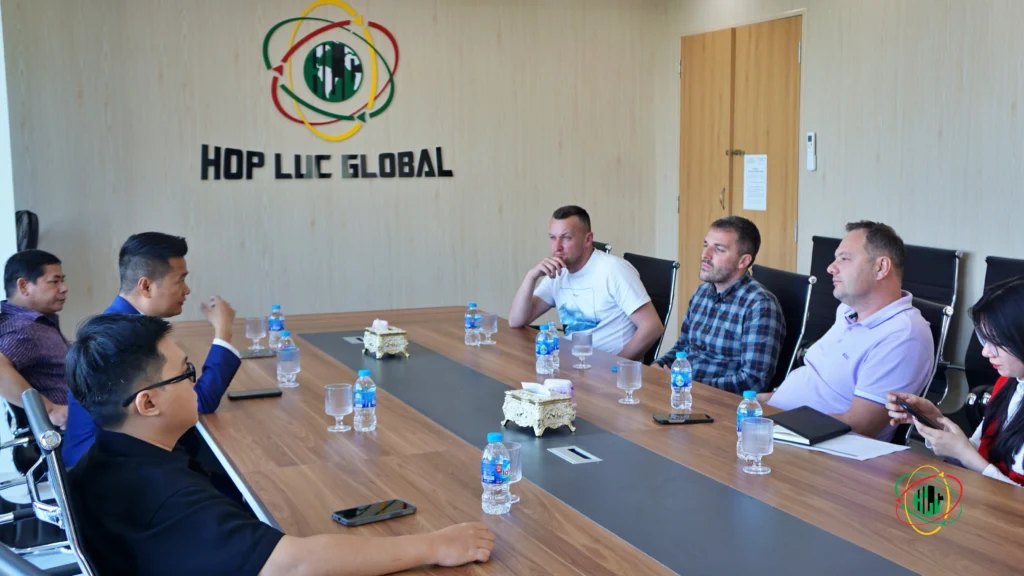
Start with a Structured Workforce Conversation
Hiring Vietnamese workers for EU operations requires more than candidate sourcing. It requires clear role requirements, realistic planning, documentation awareness, and a recruitment partner that communicates carefully.
A professional staffing agency can help employers reduce confusion by organizing the process from the first role list to candidate selection and preparation. The best results usually begin when the employer shares complete hiring information and confirms country-specific requirements before recruitment starts.
Share your role list and target start date
Hop Luc Global JSC can review your workforce plan and suggest a practical sourcing roadmap from Vietnam.
Email: contact@hoplucglobal.com
Phone: (+84) 24 6328 4768 | (+84) 983 688 060
Website: www.hoplucglobal.com.vn
Frequently Asked Questions
What does a staffing agency do for EU employers hiring from Vietnam?
A staffing agency helps organize role intake, candidate sourcing, screening, interview coordination, skill assessment where relevant, documentation preparation, and pre-departure orientation. It supports the recruitment process but does not control immigration decisions.
Which industries can use Vietnam manpower supply?
EU employers may consider Vietnam manpower supply for manufacturing, construction, logistics, warehousing, food processing, agriculture, hospitality, shipbuilding, and selected support roles. Availability and requirements should be confirmed for each destination country.
Can a staffing agency guarantee work permit or visa approval?
No. Work permit and visa approvals are decided by the relevant authorities. A responsible staffing agency can support documentation coordination, but it should not guarantee approval, timelines, or legal outcomes.
What should EU employers prepare before contacting Hop Luc Global JSC?
Employers should prepare job titles, worker quantity, job descriptions, required experience, certifications, salary range or employment terms, location, accommodation plan if applicable, target start date, language expectations, and employer-side documentation requirements.
How are Vietnamese workers screened before selection?
Screening may include profile review, work experience checks, interviews, basic documentation review, and skill assessment or trade testing where applicable. The exact screening method should be confirmed according to the role and employer requirements.
Can recruitment agencies partner with Hop Luc Global JSC?
Yes. Recruitment agencies can share employer requirements, target country, role list, worker quantity, and expected hiring schedule. Hop Luc Global JSC can then review the requirement and discuss a practical sourcing roadmap.