European employers across construction, manufacturing, and logistics face a shared challenge: finding enough skilled workers to keep projects moving. With the EU unemployment rate at a record low of 5.8% in early 2026 and job vacancy rates remaining persistently high, local recruitment alone cannot close the gap. This is where Vietnamese workforce supply to Europe has become a strategic answer — a structured, legal, and fast way to bring certified, motivated workers into EU operations. For a complete overview of why Vietnam has become a trusted recruitment hub, see our workforce recruitment pillar article.
The growing reliance on Vietnamese workforce supply to Europe reflects a structural shift in how EU companies approach hiring. Instead of relying solely on local recruitment channels, businesses are building international talent pipelines that ensure continuity, scalability, and compliance across projects.
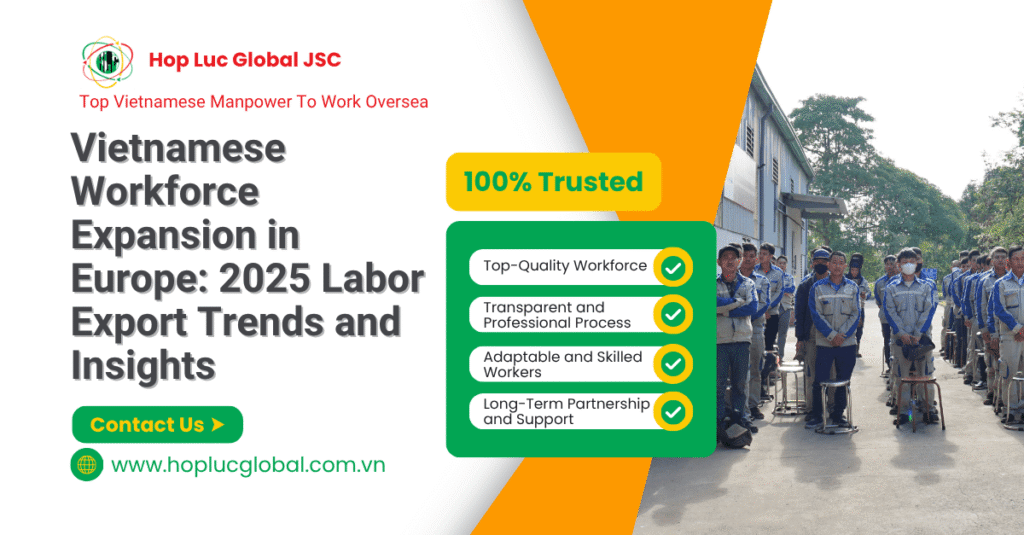
Why Europe Needs Vietnamese Workforce Supply to Europe in 2025
This is precisely where Vietnamese workforce supply to Europe becomes not just relevant, but essential. It provides a stable and legally compliant alternative to unpredictable local hiring conditions.
The numbers tell a clear story. Across most European countries, vacancy rates remain elevated despite economic activity, signaling a persistent labor shortage rather than a cyclical fluctuation. In industries such as logistics, manufacturing, and processing, the share of foreign workers in Central and Eastern Europe often exceeds 20–30%, directly affecting companies’ ability to maintain operational continuity. According to Eurostat, the EU’s job vacancy rate in the construction sector has remained above 2.9% over the past three years. In Germany, 41% of companies report they cannot find workers with sufficient skills. Poland and Hungary face similar gaps in masonry and structural engineering.
At the same time, the EU’s working‑age population is aging rapidly. The European Labour Authority has warned that cross‑border workforce compliance must be carefully managed to avoid legal exposure. This widening talent gap isn’t just a challenge — it’s a risk to project timelines, costs, and infrastructure growth. With aging populations and declining local interest in physically demanding jobs, the EU is increasingly looking abroad for reliable workforce solutions. For a deeper look at how skilled Vietnamese professionals fit into this picture, read our guide on Vietnamese skilled labor for Europe.
What Is Vietnamese Workforce Supply to Europe?
In practice, Vietnamese workforce supply to Europe operates as a long-term workforce strategy rather than a short-term fix, allowing employers to plan staffing needs with greater accuracy and lower risk.
Vietnamese workforce supply to Europe refers to the structured, legal process of recruiting, training, and deploying Vietnamese workers to EU countries under bilateral agreements and the EU‑Vietnam Free Trade Agreement (EVFTA). Unlike general labor export, this model emphasizes:
- Certified technical skills aligned with EU standards (e.g., EN ISO welding)
- Pre‑departure training covering safety, language, and cultural orientation
- Full compliance with Vietnamese law (MOLISA licensing) and EU labor regulations
- End‑to‑end support from recruitment to aftercare
This is not about sending bodies — it’s about building a predictable, quality‑focused pipeline that reduces risk for employers.
Why Vietnamese Workforce Supply to Europe Supports EU Recruitment
European employers choose Vietnamese workforce supply to Europe because it directly addresses the core problems of local hiring: shortages, turnover, and compliance gaps.
Skilled Labor Ready for Deployment
Vietnamese workers arrive with practical trade skills — welding, CNC operation, electrical assembly, formwork, and more — backed by certification aligned with EU standards. Pre‑departure training adds site‑specific safety and basic language, so workers are productive within weeks.
Cost Efficiency for Employers
All‑in costs for Vietnamese workers typically range from €1,800 to €2,500 per month — 25–35% lower than local temporary staff in Western Europe. The real savings, however, come from lower turnover and higher productivity.
High Retention and Work Ethic
Vietnamese professionals commit to multi‑year contracts. Retention rates above 90% after 12 months are common, compared to 50–60% for local agency staff. This stability reduces rehiring and retraining costs.
Adaptability to European Work Environments
Pre‑departure training covers European workplace norms, safety protocols, and basic communication. Most workers reach full efficiency within two to three weeks of arrival, and European supervisors consistently rate their teamwork and discipline highly.
📘 Want a broader view of workforce recruitment strategies?
This article focuses on Vietnamese workforce supply to Europe, but if you’re comparing sourcing models or planning long-term hiring, you may find it useful to review the full workforce recruitment framework.

Key Industries Using Vietnamese Workforce Supply to Europe
Across these sectors, Vietnamese workforce supply to Europe is becoming a preferred solution due to its ability to deliver trained workers at scale without compromising compliance.
Demand is concentrated in sectors where skill shortages are most acute:
- Manufacturing: CNC machinists, assembly technicians, quality controllers, welders
- Construction: Steel fixers, carpenters, scaffolders, heavy equipment operators
- Logistics: Warehouse operatives, forklift drivers, packaging staff
- Food Processing: Line operators, hygiene controllers, packers
- Healthcare: Nursing assistants, elderly caregivers, support staff
According to MOLISA, Vietnam aims to send 112,000 workers abroad in 2026, with a growing share headed to European markets. The Vietnamese government has also strengthened cooperation with countries like Germany and Greece, opening new legal pathways for labor mobility.
Vietnamese Workforce Supply to Europe: Recruitment Process Explained
A well-structured Vietnamese workforce supply to Europe process ensures consistency, transparency, and predictable timelines for employers managing large-scale hiring needs.
A professional deployment follows a transparent, step‑by‑step process:
- Job order analysis – define roles, certifications, shift patterns, and language needs.
- Candidate sourcing – tap pre‑vetted talent pools across Vietnam’s 63 provinces.
- Skills verification – practical trade tests (weld coupons, steel assembly, electrical mock‑ups).
- Pre‑departure training – technical refreshers, safety induction, workplace English, cultural orientation.
- Documentation and legal processing – work permits, visas, medical checks, contracts in both languages.
- Deployment and aftercare – travel coordination, on‑site orientation, and 30/60/90‑day check‑ins.
Total timeline from signed contract to arrival: 30–45 days for standard batches. For a detailed walkthrough of each stage, see our recruitment process page.
Compliance in Vietnamese Workforce Supply to Europe
Compliance is a defining feature of Vietnamese workforce supply to Europe, ensuring that both employers and workers are protected under EU labor laws and international agreements.
Legal compliance is the foundation of every successful deployment. Under the EVFTA, Vietnam has committed to labor law reforms and alignment with ILO core conventions. This includes:
- MOLISA licensing: Every agency must hold a valid license from Vietnam’s Ministry of Labour for overseas labor supply.
- Bilateral agreements: Vietnam has signed labor cooperation pacts with Germany, Poland, Romania, and Croatia, among others.
- Worker protection: Contracts are provided in both languages, with zero‑fee policies and clear grievance procedures.
- EU compliance: Deployed workers receive the same wages, working conditions, and social protections as local employees under EU directives.
Working with a licensed partner eliminates legal risks associated with informal or unlicensed brokers. For more on the ethical side, read our ethical recruitment framework.

⚖️ Not sure how compliance applies to your situation?
Requirements can vary by country, sector, and contract type. Reviewing the legal framework early helps avoid delays and unexpected costs during deployment.
Challenges in Vietnamese Workforce Supply to Europe
No international recruitment model is without hurdles. The most common challenges include:
- Visa processing times: Delays can occur depending on the destination country’s workload. Working with an experienced agency minimizes this risk.
- Language barriers: Pre‑departure training addresses basic workplace communication, but advanced language skills may require additional investment for certain roles.
- Cultural integration: While Vietnamese workers adapt quickly, employers benefit from providing clear onboarding and a buddy system for the first few weeks.
- Certification alignment: Not all Vietnamese trade certificates are automatically recognized. Professional agencies verify and align certifications with EN ISO standards before deployment.
These challenges are manageable when working with a partner that has a documented process and local support in Europe.
How Hop Luc Global Delivers Vietnamese Workforce Supply to Europe
As a licensed provider, Hop Luc Global plays a central role in delivering Vietnamese workforce supply to Europe through a controlled, transparent, and results-driven recruitment system.
Hop Luc Global JSC has built a system around transparency, training, and aftercare. Our approach includes:
- Licensed operations: MOLISA License No. 67/LĐTBXH-GP and adherence to ILO fair recruitment principles.
- Structured training: 120–180 hours of pre‑departure programs, including EN ISO welding certifications, EU safety training, and workplace language.
- Proven deployment speed: Typical timeline of 30–45 days from contract to arrival, with expedited options for urgent needs.
- Aftercare support: 30/60/90‑day check‑ins, replacement SLA, and a 24/7 emergency contact line.
Case example: A German civil engineering firm needed 25 certified welders for a railway bridge project. Local recruitment delivered only three qualified candidates in two months. Hop Luc Global deployed 25 EN ISO 9606‑1 certified welders within six weeks, including site‑specific weld training. The project started on time, passed all inspections, and saved 18% compared to local agency rates.
For more information on how we operate, visit our about page.
Future of Vietnamese Workforce Supply to Europe
Several long‑term trends will increase demand for Vietnamese workforce supply to Europe:
- Green jobs expansion: The EU Green Deal requires hundreds of thousands of workers for solar, wind, and grid projects. Vietnamese technicians are already being trained in these areas.
- Aging Europe: The share of EU workers over 55 continues to rise, accelerating retirements and deepening shortages.
- Long‑term contracts: Employers are shifting from seasonal hiring to multi‑year workforce partnerships to secure stability.
- Digital and language training: Vietnam is investing in digital skills and foreign language education, making workers even more competitive.
According to the World Bank, Vietnam’s labor force participation rate remains high, and the country is actively reforming its vocational training system to meet international standards. This positions Vietnam as a sustainable source of talent for the next decade.
Vietnamese Workforce Supply to Europe vs Other Labor Sources
| Comparison Area | Vietnamese Workforce | Other Asian Sources | Eastern European Local |
|---|---|---|---|
| Certification alignment | EN ISO, EU‑aligned training | Variable | Often EU‑recognized |
| Retention rate (12 months) | 90%+ | 70–80% | 50–60% (agency staff) |
| All‑in monthly cost (€) | 1,800–2,500 | 2,000–3,000 | 3,500–5,000 |
| Deployment speed | 30–45 days | 45–60 days | Immediate (if available) |
Vietnamese workers offer a unique combination of certified skills, low turnover, and competitive cost, making them a preferred choice for many EU employers.
📩 Exploring workforce options for your projects?
If you’re considering Vietnamese workforce supply to Europe, it may help to clarify your hiring timeline, required skills, and compliance requirements before making decisions.
You can also review the broader workforce recruitment strategy to understand how Vietnam fits into long-term planning.
Frequently Asked Questions
How do I verify a Vietnamese workforce supplier?
Check their MOLISA license, request documentation of past EU deployments, review training records, and ask for client references. A transparent provider will share these openly.
What certifications do Vietnamese workers hold?
Workers typically hold EN ISO welding certifications, EU safety training certificates, and trade‑specific endorsements. Professional agencies align training with your project’s requirements.
Is it legal to hire Vietnamese workers for EU projects?
Yes, under EVFTA Mode 4 provisions and bilateral agreements, provided the agency is licensed and all documentation is compliant. Always verify the legal framework for your specific destination country.
What are the risks of choosing the wrong provider?
Project delays, visa rejections, legal penalties, worker dropouts, and reputational damage. A wrong choice can cost far more than the initial savings.
How long does deployment take?
With a reliable partner, 30–45 days from signed contract to worker arrival. Factors affecting timeline include destination country visa processing, batch size, and certification verification.
Vietnamese workforce supply to Europe is no longer just an alternative — it is a strategic workforce solution helping EU employers overcome labor shortages, reduce costs, and maintain project timelines. By partnering with a licensed, transparent agency, you build a pipeline that delivers stability, compliance, and productivity for years to come.