European industrial employers need a clear plan when recruiting skilled workers across borders. Vietnam overseas manpower supply offers a structured way to assess sourcing options, compare candidate evidence, and allocate recruitment responsibilities before committing headcount. Vacant shifts and delayed projects can increase operating pressure, while rushed hiring creates avoidable screening and documentation gaps.
Hop Luc Global coordinates recruitment from Vietnam and holds a licence for sending Vietnamese laborers to work abroad under contracts. This guide presents seven practical checks for EU employers evaluating direct sourcing, recruitment partner coordination, and destination-country requirements. For the wider recruitment process, see our Vietnam manpower export guide. Recruitment coordination does not guarantee visa approval, work authorization, or a fixed deployment date.
Vietnam Overseas Manpower Supply: Key Takeaways
- Start with a written job brief covering duties, working conditions, headcount, and evidence requirements.
- Compare direct sourcing and partner coordination using internal capacity, responsibilities, and documentation routines.
- Review technical experience through relevant records, structured interviews, and practical assessments where appropriate.
- Keep recruitment activities separate from destination-country immigration authorization.
- Verify the recruitment provider’s legal identity, applicable licence information, and agreed service scope.
- Use target start dates for planning rather than treating them as guaranteed deployment dates.
- Assign an owner to every recruitment milestone and unresolved documentation question.
What Vietnam Overseas Manpower Supply Means for EU Employers
Vietnam overseas manpower supply is an employer-facing recruitment process that connects workforce requirements with candidate sourcing and assessment activities in Vietnam. The model requires employers to define the position, evaluate candidate suitability, and coordinate destination-country obligations with the appropriate parties.
A recruitment partner can support candidate identification, screening arrangements, assessment logistics, and documentation collection under an agreed scope. The employer retains responsibility for final hiring decisions and verification of applicable requirements.
The Employer-Side View: Sourcing as a Structured Process
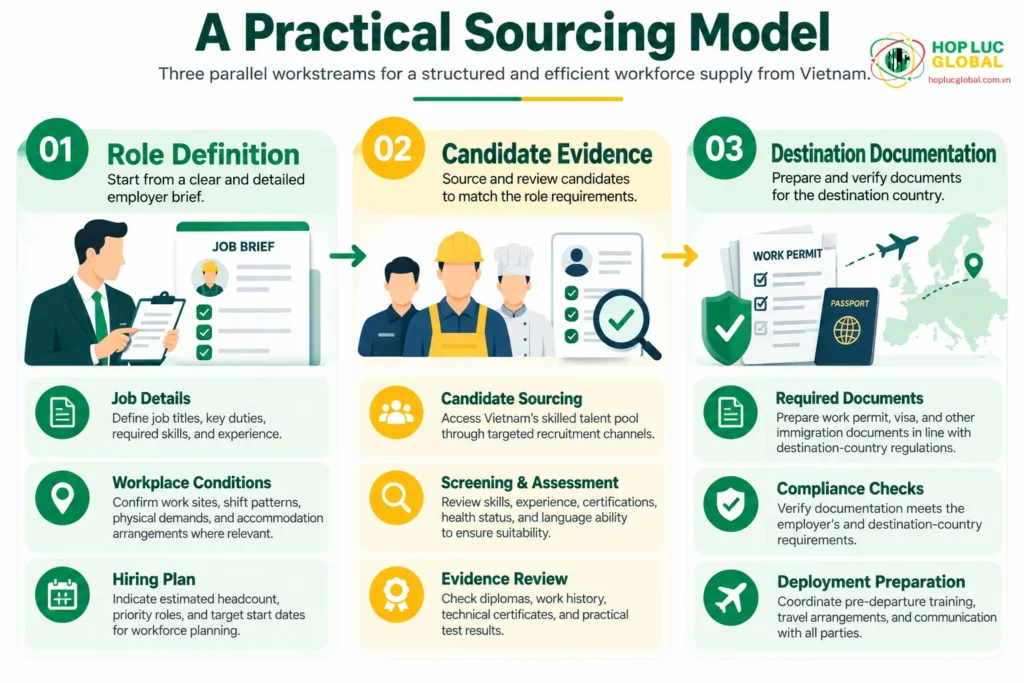
A structured Vietnam overseas manpower supply process divides the recruitment project into three connected workstreams: role definition, candidate assessment, and destination-country documentation. Each workstream needs a responsible person and evidence that employers can review.
The employer defines the workforce requirement and makes hiring decisions. The recruitment partner coordinates agreed activities in Vietnam. Competent authorities determine immigration and work authorization outcomes according to the relevant legal framework.
These responsibilities must remain distinct. Candidate selection does not establish work eligibility, and successful recruitment screening does not guarantee permission to enter or work in a destination country.
What This Guide Covers and What Requires Qualified Advice
This guide addresses sourcing strategy, written recruitment briefs, screening evidence, documentation ownership, and agency due diligence. It does not provide immigration, employment law, or tax advice for a particular European country.
Hop Luc Global identifies European target markets including Lithuania, Latvia, Greece, Croatia, Finland, Estonia, Romania, Bulgaria, Poland, and Hungary. These countries provide geographic planning context, not evidence that recruitment requirements are identical across the markets.
Employers should review country-specific employment and mobility information through the official EURES European Employment Services portal and confirm applicable requirements with competent destination-country authorities or qualified advisers.
Defining Roles Before Vietnam Overseas Manpower Supply Begins
A written recruitment brief helps employers compare candidates against the actual position rather than relying on broad job titles. In Vietnam overseas manpower supply, clear requirements also give the recruitment partner a measurable basis for screening.
The objective is to identify what the worker must be able to do, which experience can be verified, and which employment conditions the candidate needs to understand before selection.
The Eight Details Every Recruitment Brief Should Contain
A practical overseas recruitment brief should contain the following information:
- Job title: Identify the position and relevant occupational category.
- Daily duties: Describe actual tasks, equipment, tools, materials, and expected responsibilities.
- Headcount: Specify required workers by role and work location.
- Work location: State the destination country and relevant workplace or project site.
- Working conditions: Explain shifts, physical requirements, and relevant workplace conditions.
- Experience: Identify essential technical experience and acceptable evidence.
- Language expectations: Describe communication needs for work instructions and safety.
- Target start date: Provide a planning benchmark, subject to recruitment progress and destination-country authorization.
For employers assessing Vietnam workers for hire, the difference between a generic job title and an operational brief matters. A production role may involve specific equipment, materials, or shift routines that a candidate has never encountered.
Writing Criteria That a Recruitment Partner Can Verify
Replace subjective descriptions with observable requirements. Instead of requesting a candidate with a good attitude, ask for examples of relevant work routines, previous responsibilities, or safe equipment handling.
Employers can distinguish between evidence that candidates supply and assessments that recruitment partners coordinate. Employment documents, references, technical interviews, and practical demonstrations serve different purposes.
For Vietnam overseas manpower supply projects involving skilled trades, screening criteria should correspond to the duties in the written brief. Agree on how to handle missing evidence and who will review assessment results before shortlisting.
Comparing Sourcing Models: Direct Employer Sourcing Versus Partner Coordination
The sourcing model affects internal workload, candidate assessment arrangements, and communication responsibilities. Employers should compare these operational requirements before treating supplier fees as the primary decision factor.
Vietnam overseas manpower supply can involve direct employer sourcing, coordination through a recruitment partner, or a combination of both. Each arrangement requires a defined process.
For broader labour market and employment context, employers may consult Eurostat’s official European labour market statistics. Eurostat can inform an employer’s understanding of its destination market, but general labour statistics do not establish candidate availability in Vietnam or predict recruitment outcomes.
Direct Sourcing: Employer Control and Internal Capacity
Direct sourcing allows employers to manage candidate outreach, screening arrangements, and recruitment communication through their own teams. This approach requires internal recruitment capacity and an understanding of the local sourcing environment.
Employers also need procedures for reviewing evidence, coordinating interviews, and identifying documentation responsibilities. Without these arrangements, direct control may increase administrative workload.
Direct sourcing can suit companies with established international HR resources. It does not remove the need to verify destination-country requirements.
Partner Coordination: Scope, Evidence, and Responsibility
Partner coordination allows employers to assign specific recruitment activities in Vietnam to an external provider. These activities may include candidate sourcing, interview scheduling, trade assessment coordination, and supporting documentation collection.
A written agreement should identify each party’s responsibilities, reporting expectations, communication contacts, and service boundaries.
When evaluating a Vietnam overseas manpower supply partner, employers should ask how the provider records screening results and handles incomplete candidate information. Verifiable procedures offer a clearer basis for comparison than broad service claims.
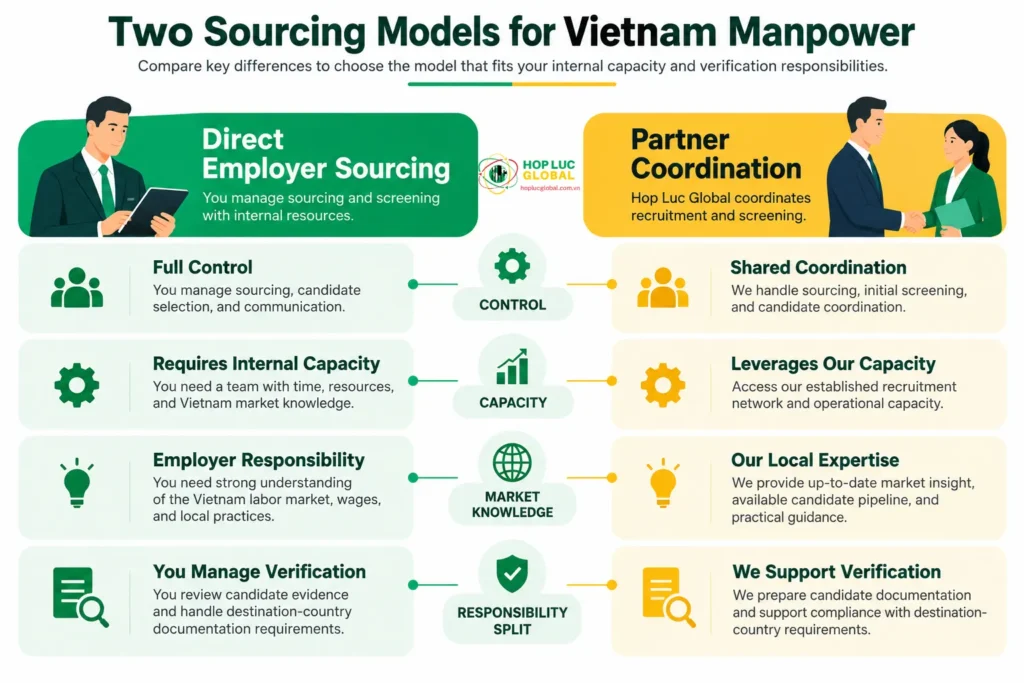
A Hybrid Approach: Combining Internal Oversight With Local Coordination
A hybrid model keeps employer-side HR oversight while assigning selected sourcing and screening tasks to a recruitment partner in Vietnam.
The employer may define the shortlist criteria, review technical evidence, and conduct final interviews. The partner can coordinate local recruitment activities under the written scope.
This arrangement can reduce the need for employers to conduct every sourcing activity directly. Clear responsibility allocation remains necessary.
Comparison Table: Choosing the Appropriate Recruitment Model
| Assessment Area | Direct Sourcing | Partner Coordination | Hybrid Model |
|---|---|---|---|
| Candidate sourcing | Employer team | Recruitment partner | Shared by agreement |
| Initial screening | Employer team | Partner under agreed criteria | Partner with employer review |
| Final hiring decision | Employer | Employer | Employer |
| Documentation coordination | Employer-managed | Defined partner support | Allocated between parties |
| Destination-country obligations | Employer verification | Employer verification | Employer verification |
| Local recruitment capacity | Internal capability required | Partner capability required | Shared operational capacity |
No single model suits every employer. The appropriate arrangement depends on company resources, the positions involved, and the activities covered by the proposed agreement.
Seven Essential Checks for Vietnam Overseas Manpower Supply
Employers can use seven practical checks to evaluate a Vietnam overseas manpower supply arrangement before making a commercial commitment.
Check the Written Job Requirements
Confirm that the recruitment brief describes actual duties, working conditions, experience requirements, and expected headcount. Make sure the partner understands which criteria are mandatory and which skills can be developed through training.
Check Candidate Evidence and Assessment Methods
Identify which records support a candidate’s work history and which assessments evaluate practical ability. Request a consistent reporting format so reviewers can compare candidates against the same criteria.
Check the Recruitment Provider’s Legal Identity
Review the recruitment company’s registered name and identification details. Compare its claims against applicable official records rather than relying entirely on marketing materials.
Check the Agency Licence and Its Scope
Confirm that the provider holds the relevant licence for the proposed activities. Review the issuing authority, licence scope, and supporting documentation where applicable.
A licence associated with overseas recruitment does not establish that every destination-country requirement has been satisfied.
Check Documentation Responsibilities
Prepare a responsibility matrix covering employer documents, candidate records, partner coordination, and destination-country submissions. Identify who reviews each item and how outstanding questions will be escalated.
Check Destination-Country Requirements
Employers should confirm the applicable employment and immigration requirements through competent authorities or qualified advisers. The EURES information network provides official employment-related resources for European labour markets, while country-specific decisions remain subject to the relevant authorities.
Check Communication and Recruitment Milestones
Agree on reporting intervals, contacts, assessment milestones, and the process for updating recruitment forecasts. Use target dates for planning, with adequate flexibility for factors outside the recruitment partner’s control.
These seven checks help an employer establish a documented basis for comparing recruitment arrangements. They do not replace professional review of legal requirements.
Screening, Documentation, and Partner Due Diligence
Screening and documentation connect the recruitment brief with a practical hiring decision. For Vietnam overseas manpower supply, each stage should produce information that the employer can review.
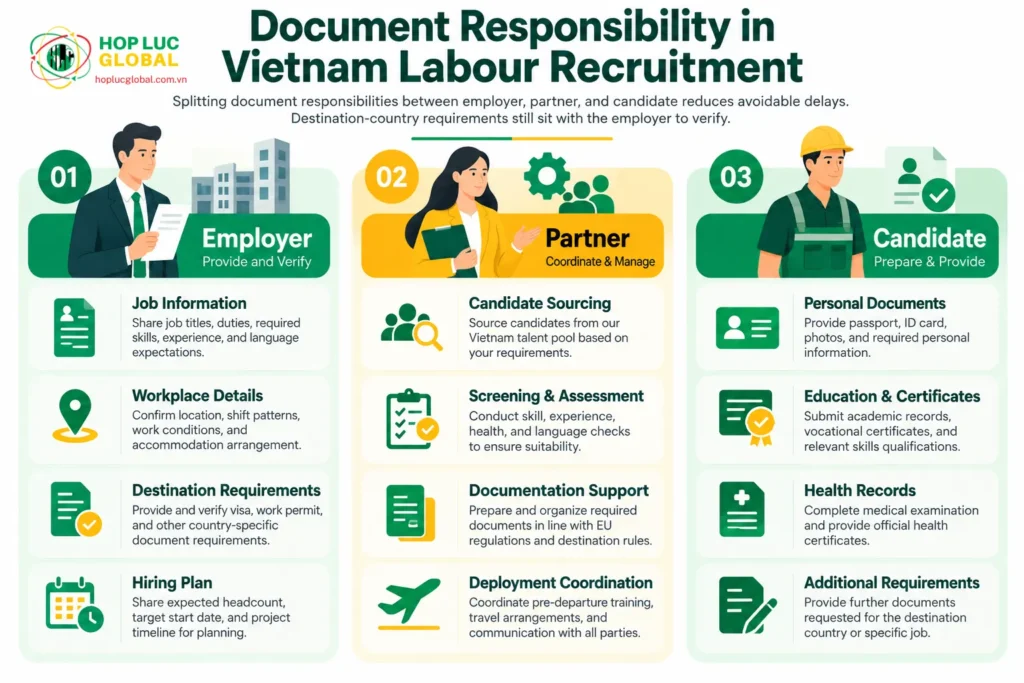
Candidate Screening and Evidence Review
Work history provides an initial basis for screening. It does not automatically confirm technical competence with particular equipment or production systems.
Employers can request structured interviews, practical assessments, and supporting experience records according to the role. A recruitment partner may coordinate these activities and provide documented results for employer review.
Any qualification recognition requirements should be checked under the applicable destination-country rules. A technical assessment organized during recruitment does not establish formal recognition of a qualification.
Documentation Ownership and Destination-Country Checks
International recruitment documents generally involve more than one party. The employer prepares the required employer-side information, candidates supply their relevant personal records, and the recruitment partner coordinates the activities identified in the agreement.
For Vietnam overseas manpower supply, maintain a written record of document status, outstanding items, and responsible contacts. Protect candidate personal information through appropriate access controls and secure communication methods.
Employers should verify destination-country requirements through competent authorities or qualified advisers. Immigration authorization remains separate from candidate screening and recruitment documentation.
Partner Due Diligence: Identity, Licence, and Service Scope
A structured review should confirm the provider’s registered identity, relevant licence information, and the services included in the proposed agreement.
Hop Luc Global Joint Stock Company identifies Enterprise Registration Certificate No. 0110103022 and License No. 67/BNV-GP for sending Vietnamese laborers to work abroad under contracts. Employers should match these details against the relevant issuing authority records during due diligence.
Ask which activities the provider will coordinate, how it records evidence, and which responsibilities remain outside its agreed scope. Supplier assessment should focus on verifiable information rather than rankings or unsupported claims.
How Hop Luc Global Supports Vietnam Overseas Manpower Supply
Hop Luc Global supports European employers and recruitment partners seeking structured recruitment coordination from Vietnam. The process begins with the employer’s written requirements and an assessment of the activities requiring local coordination.
What Hop Luc Global Coordinates and What It Does Not
Hop Luc Global coordinates agreed recruitment activities, including candidate sourcing, screening arrangements, and documentation routines associated with Vietnam overseas manpower supply.
Hop Luc Global Joint Stock Company identifies Enterprise Registration Certificate No. 0110103022 and License No. 67/BNV-GP for sending Vietnamese laborers to work abroad under contracts. Its company information states that the licence was issued by the Ministry of Home Affairs on October 26, 2023, and adjusted in 2026. These details should be checked against current official records before publication or contractual reliance.
The company also identifies an orientation education facility in Noi Bai Commune, Hanoi City.
The employer retains final hiring responsibility and must verify applicable destination-country requirements. Hop Luc Global does not guarantee immigration approvals, worker placement volumes, or deployment dates.
How the First Recruitment Discussion Works
Employers can begin by providing a role list, required headcount, destination country, worksite information, and preferred start date.
The discussion should identify sourcing feasibility questions, assessment expectations, documentation responsibilities, and the proposed division of work.
For Vietnam overseas manpower supply, an effective first discussion should produce a list of items requiring confirmation and clear next steps for each party. Recruitment planning must remain distinct from work authorization decisions.
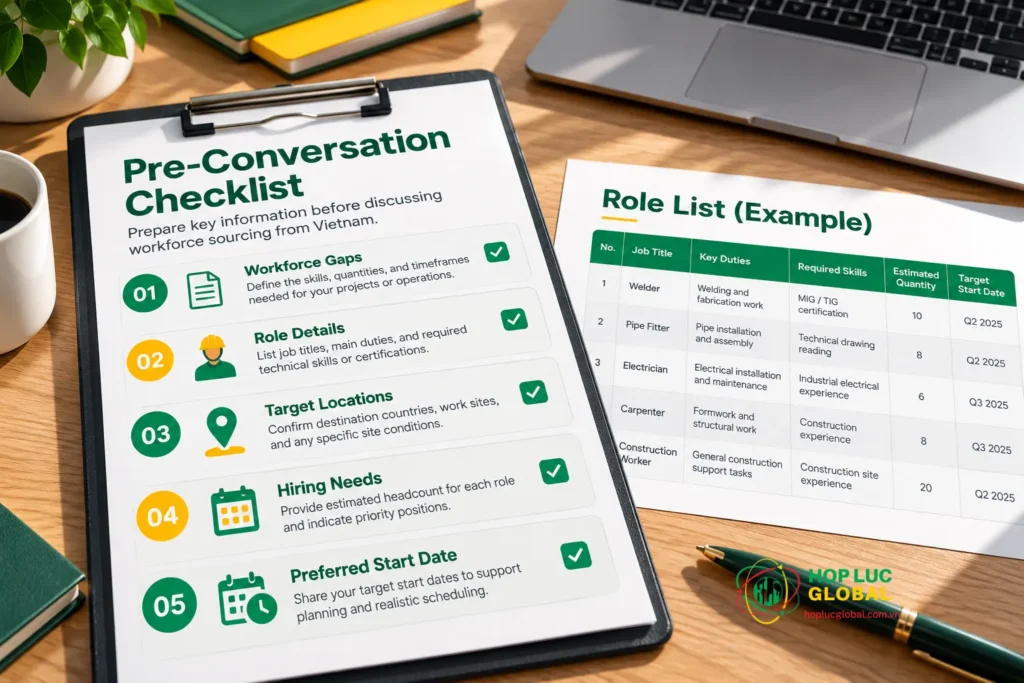
Next Steps: Preparing a Vietnam Overseas Manpower Supply Project
Before contacting a recruitment partner, employers should assemble a concise requirement file. This helps both sides assess the proposed recruitment activities against actual operational needs.
A Practical Pre-Conversation Checklist
- Prepare the list of required positions and headcount.
- Describe daily duties, tools, equipment, and mandatory experience.
- Identify the destination country and worksite.
- Record shift arrangements and working conditions.
- Define assessment evidence and interview expectations.
- Identify internal HR, operations, and documentation contacts.
- Provide a target start date as a planning benchmark.
- List destination-country questions that require qualified review.
A complete brief makes it easier to discuss sourcing scope, assess the proposed recruitment process, and identify outstanding responsibilities before moving toward a formal agreement.
Frequently Asked Questions About Vietnam Overseas Manpower Supply
What is a practical sourcing model for Vietnam overseas manpower supply?
It is a structured recruitment process that separates employer requirements, candidate sourcing, screening evidence, documentation coordination, and destination-country authorization. Each activity has a defined responsible party.
How does direct sourcing compare with partner coordination?
Direct sourcing requires employers to manage recruitment activities through their internal teams. Partner coordination assigns agreed sourcing and screening activities to a recruitment provider. Both arrangements leave final hiring decisions and applicable employer obligations with the employer.
What should an employer include in a recruitment brief?
The brief should describe job duties, required headcount, work location, working conditions, experience, language expectations, assessment criteria, and target start date.
How can employers evaluate candidate screening quality?
Employers should review the assessment criteria, evidence requested, reporting format, and procedures for handling incomplete information. Depending on the role, practical assessments and structured interviews may complement employment records.
Who is responsible for destination-country documentation?
Responsibilities depend on the applicable rules and agreements, but the employer must verify its own legal obligations. Recruitment partners can coordinate defined documentation activities without replacing the competent authorities or qualified advisers.
Does Vietnam overseas manpower supply guarantee a work permit or visa?
No. Recruitment activity does not guarantee immigration authorization. The relevant authorities assess applications according to the destination country’s requirements.
How should employers verify a recruitment agency in Vietnam?
Employers should review the agency’s legal identity, relevant licence information, written service scope, and operational responsibilities. Licence details should be checked against applicable official records.
Can EU employers request workers for different industries?
Employers can submit recruitment requirements for positions in manufacturing, construction, and other operational sectors for an initial discussion. Whether a particular recruitment project can proceed depends on the roles, candidate availability, service scope, and applicable requirements.
Conclusion: Building a Practical Recruitment Roadmap
Vietnam overseas manpower supply can provide EU employers with an additional recruitment channel when sourcing arrangements follow clear operational requirements. A written job brief, consistent candidate evidence, verified agency information, and defined responsibilities help employers make informed decisions.
Hop Luc Global supports recruitment coordination from Vietnam under an agreed service scope. Employers planning international recruitment can begin by documenting their required positions, headcount, destination country, and target start date.
Share Your Role List and Target Start Date
Hop Luc Global supports European employers with candidate sourcing, recruitment screening coordination, and documentation-related activities in Vietnam under an agreed scope.