European industrial employers face staffing challenges across factory floors, construction sites, and food processing plants. For companies considering Vietnam manpower export, a clear recruitment process starts with precise role definitions, candidate screening criteria, and partner verification. Rushed international hiring can create documentation bottlenecks, skill mismatches, and compliance risks. A qualified Vietnamese recruitment coordinator can help organize sourcing, candidate assessment, and document preparation. Hop Luc Global Joint Stock Company supports employer-side workforce planning in Vietnam, while work authorization decisions remain with the employer and the competent authorities in the destination country.
Key Takeaways
- Cross-border recruitment separates candidate sourcing in Vietnam from work authorization in the destination country.
- Written briefs specifying machinery, materials, shift structures, and workplace conditions prevent skill mismatches.
- European employers must verify agencies against official Vietnamese registration and labor-sending license records.
- Deployment timelines and approvals depend on competent national authorities, not agency schedules.
What Vietnam Manpower Export Means for EU Employers
Cross-border hiring succeeds only when European HR directors and plant managers define every operational role upfront. Structured coordination prevents costly missteps during candidate selection and government review.
The Employer-Side Definition: Sourcing, Screening, and Coordination
In a B2B context, Vietnam manpower export is a structured sourcing and coordination process rather than a single transaction. Employers assessing Vietnam overseas labour supply should separate the project into three workstreams: technical role definition, candidate skill evidence review, and destination-country documentation checks. Clear boundaries help protect the hiring company. Effective Vietnam workforce sourcing for European employers keeps recruitment coordination in Vietnam separate from work authorization in Europe.
Hop Luc Global Joint Stock Company is registered in Vietnam under Enterprise Registration Certificate No. 0110103022 and holds License No. 67/BNV-GP for sending Vietnamese labourers to work abroad under contracts, issued by the Ministry of Home Affairs on October 26, 2023, and adjusted in 2026. Employers should independently verify the agency’s current registration and licence details. This Vietnamese authorization does not replace destination-country work authorization requirements, which must be confirmed with the relevant national authorities.
What This Guide Covers and What It Leaves to Qualified Advisers
Structured Vietnam manpower recruitment requires clear operational scope from day one. This guide covers employer-side workforce planning, written briefs, screening evidence, documentation coordination, and agency due diligence. It excludes legal and tax counsel. No recruitment partner can promise government authorization outcomes or fixed deployment dates. While Hop Luc Global lists Lithuania, Latvia, Greece, Croatia, Finland, Estonia, Romania, Bulgaria, Poland, and Hungary as business planning contexts, requirements vary by destination country and should be checked with the relevant authority. Employers remain responsible for verifying country-specific administrative procedures with competent national authorities or qualified advisers.
Sector Demand and Role Definition Across European Industry
Industrial hiring across Europe spans diverse operating environments. Employers planning Vietnam manpower export can review official labour market and sector statistics from Eurostat to understand the broader context of their destination country. Defining exact shop-floor tasks remains essential to assessing whether candidates match production requirements. Any statistics used in workforce planning should be checked against the relevant Eurostat dataset and publication date.
Manufacturing, Welding, and Mechanical Roles
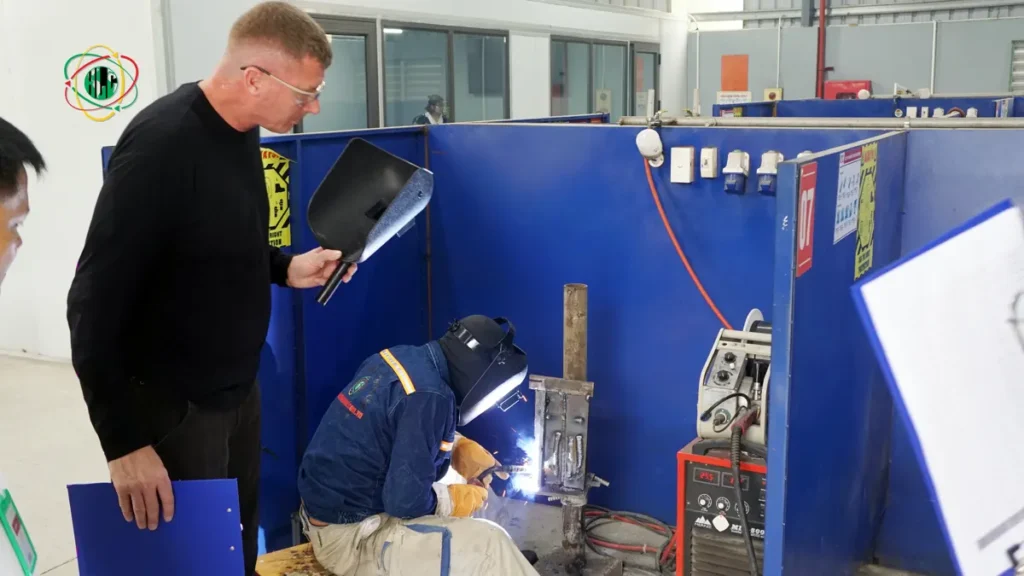
Evaluating Vietnam skilled labour supply for EU factories starts with replacing generic job titles with exact technical specifications. Generic titles fail. When plant managers source Vietnam technical workers Europe operations require, the brief must specify the welding process, base metals, material thickness, position tolerances, machine controller brands, and shift patterns. Specifying these parameters connects Vietnam skilled labour supply for EU manufacturers directly to verifiable shop-floor criteria. Employers should request filmed trade tests on matching workpieces. Because credential recognition and worker documentation standards vary by destination country, employers must verify local certification rules with competent authorities before testing begins.
Construction, Shipbuilding, and Civil Engineering
Heavy industrial projects demand clear physical and supervisory criteria in the initial brief. Project directors evaluating a Vietnam construction workforce or a specialized Vietnam shipbuilding workforce must document site conditions, weather exposure, work-at-height rules, safety gear standards, and supervision ratios upfront. Site realities dictate candidate suitability. Distinguishing general laborers from trade-specific workers—such as hull fitters, marine pipefitters, shuttering carpenters, or rebar steel fixers—prevents costly mismatches after arrival. Sourcing Vietnam technical workers Europe shipyards and civil contractors rely on requires agreeing on practical assessment methods before candidate outreach starts. Employers must confirm local site safety rules and occupational card requirements independently.
Food Processing, Textiles, and Meat Processing
High-volume production lines depend on physical endurance and strict hygiene routines. Engaging the Vietnamese industrial workforce for food processing, meat packing, or textile manufacturing requires honest descriptions of daily working environments. Line conditions filter candidates quickly. Employers should state ambient temperatures, cold-chain exposure, standing-work hours, shift rotations, and raw-material handling rules in writing. Production managers must also define the workplace instruction comprehension needed to follow safety signage and quality checks. Because food-sector hygiene and health documentation standards differ by jurisdiction, employers must confirm country-specific administrative procedures with local regulatory authorities prior to onboarding.
Turning Employer Requirements Into a Recruitment Brief
On paper, starting an overseas hiring project looks as simple as forwarding a domestic job advertisement to an agency. In practice, domestic job descriptions omit the environmental and technical details overseas recruiters need, causing weeks of clarification and mismatched shortlists.
The Eight Details Every Brief Should Contain
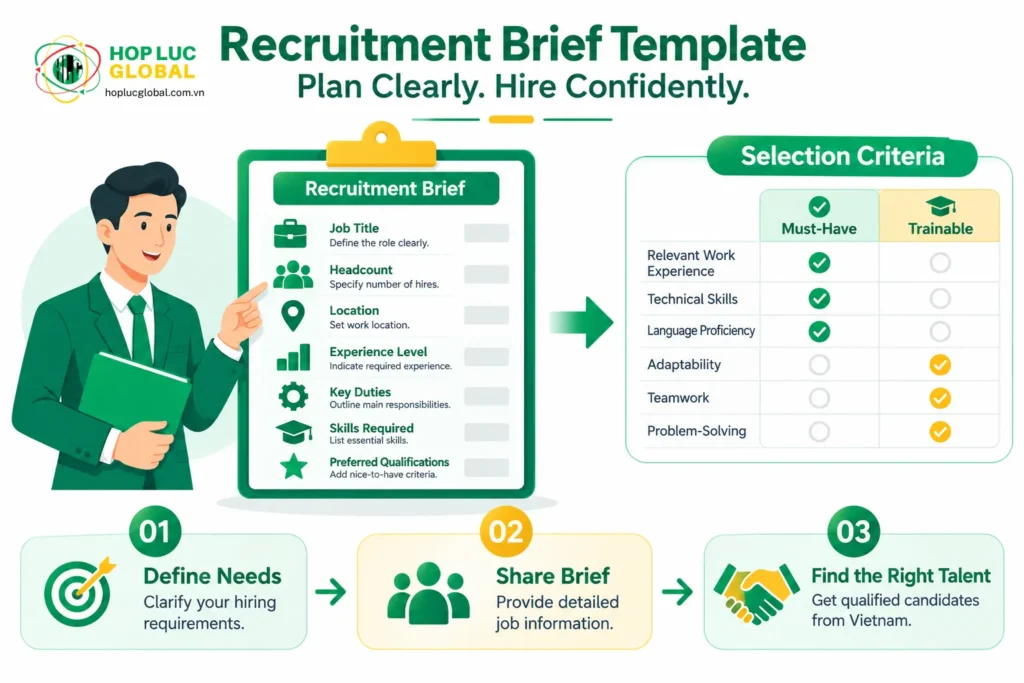
Structured cross-border workforce planning begins with a written recruitment brief that translates plant floor needs into verifiable sourcing rules. When evaluating Vietnam workers for hire through a Vietnam international recruitment partner, HR directors should organize the brief around eight operational fields:
- Job title paired with primary machinery or tool usage
- Daily operational duties and measurable output expectations
- Headcount broken down by role and department
- Physical work location and site access details
- Working conditions including temperature, noise, and shift rotation
- Minimum practical experience versus trainable tasks
- Workplace instruction comprehension for safety and handovers
- Target start date framed as an internal planning benchmark
Separating mandatory technical skills from trainable routines helps Hop Luc Global filter applicants accurately from a written brief. A complete brief improves screening accuracy, though it never shortens government authorization processing times.
Writing Criteria That a Partner Can Actually Verify
Subjective adjectives create friction during candidate screening. Phrases like team player cannot be tested in a workshop. Observable evidence drives selection. Employers should convert every role requirement into a concrete verification step before sourcing starts. Separate candidate-supplied documents, such as past employment records, from the practical trade assessments the partner conducts in Vietnam. Both parties should agree in writing on how to handle incomplete files before scheduling interviews. Documentary evidence supports internal selection decisions only and never guarantees destination-country work authorization approval.
Candidate Screening and Evidence Review
On paper, a candidate folder containing a translated resume and a vocational certificate appears sufficient to justify a job offer. In practice, plant managers often discover that domestic job titles and training certificates from abroad do not reflect familiarity with European industrial tolerances, safety lockouts, or production speeds.
What Work History Evidence Can and Cannot Tell You
Effective Vietnam manpower recruitment treats written work history as an initial filter rather than proof of shop-floor competence. Employment books and past references confirm only that an applicant worked in an industry. Paperwork never replaces testing. A candidate listed as a technician in a small domestic workshop may have operated manual lathes rather than automated multi-axis machinery used in European plants. When documentary evidence is thin, employers should prepare targeted technical questions covering machine setup, fault troubleshooting, and material handling. Recruitment partners coordinate document collection, while employers must remember that domestic Vietnamese qualifications are not automatically recognized under destination-country work authorization requirements.

Practical Assessment and Interview Structure
Verifying technical capability requires combining hands-on trade trials with structured live interviews. Employers evaluating Vietnam skilled labour supply for EU production lines can ask the coordinator to organize supervised practical assessments using materials and tasks that mirror the European workplace. Video recording adds transparency. Combining live video interviews with trade tests allows plant supervisors to observe how Vietnam technical workers Europe facilities consider hiring follow verbal instructions, use protective gear, and inspect their output. Employers should state workplace language expectations honestly in the rubric, focusing on practical instruction comprehension. Practical assessments support internal selection only and never substitute for country-specific administrative procedures to verify with authorities.
Documentation Coordination and Destination-Country Checks
On paper, cross-border documentation follows a linear checklist where each form triggers the next step predictably. In practice, European employers face real-world friction from unclear document ownership, local notarization queues, seasonal embassy workload spikes, and shifting national regulations that delay deployment when buffer time is absent.
Splitting Responsibilities Between Employer, Partner, and Candidate
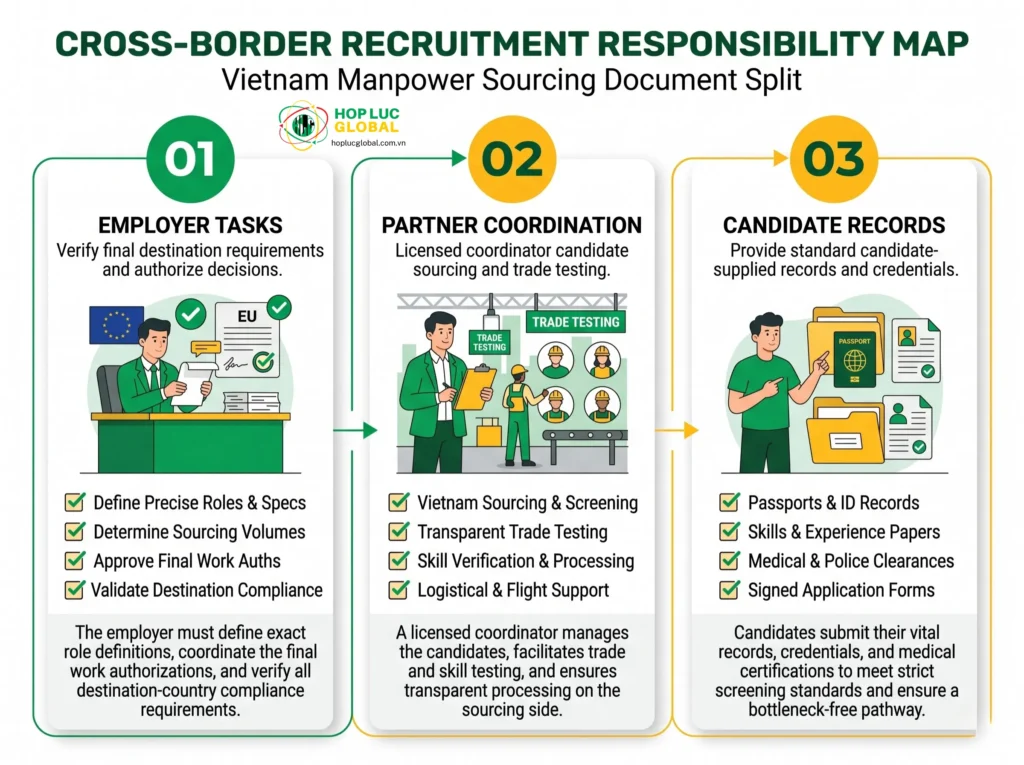
Disciplined Vietnam recruitment compliance depends on assigning every document task to a clear owner before candidate selection concludes. When planning cross-border workforce planning for manpower export to Europe, ambiguity between the HR team and the recruitment agency can cause avoidable delays. A practical responsibility matrix splits tasks into three tracks: employer-side documentation checks in the destination country, partner-side coordination in Vietnam, and candidate-supplied personal records.
Hop Luc Global coordinates the Vietnamese track under License No. 67/BNV-GP for sending Vietnamese labourers to work abroad under contracts, assisting selected workers with domestic document preparation and status tracking. Employers should check the European Commission’s EU Immigration Portal as a starting point for country-specific information, then confirm current requirements with the competent national authority. Shared logs should track milestone dates without exposing personal data through unsecured email threads.
Why Requirements Differ by Country and by Role
Assuming that one European hiring procedure applies across every destination country is a common operational mistake. Destination-country work authorization requirements can vary by national rules, industrial sector, and occupational category. Employers can consult the official EURES European Employment Services website for information about European labour markets and cross-border employment. Before making a hiring decision, they should verify current requirements directly with the competent national ministry, immigration authority, or labour inspectorate. What applies to a food processing operative in one country may differ from the requirements for a structural welder in another. Treat recruitment partner input as coordination support, not as a legal determination.
Due Diligence on a Vietnam Workforce Export Agency
Selecting an overseas recruitment partner requires the same procurement rigor that European manufacturers apply to equipment suppliers. Independent credential verification protects your organization from unverified intermediaries and compliance exposure.
Company Identity and Licence Checks
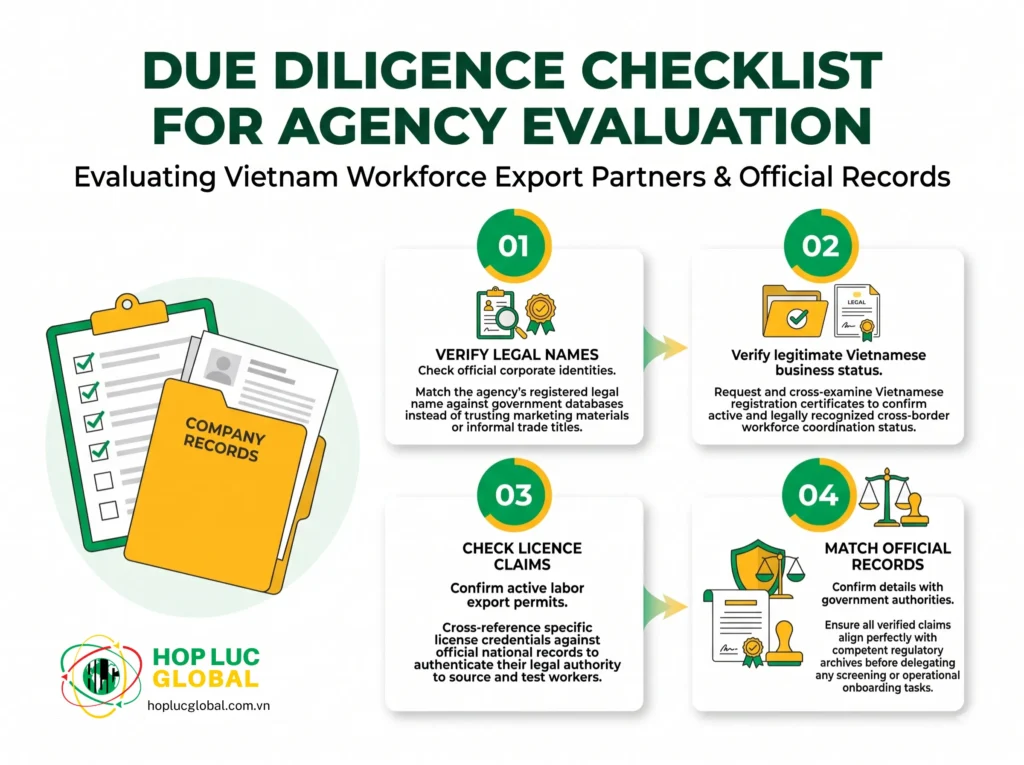
Evaluating a workforce export agency Vietnam offers begins with verifying corporate identity and regulatory licensing against official Vietnamese government registries. Unverified brokers often rely on polished websites, cropped certificate photos, or informal assurances during introductory calls. Verbal assurances carry zero weight. European procurement and HR teams should request the agency’s exact Vietnamese legal name, enterprise registration number, and labor-sending license number, then cross-check those identifiers against public records.
Hop Luc Global Joint Stock Company operates under Enterprise Registration Certificate No. 0110103022 (issued by the Hanoi Department of Finance on August 29, 2022) and holds License No. 67/BNV-GP (formerly No. 67/LĐTBXH-GP) for sending Vietnamese laborers to work abroad under contracts, issued by the Ministry of Home Affairs on October 26, 2023, and adjusted in 2026. Employers should ask any prospective partner to explain its license scope in writing.
Service Scope, Communication, and Commercial Clarity
Rather than relying on unverified rankings claiming to identify the best manpower exporter Vietnam has available, employers should evaluate partners against a transparent operational checklist. Structured Vietnam overseas manpower supply agreements require a written scope of work before sourcing starts. Written terms prevent disputes. That scope should define how the agency handles candidate sourcing, trade testing logistics, domestic document coordination, and pre-departure orientation. Employers should require named account coordinators, scheduled weekly status reports, and clear escalation paths for missing candidate records. The contract must also itemize all service fees and specify which costs the employer pays versus statutory items applicable to candidates under Vietnamese law.
How Hop Luc Global Supports Employer-Side Workforce Planning
Structured recruitment coordination bridges the gap between a European plant manager’s staffing plan and candidate preparation in Vietnam. Clear operational boundaries keep both teams aligned through pre-departure readiness.
What Hop Luc Global Coordinates and What It Does Not
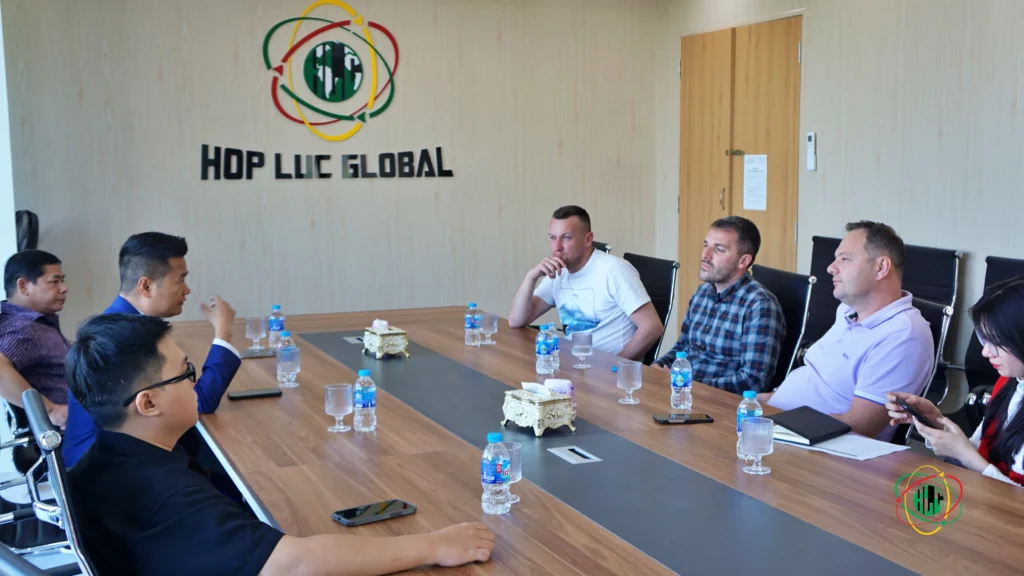
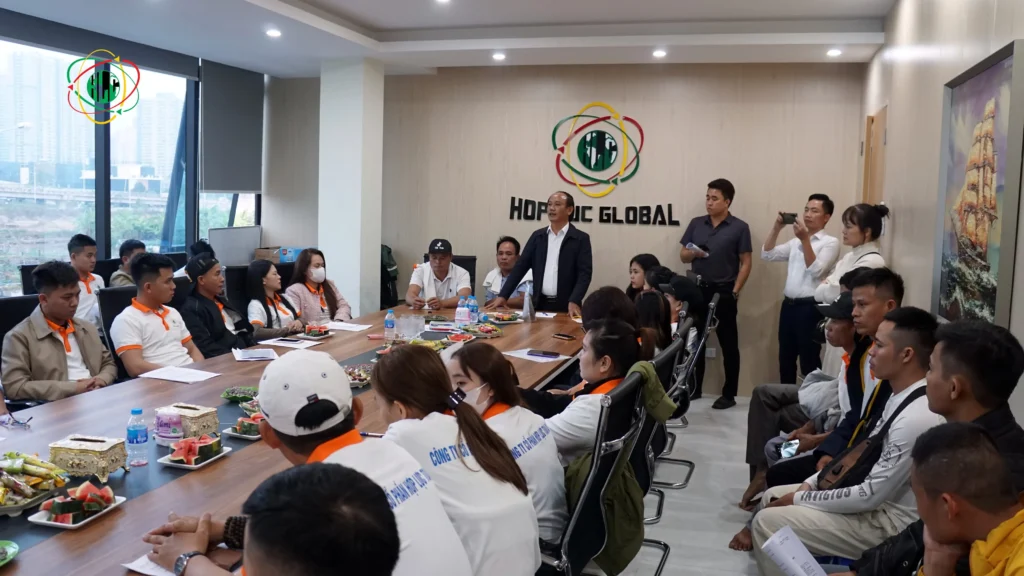
Within the Vietnam manpower export process, About Hop Luc Global outlines how the organization functions as a licensed Vietnam labour supply agency focused on employer-side coordination. Legally registered under Enterprise Registration Certificate No. 0110103022 and holding License No. 67/BNV-GP for sending Vietnamese laborers to work abroad under contracts, Hop Luc Global coordinates candidate sourcing from written briefs, organizes trade testing and interview logistics, manages domestic candidate document collection, and conducts pre-departure preparation at its dedicated Orientation Education Facility in Noi Bai Commune, Hanoi City.
Scope boundaries remain explicit. The employer retains full authority over candidate selection, employment contracts, and destination-country work authorization requirements. Hop Luc Global does not provide legal immigration counsel and never guarantees visa approvals, placement volumes, or arrival dates.
How a First Conversation Typically Runs
Initiating a discussion around Vietnam manpower supply for EU employers follows a practical operational agenda. During an initial review, the employer shares a preliminary role list, required headcount, work locations, and target start dates. Clarifying assumptions comes first. Both sides review technical duties to determine what practical screening evidence can be collected in Vietnam and how interviews will run. The teams then map out the responsibility split for employer-side documentation checks versus candidate-side records in Vietnam, noting which country-specific administrative procedures the employer will confirm with competent national authorities.
Next Steps: Preparing Your Role List and Target Start Date
Internal preparation on the employer side determines how productively an initial scoping discussion unfolds. Compiling core operational facts before contacting a Vietnamese partner establishes realistic planning milestones.
A Short Pre-Conversation Checklist
Effective cross-border workforce planning starts with assembling a concise internal requirement file across your operations, HR, and legal teams. Before scheduling a scoping review with a recruitment partner in Vietnam, plant managers and HR directors should prepare three foundational inputs:
- A structured role list detailing machinery, tools, material specifications, daily duties, and headcount per facility
- Destination country, site location, shift schedule, working conditions, and workplace instruction expectations
- A target start date treated strictly as an internal planning benchmark rather than a fixed commitment
Start dates remain planning targets. Because destination-country work authorization requirements and authority review speeds sit outside any agency’s control, building schedule buffers into your production plan protects operational continuity.
Frequently Asked Questions
Does Vietnam manpower export guarantee a work permit or visa?
No recruitment agency can guarantee work permits or visa approvals. Employers and candidates must satisfy destination-country work authorization requirements, and final approval decisions rest exclusively with competent national authorities.
How long does recruitment from Vietnam usually take?
Overall timing depends on role complexity, trade testing schedules, document readiness, and destination-country authority review workloads. Employers should treat target start dates as flexible planning benchmarks rather than fixed commitments.
Which sectors can a Vietnam-based recruitment partner support?
- Industrial manufacturing, CNC machining, and mechanical assembly
- Structural welding, metal fabrication, and plant maintenance
- Civil construction, scaffolding, shuttering, and shipbuilding trades
- Food processing, meat packing, and textile production lines
What documents should an employer prepare first?
- Written job descriptions specifying machinery, materials, and daily duties
- Headcount breakdown per site and shift rotation schedules
- Physical workplace conditions, safety rules, and instruction expectations
- Employer-side corporate registration and national authorization documents
How can an employer verify a Vietnam workforce export agency?
- Request the agency’s exact Vietnamese legal name and enterprise registration number.
- Cross-check the labor-sending license number against official Ministry of Home Affairs records.
- Review a written scope of work covering sourcing, testing, and document coordination.
- Confirm itemized commercial terms and named operational communication contacts in writing.
Is language ability required before hiring Vietnamese workers?
Language expectations depend on the specific industrial role and site supervision structure. Employers should define required workplace instruction comprehension in the recruitment brief and evaluate practical communication honestly during interviews.
Who is responsible for compliance in the destination country?
The European employer remains responsible for verifying and meeting destination-country work authorization requirements with competent national authorities or qualified advisers. A recruitment partner coordinates candidate sourcing, screening, and domestic Vietnamese documentation steps only.
Share your role list and target start date.
Hop Luc Global supports candidate sourcing, recruitment coordination, and Vietnamese-side document preparation for EU employers. Destination-country requirements should be verified with the relevant authorities.