European employers planning international recruitment need a clear process for defining vacancies, assessing candidates, and checking recruitment partners. Vietnam overseas labour supply can support workforce planning across manufacturing, construction, welding, food processing, shipbuilding, and technical trades. The outcome depends on the quality of the role brief, screening evidence, documentation coordination, and partner due diligence. Hop Luc Global coordinates recruitment activities in Vietnam and holds a licence for sending Vietnamese labourers to work abroad under contracts. This guide explains how EU employers can assess a potential workforce partner without assuming visa approval, placement volume, or fixed start dates. For the broader sourcing process, see our Vietnam manpower export pillar guide.
Key Takeaways
- Assess a Vietnam-based partner on legal identity, licence scope, service scope, and written communication routines.
- Keep recruitment coordination separate from destination-country work authorization decisions.
- A written brief with machinery, materials, conditions, and evidence criteria improves candidate screening.
- Start dates remain planning targets because destination-country review sits outside any agency’s control.
What Vietnam Overseas Labour Supply Means for EU Employers
The Employer-Side Definition: Sourcing, Screening, and Coordination
Vietnam overseas labour supply describes an employer-facing sourcing and coordination process. Employers define roles and own hiring decisions. A partner coordinates candidate sourcing, evidence collection, and document routines. Three workstreams should run side by side: role definition, candidate evidence review, and destination-country documentation checks. Treat recruitment coordination and immigration authorization as separate tracks. A partner can structure the first track. The second track depends on rules that employers verify with competent authorities or qualified advisers. Hop Luc Global Joint Stock Company is registered in Vietnam and holds License No. 67/BNV-GP for sending Vietnamese laborers to work abroad under contracts.
What This Guide Covers and What It Leaves to Qualified Advisers
This guide covers planning, written briefs, screening evidence, documentation ownership, and partner checks. It leaves legal advice, tax advice, and authorization outcomes to qualified advisers. Employers should not treat partner guidance as a legal determination. Hop Luc Global lists European target markets including Lithuania, Latvia, Greece, Croatia, Finland, Estonia, Romania, Bulgaria, Poland, and Hungary as planning context only. Requirements vary by destination country and should be checked with the relevant authority. A Vietnam labour supply agency can coordinate process steps. It cannot replace employer verification.

Defining the Workforce Requirement Before Partner Assessment
The Eight Details Every Brief Should Contain
On paper, a brief looks like a domestic job advertisement. In practice, overseas recruiters need shop-floor detail to screen candidates. Include job title, duties, headcount, work location, working conditions, experience level, language expectations, and target start date. Separate must-have criteria from trainable routines. A vague brief produces profiles that cannot be assessed.
When evaluating Vietnam workers for hire, ask whether the partner works from a written brief and how it records evidence. Vietnam international labour supply works best when the employer names one internal owner for the brief. For general labour market and sector context, employers can consult Eurostat, the official source of European statistics. Check the relevant dataset and publication date before using any specific figures in workforce planning.
Writing Criteria That a Partner Can Actually Verify
Convert subjective traits into observable evidence requests. Instead of asking for a team player, ask for examples of shift handovers the candidate has followed. Separate documents the candidate can supply from assessments the partner must run. Agree in writing on what happens when evidence is incomplete. No document guarantees suitability or approval. The brief is a planning tool, not a compliance certificate. Overseas workforce sourcing Vietnam improves when criteria are specific enough for a trade test or structured interview.
How to Assess Candidate Screening and Evidence Quality
What Work History Evidence Can and Cannot Tell You
On paper, a translated resume and a vocational certificate appear sufficient. In practice, the same job title means different things across workshops and regions. Employment records confirm an industry history; they do not prove shop-floor competence. When evidence is thin, ask the partner to describe actual tasks, equipment used, and supervision level. Vietnam labour recruitment process should include targeted technical questions. No partner should claim that a Vietnamese qualification is recognized in a destination country. Employers verify local recognition rules with competent authorities before testing begins.

Practical Assessment and Interview Structure
Trade tests, video interviews, and technical questioning work as complementary methods. Ask the coordinator to organize supervised practical assessments that mirror the European workplace. Record outcomes so candidates can be compared fairly. State language expectations honestly, including the level needed for workplace instructions. Assessments support selection only. They do not replace destination-country work authorization requirements. A Vietnam overseas manpower supply partner should be able to explain how it schedules tests, who supervises them, and how results are shared.
Documentation Ownership and Destination-Country Checks
Splitting Responsibilities Between Employer, Partner, and Candidate
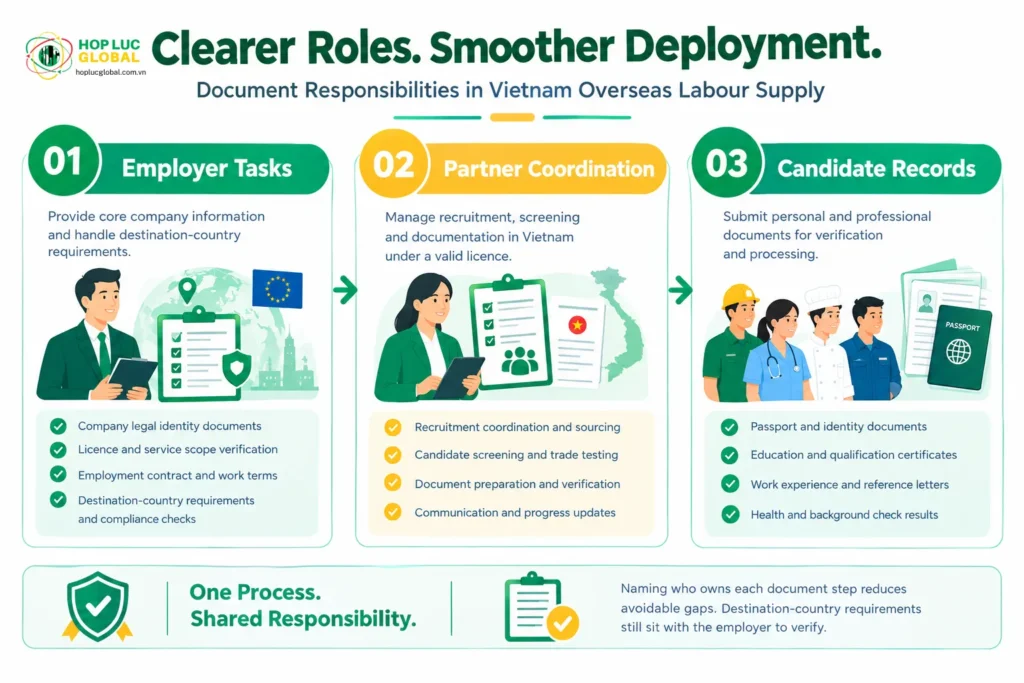
Document delays usually come from unclear ownership. Split tasks into three tracks: employer-side documents in the destination country, partner-side coordination in Vietnam, and candidate-supplied personal records. Record status without exposing personal data across unsecured email. Hop Luc Global coordinates the Vietnamese track under its licence for sending Vietnamese laborers to work abroad under contracts. That licence does not make any document set sufficient for a destination country. For country planning, see our manpower export to Europe guide. Vietnam recruitment compliance depends on clear ownership, not paperwork volume.
Why Requirements Differ by Country and by Role
Destination-country requirements can vary by country, sector, and job role. A food processing operative and a structural welder may need different checks depending on the intended employment and destination. Employers can consult the official EURES European Employment Services website for general information about European labour markets and employment mobility. They should then verify current requirements with the competent authority in the destination country or a qualified adviser. Treat recruitment partner guidance as coordination support, not a legal determination. Do not assume that one general statement applies across Europe. Before committing to a recruitment plan, record which requirements were checked, when they were checked, and which authority or adviser provided the information.
Partner Due Diligence: Identity, Licence Scope, and Service Scope
Company Identity and Licence Checks
Match the legal name, registration details, and licence claims against official records. Ask for the scope of the licence and how the partner describes its own limits. Screenshots and verbal claims are weak evidence. For a workforce export agency Vietnam, check Enterprise Registration Certificate No. 0110103022 and License No. 67/BNV-GP against issuing authority records. Confirm licence wording with operations before publishing body copy that quotes it. Do not rank agencies or imply superiority. Due diligence is a comparison exercise, not a popularity contest.
Service Scope, Communication, and Commercial Clarity
Ask for a written scope covering sourcing, screening, document coordination, and post-selection support. Name communication contacts and expected response routines. Fee transparency matters: ask what each party pays for. Compare agencies on written scope, evidence standards, and willingness to explain limitations. No fee figures belong in this guide because commercial terms vary by project. Clarity about responsibility matters more than a polished pitch. When assessing a Vietnam overseas labour supply partner, employers should look for documented routines and clear responsibilities rather than relying on verbal assurances.
How Hop Luc Global Simplifies Workforce Partner Assessment
What Hop Luc Global Coordinates and What It Does Not
Hop Luc Global coordinates Vietnam overseas labour supply activities from written role briefs through candidate sourcing, screening coordination, and document handling routines. The employer retains responsibility for employment decisions and destination-country verification.
Hop Luc Global Joint Stock Company is registered under Enterprise Registration Certificate No. 0110103022. It holds License No. 67/BNV-GP for sending Vietnamese labourers to work abroad under contracts, issued by the Ministry of Home Affairs on October 26, 2023, and adjusted in 2026. The company also operates an orientation education facility in Noi Bai Commune, Hanoi City. Employers should independently verify current registration and licence details against the relevant records. Hop Luc Global does not guarantee authorisation approval, placement volume, or start dates. Learn more about Hop Luc Global.
How a First Conversation Typically Runs
Employers share a role list, headcount, work locations, and target start date. The discussion covers feasibility questions, evidence expectations, and the responsibility split. Both sides agree on what will be confirmed and by whom before any commitment. Before that conversation, prepare a short internal file: role list with duties, destination country and site, shift schedule, and working conditions. Treat the target start date as a planning benchmark, not a commitment. This is a planning discussion, not an approval step.
Frequently Asked Questions
How can an employer judge whether a Vietnam-based workforce partner is credible?
- Match legal name and registration against official records.
- Ask for licence scope in writing.
- Request a written service scope and communication routine.
What should an employer prepare before assessing a workforce partner?
Prepare a job description, role requirements, working conditions, headcount, and target start date. Confirm destination-country requirements locally before committing to a plan.
How can an employer evaluate candidate screening quality?
- Review the evidence the partner requests.
- Agree practical assessment methods before sourcing.
- Record outcomes for fair comparison.
Who is responsible for documentation in the destination country?
The employer remains responsible for verifying and meeting destination-country requirements with competent authorities or qualified advisers. A partner coordinates process steps only.
Does Vietnam overseas labour supply guarantee a work permit or visa?
No. No agency can guarantee authorization outcomes. Employers and candidates must meet destination-country requirements, and decisions rest with relevant authorities.
How long does assessment and recruitment from Vietnam usually take?
Timing depends on role complexity, evidence availability, and destination-country review. Start dates are planning targets, not fixed commitments.
Share your role list and target start date.
Hop Luc Global supports candidate sourcing, recruitment coordination, and Vietnamese-side document preparation for EU employers. Employers should confirm destination-country employment and work authorisation requirements with the relevant authorities.