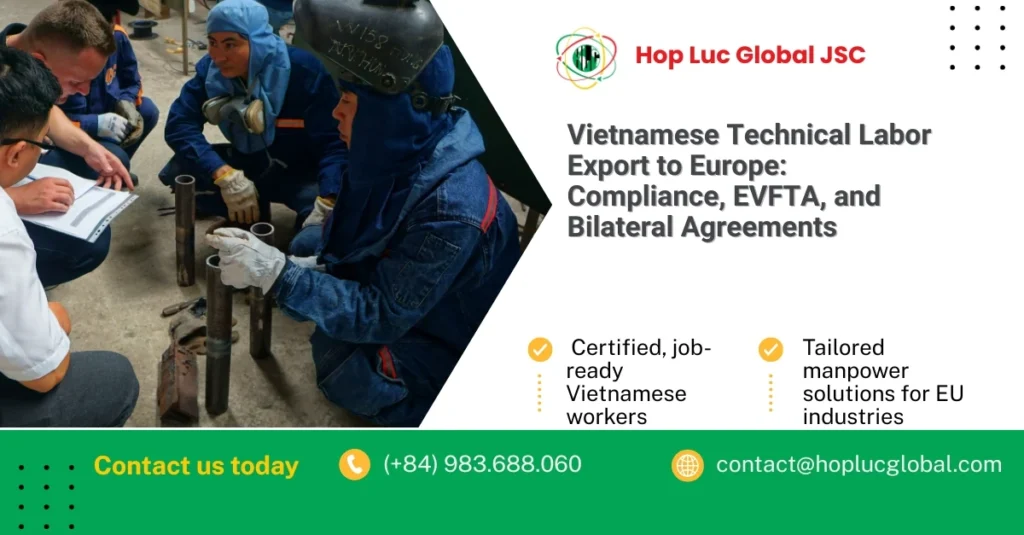
European employers in manufacturing, construction, hospitality, agriculture, and technical services increasingly face the same operational problem: persistent difficulty finding reliable workers for roles that keep production lines moving, projects on schedule, and facilities fully staffed. When local hiring channels slow down, delays can reduce output, strain existing teams, and create compliance pressure. Vietnam recruitment offers European employers a structured workforce-sourcing option that connects clear employer requirements with suitably assessed Vietnamese candidates. This guide explains how recruitment in Vietnam works from an employer perspective, how to evaluate a Vietnam human resource agency, and how Hop Luc Global supports European workforce planning without unsupported promises.
What Vietnam Recruitment Means for European Employers
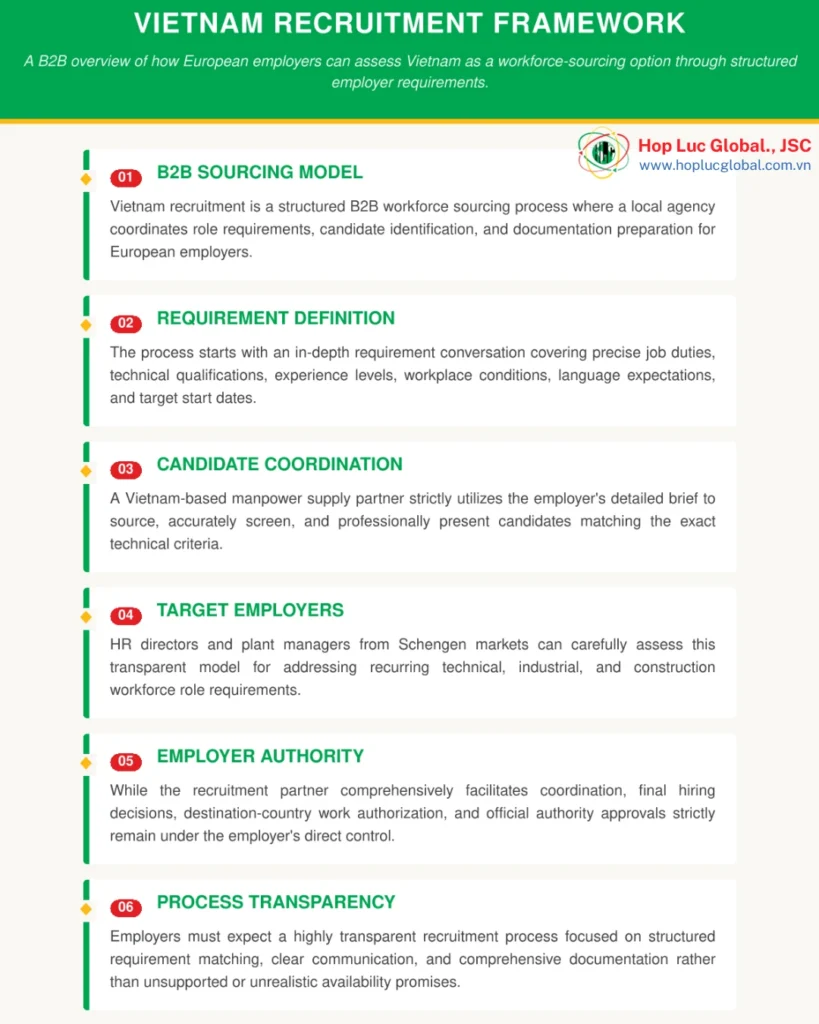
Vietnam recruitment is a business-to-business workforce sourcing process rather than a simple candidate search. For a European employer, it means working through a Vietnam-based recruitment or manpower supply partner to define role requirements, identify suitable candidates, coordinate documentation, and prepare workers for employer review. The recruitment partner supports the process, but final hiring decisions and destination-country work authorization remain separate matters controlled by the employer and relevant authorities.
Vietnam Recruitment as a B2B Workforce Sourcing Model
In a B2B workforce sourcing model, the employer does not simply receive CVs. The process begins with a requirement conversation covering job duties, qualifications, experience, workplace conditions, language expectations, and target start date. A Vietnam staffing agency then uses that brief to source, screen, and present candidates who match the employer’s criteria. This is different from final hiring because the employer must still assess suitability and follow destination-country administrative procedures.
A Vietnam employment agency for Europe can support this process by coordinating between the employer in Europe and candidate activities in Vietnam. Hop Luc Global is a Vietnam-based manpower supply agency serving European employers and recruitment partners. Its role is to facilitate requirement matching and candidate coordination, while recognizing that employer hiring decisions and authority approvals remain outside the agency’s control.
Which European Employers May Consider Vietnamese Manpower
European employers that may consider Vietnamese manpower include HR directors, CEOs, COOs, plant managers, construction managers, and recruitment agencies with recurring workforce needs. The model is most relevant when employers have clearly defined roles across technical, industrial, construction, hospitality, agricultural, healthcare, caregiver, or other suitable occupational areas. Role suitability should always drive the discussion. Vietnamese candidates are not automatically suitable for every occupation.
Hop Luc Global’s verified target markets include Lithuania, Latvia, Greece, Croatia, Finland, Estonia, Romania, Bulgaria, Poland, Hungary, and wider Schengen markets. These are business target markets, not proof that any specific recruitment pathway is automatically available. Employers should confirm destination-country requirements separately.
What European Employers Should Expect From a Recruitment Partner
A practical Vietnam foreign labour agency should provide a transparent recruitment process, clear communication, and structured documentation coordination. Employers should expect the agency to collect complete role information, explain how candidates are sourced and screened, and identify where employer or authority responsibilities begin. Employer-side participation remains necessary.
Transparency matters more than speed claims. A Vietnam human resource agency that focuses on requirement matching and documented communication is more useful than one that offers unsupported availability promises.
Why European Employers Consider Vietnamese Overseas Manpower
Many European employers evaluate Vietnamese overseas manpower because they need an additional sourcing channel for recurring operational roles. The decision should be based on workforce gaps, role definition, and employer readiness rather than a general assumption that overseas recruitment solves every hiring problem. Vietnam recruitment is one potential option within a broader workforce plan.
European employers should assess overseas recruitment alongside current labour-market conditions in their target country. For current employment, vacancy and labour-market indicators, employers can review the latest data published by Eurostat before making workforce planning decisions.
Workforce Gaps in Technical and Operational Roles
Hiring difficulty in technical and operational roles can affect production continuity, project scheduling, and workforce stability. When local hiring does not produce enough suitable candidates, employers may look for additional sourcing channels. Vietnamese manpower can support employer-defined requirements in industrial, technical, construction, hospitality, agricultural, and other operational settings.
Recruitment in Vietnam gives European employers access to a workforce-sourcing pipeline that can be evaluated against the same criteria used for local recruitment: qualifications, experience, practical competence, communication ability, and workplace readiness.
Sector-Specific Workforce Requirements
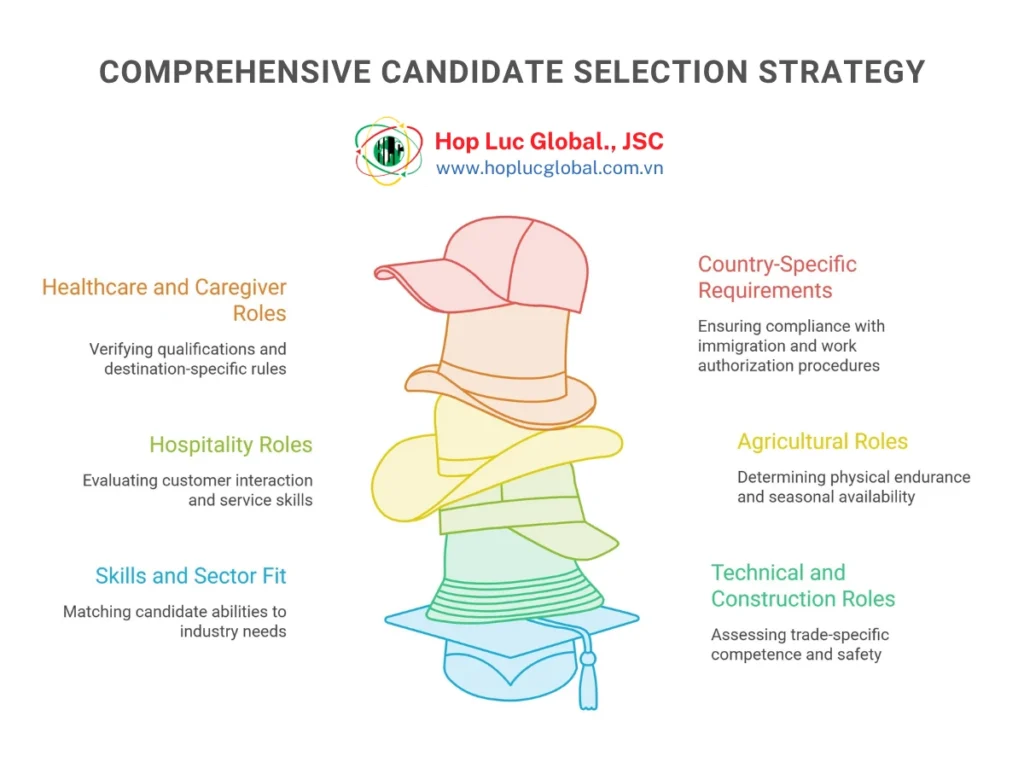
Different sectors require different screening criteria. Technical roles may need practical trade skills and equipment experience. Construction roles may require physical capability, site safety awareness, and trade-specific competence. Hospitality roles often involve customer-facing communication. Agricultural roles may require physical endurance and seasonal availability. Healthcare and caregiver roles can involve professional qualifications and additional checks.
A well-written job description is the foundation of every recruitment discussion. Employers should define duties, experience, qualifications, language expectations, working conditions, and non-negotiable requirements. This clarity allows the Vietnam recruitment partner to screen candidates against real workplace criteria.
When Vietnam Is a Practical Workforce-Sourcing Option
Vietnam is a practical option when the employer has clearly defined recurring roles, an ongoing hiring need, and internal capacity to support cross-border recruitment. It is less practical when job requirements are unclear, when immediate deployment is expected, or when destination-country rules make the role unsuitable.
A requirement-led assessment should consider the number of roles, urgency, job complexity, and employer readiness. Vietnam recruitment is not a default solution. It becomes more useful when treated as a workforce-planning exercise.
How to Evaluate a Vietnam Recruitment Agency for Europe
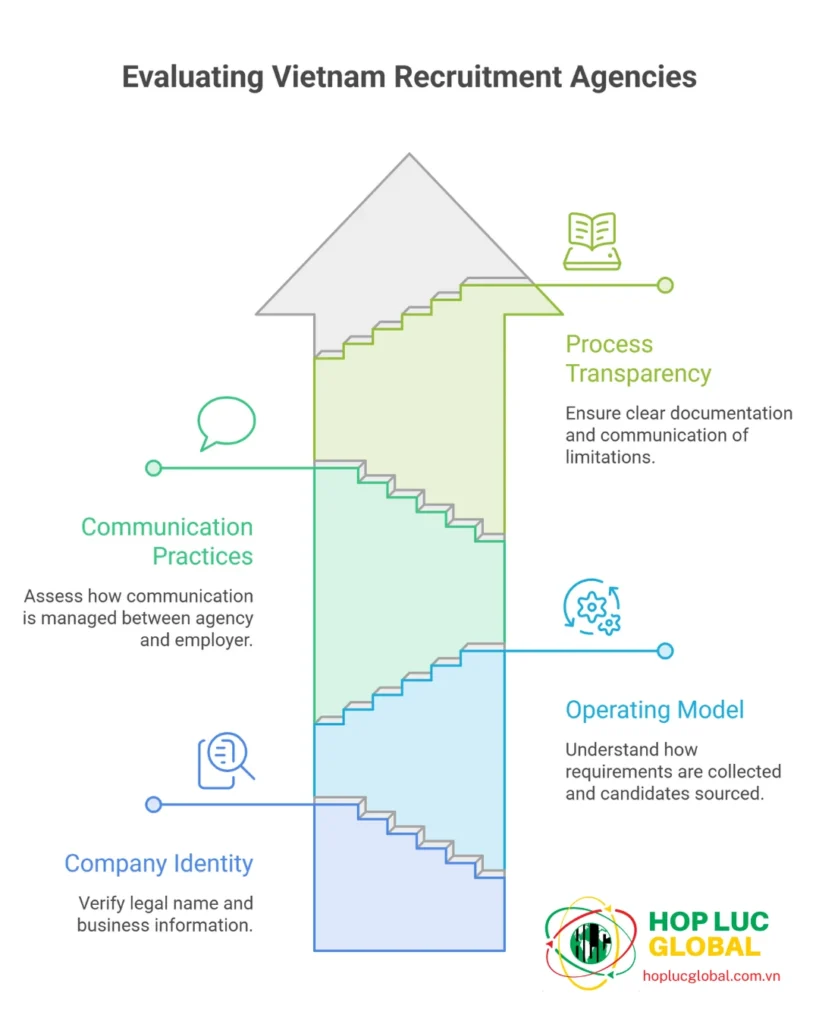
Selecting a Vietnam recruitment agency for Europe requires more than reviewing a website. Employers should evaluate company identity, operating model, communication practices, and process transparency.
What to Check in a Vietnam Human Resource Agency
Start with company identity and documented business information. Hop Luc Global’s legal name is Hop Luc Global Joint Stock Company, a Vietnam-based manpower supply agency serving European employers and recruitment partners. Its verified profile lists license 67/LĐTBXH-GP, issued on 2023-10-26, although employers should confirm the current scope of any license with the company before relying on it for a specific activity.
A credible Vietnam human resource agency should explain how employer requirements are collected, how candidates are sourced and screened, and how communication is managed. The verified About Us page is available at https://hoplucglobal.com.vn/who-we-are/.
Questions to Ask Before Choosing a Vietnam Staffing Agency
Employers should ask a Vietnam staffing agency practical questions. How are requirements collected and clarified? How are candidates sourced and screened? How are documentation and communication coordinated? What role does the employer play in candidate review? Where do employer or authority responsibilities begin?
Additional questions may cover unsuitable referrals, incomplete information, and changes during sourcing. Employers should not expect the agency to control authority decisions or guarantee approvals.
Why Transparent Processes Matter More Than Recruitment Promises
Unsupported claims about speed, availability, cost, or outcomes should be treated with caution. A transparent process allows employers to evaluate risk realistically. Employers should look for agencies that document requirements, explain screening methods, and communicate limitations clearly.
Process transparency also supports compliance. Structured recruitment is a risk-management practice, not a guarantee of fast results.
The Vietnam Recruitment Process: From Employer Requirement to Candidate Preparation
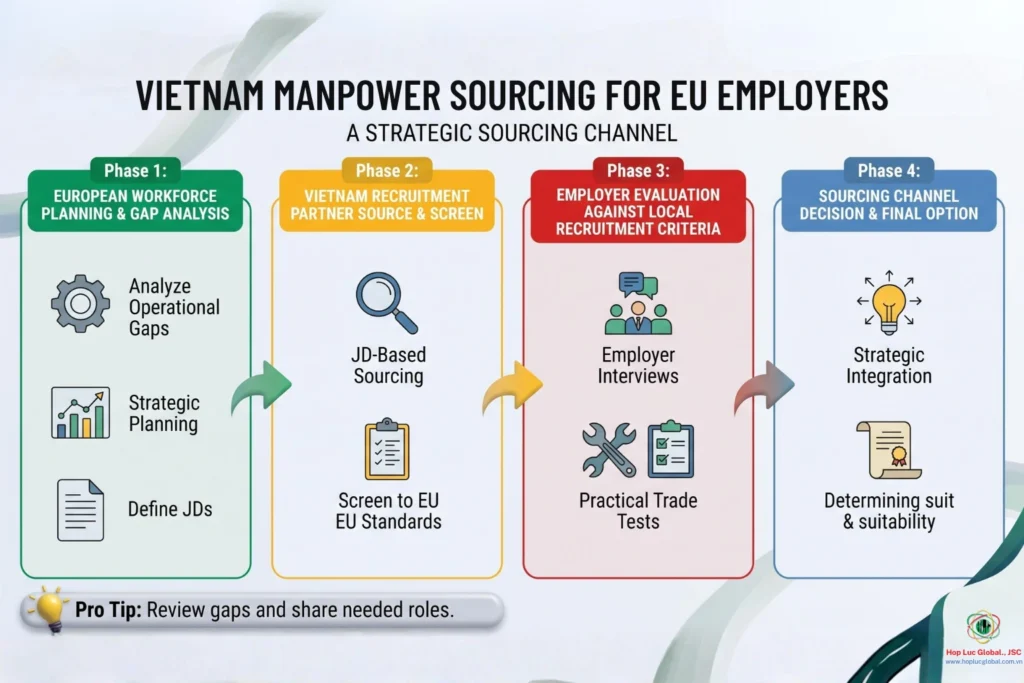
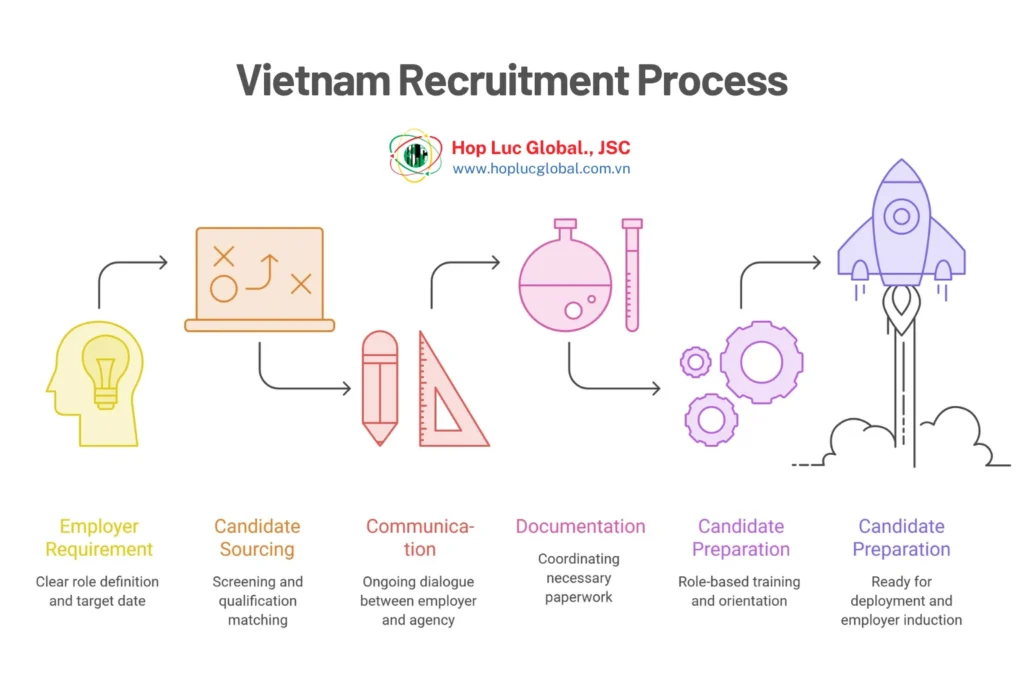
A structured Vietnam recruitment process starts with the employer’s workforce requirement and moves through candidate sourcing, screening, communication, documentation coordination, and preparation. The employer remains involved throughout.
Define the Role, Workforce Need, and Target Start Date
Employers should provide a clear role list and target start date before recruitment begins. The role list should include job title, duties, technical requirements, experience, language expectations, working conditions, location, and non-negotiable qualifications. A target start date helps planning, although it does not create a guaranteed deployment date.
Clear specifications reduce unsuitable referrals. When employers identify essential requirements separately from trainable skills, the agency can screen more accurately.
Candidate Sourcing, Screening, and Qualification Matching
Once the brief is clear, the Vietnam recruitment agency sources candidates against defined criteria. Screening may include reviewing qualifications, experience, and practical skills. For technical roles, practical assessment can matter alongside CV review.
Recruitment in Vietnam should be role-based rather than volume-based. A Vietnam B2B recruitment service should present candidates who match operational needs. Employer review remains essential.
Communication, Documentation Coordination, and Preparation
Communication between employer and agency should continue during candidate review. Employers should confirm which candidates move forward and flag concerns. The agency coordinates documentation at a process level, although the exact document list varies by destination.
Preparation should be role-based. A construction worker may need site safety orientation, while a hospitality worker may need customer-facing communication preparation. A Vietnam employment agency for Europe can support preparation, but it cannot replace employer-specific induction or authority procedures.
Timeline Planning and Risk Mitigation
Employers should plan around dependencies rather than assume a fixed deployment date. Timeline factors include role brief completeness, candidate availability, documentation readiness, employer review time, and destination-country procedures.
Early communication and contingency planning help manage uncertainty. Employers should treat timeline planning as a shared responsibility.
Skills, Sector Fit, and Destination-Country Requirements
Skills and sector fit must drive candidate selection in Vietnam recruitment. Employers should define required skills, experience, and workplace behaviors, then confirm the role is suitable under applicable destination-country requirements.
Assessing Technical and Construction Workforce Requirements
Technical and construction roles require clear trade definitions. Employers should describe required skills, experience, practical competencies, and workplace expectations such as site safety or equipment handling. For construction roles, a Vietnam construction workers to Europe recruitment discussion should focus on trade-specific competence and physical readiness.
For technical roles, employers may need to assess problem-solving ability and familiarity with specific processes. A Vietnam technical workers for Europe assessment works best when the employer provides detailed role examples. Qualification recognition must be confirmed for the destination country.
Hospitality, Agricultural, Healthcare, and Caregiver Roles
Hospitality roles often involve customer interaction and require communication skills and service orientation. A Vietnam hospitality staff for Europe recruitment discussion should include language expectations and customer-facing responsibilities.
Agricultural roles may require physical endurance and seasonal availability. Healthcare and caregiver roles can involve regulated qualifications and destination-specific requirements. A Vietnam recruitment agency for healthcare can support discussions, but employers must verify current rules for the destination country.
Why Country-Specific Requirements Must Be Checked
Country-specific requirements vary across European markets. Hop Luc Global’s verified target markets include Lithuania, Latvia, Greece, Croatia, Finland, Estonia, Romania, Bulgaria, Poland, Hungary, and wider Schengen markets. A listed market does not mean a specific pathway is automatically available.
Employers should distinguish their workforce requirements from immigration and work authorization procedures. Because rules can differ by destination country and may change over time, employers should review current official guidance from the European Commission and the relevant national authority before committing to a recruitment pathway.
Building a Reliable B2B Vietnam Recruitment Pipeline
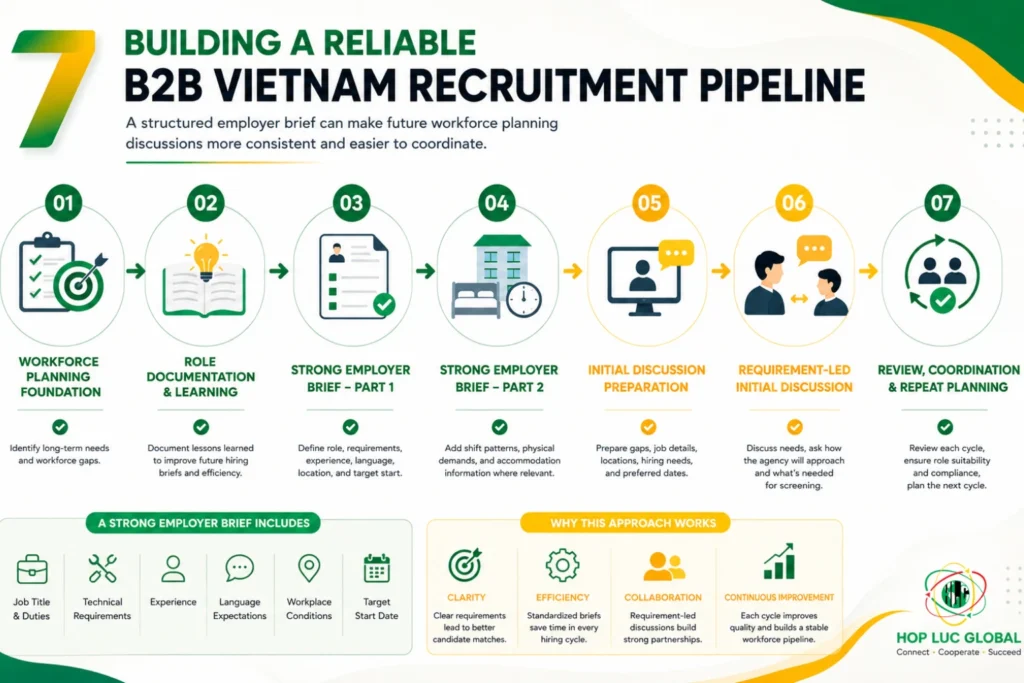
A reliable Vietnam recruitment pipeline develops when employers treat overseas sourcing as a repeatable workforce-planning process. Documenting recurring roles and standardizing briefs can make future cycles more efficient.
From One Hiring Requirement to Repeat Workforce Planning
The first engagement often reveals what information should have been prepared in advance. After one cycle, employers can document recurring roles and standardize future briefs.
A Vietnam B2B recruitment service works best when treated as an ongoing relationship. Clear communication supports smoother review and coordination. Each cycle remains subject to role suitability and destination-country requirements.
What a Strong Employer-Side Recruitment Brief Should Contain
A strong brief should include job title, duties, technical requirements, experience, language expectations, workplace conditions, location, and target start date. Employers should identify non-negotiable requirements separately from trainable skills.
The brief should also include practical workplace information such as shift patterns, physical demands, and accommodation arrangements where relevant.
How to Prepare for an Initial Discussion With a Recruitment Partner
Before contacting a Vietnam human resource agency, employers should prepare workforce gaps, job descriptions, target locations, approximate hiring needs, and preferred start dates.
An initial discussion should be requirement-led rather than sales-driven. Employers should ask how the agency would approach their roles and what information is needed for screening.
How Hop Luc Global Supports European Employers With Vietnam Recruitment
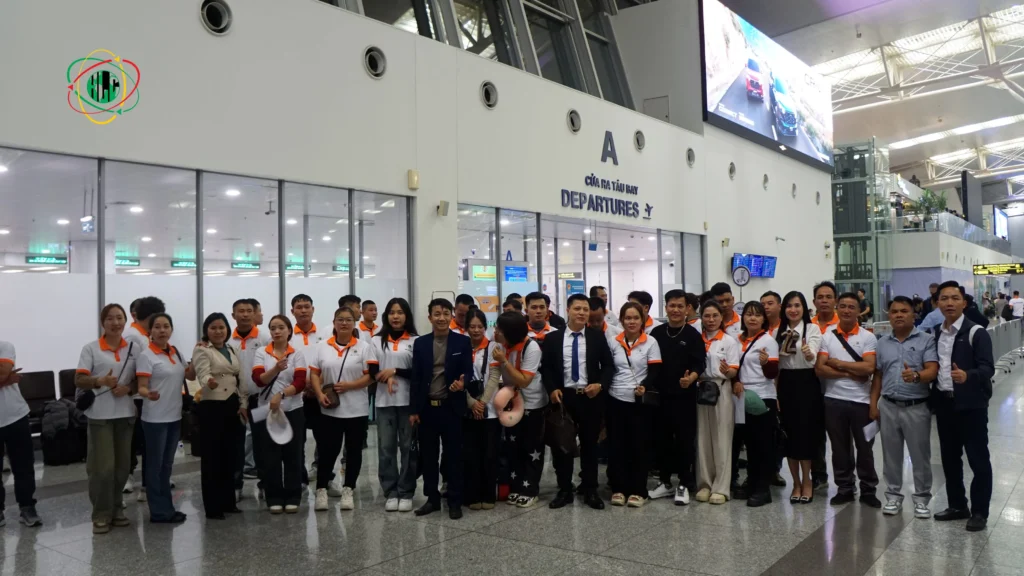
Hop Luc Global is a Vietnam-based manpower supply agency serving European employers and recruitment partners. Its approach to Vietnam recruitment is practical and requirement-led.
A Vietnam-Based Partner for European Workforce Requirements
Hop Luc Global operates as a Vietnam-based partner for European workforce requirements. Its legal name is Hop Luc Global Joint Stock Company, and its verified profile identifies target markets including Lithuania, Latvia, Greece, Croatia, Finland, Estonia, Romania, Bulgaria, Poland, Hungary, and wider Schengen markets.
A Vietnam-based partner can coordinate employer requirements with Vietnam-side recruitment activities. This coordination does not replace employer responsibilities or authority decisions. Employers can also review Hop Luc Global’s company background before starting a recruitment discussion.
A Requirement-Led Approach to Candidate Coordination
Hop Luc Global’s approach centers on clear employer requirements, candidate matching, communication, and documentation coordination. The agency supports the process by helping employers define role criteria and review candidate information.
As a Vietnam staffing agency and Vietnam human resource agency, Hop Luc Global can explain what information is needed to assess candidates. It does not claim to control approval decisions or guarantee outcomes.
How Employers Can Start a Practical Recruitment Discussion
Employers can start by preparing their role list and target start date. Sharing this information allows Hop Luc Global to assess the requirement and identify next steps.
Suitability and subsequent steps remain subject to candidate assessment and destination-country requirements. Employers should use the official Contact Page to begin.
Frequently Asked Questions About Vietnam Recruitment
What does Vietnam recruitment mean for a European employer?
Vietnam recruitment is a structured B2B workforce-sourcing process connecting employer requirements with suitable Vietnamese candidates. It includes requirement collection, sourcing, screening, communication, documentation coordination, and preparation. It does not replace destination-country hiring or work authorization decisions.
Ethical recruitment should also be considered as part of the employer’s workforce-sourcing framework. Employers and recruitment partners can review relevant guidance from the International Labour Organization (ILO) when assessing fair recruitment and worker-protection practices.
Which types of European employers can consider recruiting manpower from Vietnam?
Employers with suitable technical, industrial, construction, hospitality, agricultural, healthcare, caregiver, or other defined requirements may evaluate Vietnam as one option. Suitability depends on role requirements, candidate qualifications, and destination-country rules.
How should an employer evaluate a Vietnam recruitment agency?
Check company information, requirement handling, candidate screening, communication, documentation coordination, country-specific awareness, and transparency. Unsupported promises should be treated with caution.
What information should an EU employer provide before starting Vietnam recruitment?
Prepare a role list, job duties, qualifications, experience requirements, workplace conditions, target location, and target start date.
Can Vietnam recruitment cover different European countries?
Hop Luc Global’s verified target markets include Lithuania, Latvia, Greece, Croatia, Finland, Estonia, Romania, Bulgaria, Poland, Hungary, and wider Schengen markets. Requirements vary by destination.
How long does the Vietnam recruitment process take?
Timelines depend on employer requirements, candidate suitability, documentation, authority review, and destination-country procedures. A fixed promise should not be expected.
How can a European employer start a discussion with Hop Luc Global?
Prepare and share your role list and target start date, then contact Hop Luc Global to discuss your workforce requirements.
Ready to secure your technical workforce?
- Transparent compliance checks
- End-to-end documentation support
- Pre-screened Vietnamese talent
or email directly at contact@hoplucglobal.com
For additional company information, you can also review Hop Luc Global’s company background.