European employers facing persistent skilled labour shortages are increasingly exploring Vietnam skilled labour as a strategic workforce solution. For manufacturing, construction, logistics, and technical industries, the search for reliable talent has moved beyond domestic markets. This practical guide examines how structured international recruitment from Vietnam can help European companies build stable, long-term workforce pipelines while maintaining compliance with destination-country requirements.
For many manufacturers, construction firms, logistics operators, and industrial employers, Vietnam skilled labour has become an important consideration when building long-term workforce pipelines. Rather than focusing only on recruitment costs, employers increasingly evaluate workforce availability, role suitability, documentation coordination, and structured recruitment processes.
European Skilled Labour Shortages: A Persistent Challenge
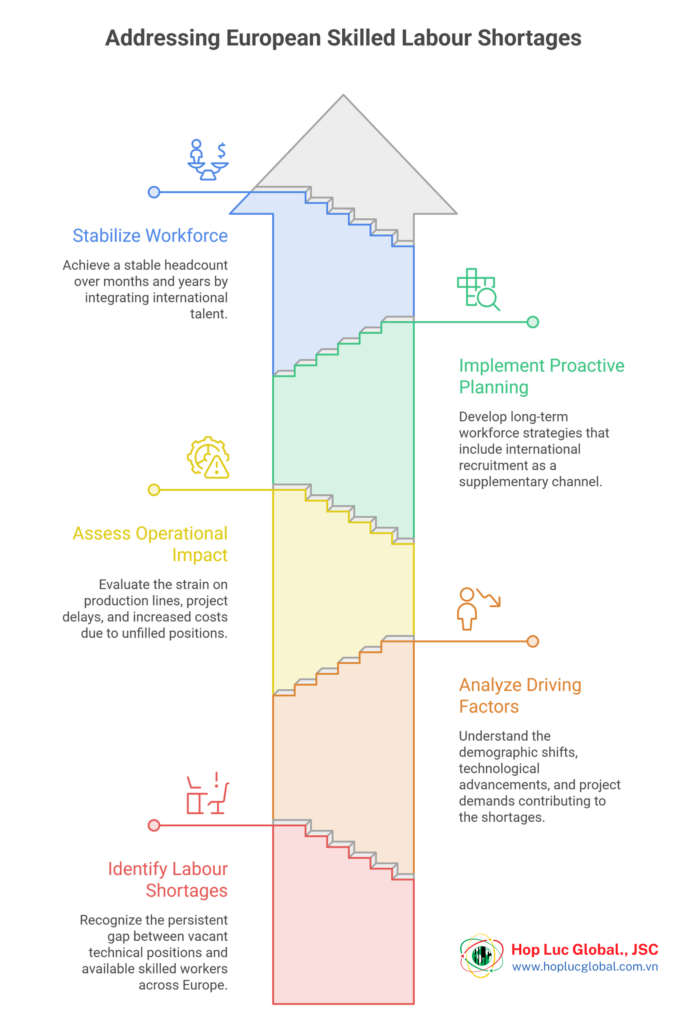
Across Europe, the gap between vacant technical positions and available skilled workers continues to widen. Data from Eurostat and the European employment services network EURES consistently show high job vacancy rates in manufacturing, construction, logistics, and engineering. For HR directors, plant managers, and project leaders, this isn’t a temporary cycle—it’s a structural challenge demanding long-term workforce planning.
European employers can review the latest labour market indicators and skills shortage statistics published by Eurostat before making workforce planning decisions.
Key Factors Driving Labour Shortages in Manufacturing and Construction
Several forces are compounding the problem. Demographic shifts have reduced the working-age population in many EU member states, while the rapid adoption of automation and digital technologies creates new skills gaps faster than local training systems can fill them. At the same time, major infrastructure and green transition projects are accelerating demand for construction tradespeople, welders, electricians, and mechanical technicians. Limited vocational training pipelines in some countries further restrict the availability of young, production-ready workers. In this environment, European employers are increasingly complementing local recruitment with structured international sourcing—one option being Vietnam skilled labour.
Impact on Business Operations and Workforce Planning
Unfilled positions translate directly into operational strain. Production lines slow down, project milestones shift, and overtime costs climb, increasing pressure on existing teams and raising attrition risks. Many companies find that reactive, last-minute hiring cannot keep pace with project demands. A growing number of employers are therefore adopting proactive workforce planning that includes international recruitment as a continuity measure. This approach doesn’t replace local hiring; it adds a supplementary, dependable channel that can help stabilize headcount over months and years, rather than scrambling for short-term fixes.
Why Vietnam Skilled Labour Is Increasingly Considered by European Employers
Vietnam’s emergence as a sourcing market for skilled workers is grounded in practical workforce attributes, not hype. European companies exploring long-term manpower partnerships find a combination of demographic readiness, vocational training depth, and growing industrial experience that aligns well with their needs.
As labour shortages continue across several European industries, Vietnam skilled labour is increasingly evaluated as part of broader workforce planning strategies for manufacturing, infrastructure, engineering, logistics, and technical operations.
Young Workforce with Strong Vocational Foundations
Vietnam benefits from a relatively young population and a large pool of working-age individuals who have pursued technical career paths. Across the country, a network of vocational colleges and technical training centres produces graduates in mechanical engineering, electrical trades, welding, construction crafts, and industrial maintenance. These programmes emphasise hands-on practice, often in partnership with local and foreign-invested factories, giving trainees exposure to real production environments. While no training can fully replicate every destination country’s exact standards, the vocational base provides a solid starting point for role-based preparation tailored to employer requirements. This supply of trainable manpower is a key reason why many European recruiters now consider Vietnam skilled manpower supply as part of their workforce mix.
Practical Industrial Experience and Role Readiness
Beyond formal education, many Vietnamese candidates bring practical experience from domestic manufacturing hubs, shipbuilding yards, infrastructure projects, and Asian regional assignments. They have operated CNC machinery, performed structural welding, maintained production lines, and worked under international safety protocols. Reputable recruitment partners use trade tests and practical assessments to verify these skills, ensuring that candidates presented to European employers are not just paper-qualified but can demonstrate their capabilities. Suitability is always assessed on a case-by-case basis, and the goal is to match each role’s technical demands with candidates who have relevant, verifiable experience.
Compliance-Aware Recruitment Pathways
International recruitment involves navigating multiple regulatory frameworks. Professional manpower supply agencies follow a multi-step compliance-aware process: verifying candidate identities and credentials, conducting medical examinations, preparing documentation packages, and aligning with destination-country administrative requirements. Throughout, transparent communication keeps employers informed. It is crucial to understand that final work authorization decisions—whether work permits, visas, or other permissions—are made by destination-country authorities and are subject to their review. An ethical partner will never offer guarantees of approval or fixed timelines, but will instead focus on meticulous documentation coordination to minimise administrative risks.
Key Industries and Worker Categories Commonly Recruited from Vietnam
The versatility of Vietnam technical workers for Europe can be seen across multiple industries. While exact availability depends on current candidate pools and employer specifications, the following categories illustrate typical recruitment demand.
Different industries require different workforce profiles, making it important to match Vietnam skilled labour with specific operational requirements rather than applying one recruitment approach across every project.
Manufacturing and Light Industrial Roles
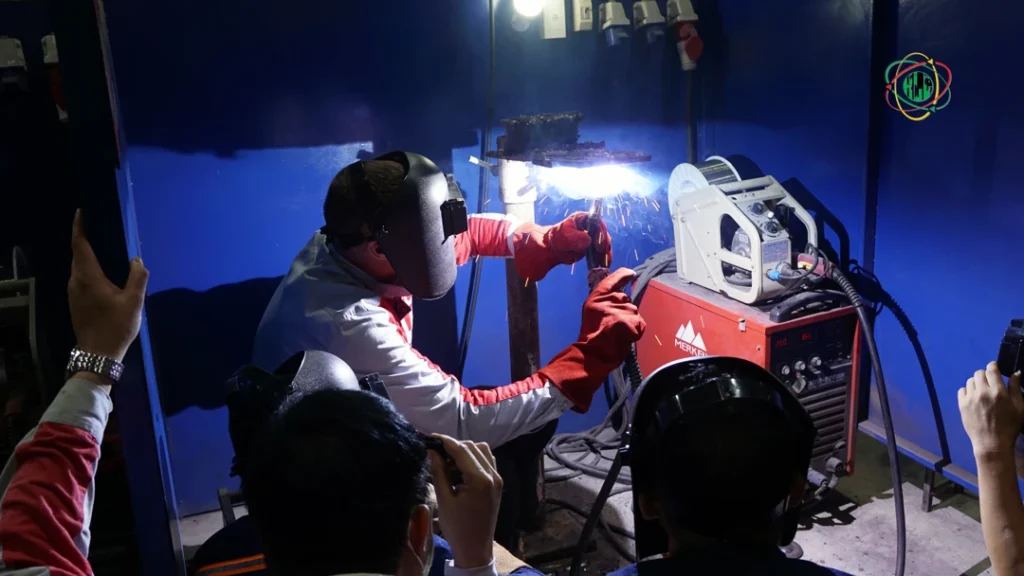
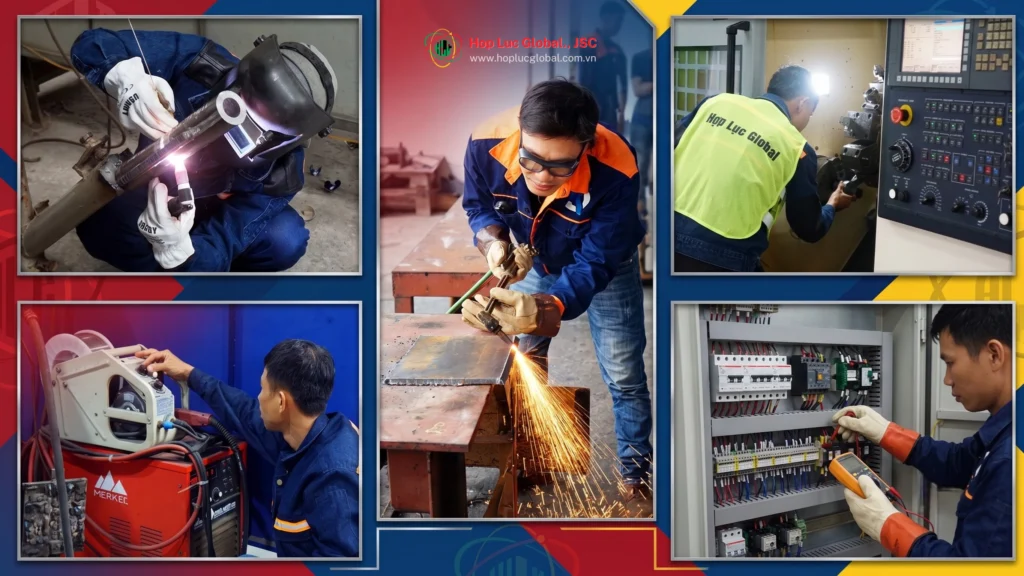
European factories frequently seek skilled welders (MIG/MAG, TIG, arc), CNC machine operators, metal fabricators, and assembly line technicians. Vietnamese candidates often bring experience from high-volume production settings, including electronics, automotive components, and heavy machinery. Additional roles include quality control inspectors and industrial machine maintenance staff.
Construction and Infrastructure Trades
For large-scale building, civil engineering, and energy projects, recruiters commonly hire formwork carpenters, steel fixers, masons, and general construction operatives. Equipment operators and pipefitters are also in demand. It is important to note that destination-country-specific certification or licensing may be required, and employers should verify whether additional on-site assessment or supplementary training will be needed after arrival.
Logistics, Warehousing, and Technical Support
With e-commerce and supply chain expansion, many European operations look for forklift operators, warehouse pickers/packers, logistics coordinators, and maintenance technicians. Vietnamese workers familiar with lean manufacturing, 5S principles, and inventory management systems can integrate more quickly into established logistics workflows.
Engineering and Maintenance Technicians
Junior mechanical and electrical engineers, maintenance planners, and reliability technicians with vocational diplomas form another valuable segment. They often support automation upgrades, plant maintenance, and equipment reliability programmes. While not a substitute for senior engineers, these technicians can fill critical mid-level technical gaps.
How to Evaluate a Vietnam Manpower Supply Partner
Choosing the right recruitment partner is as important as selecting the right workers. A systematic evaluation framework helps European employers separate professional agencies from opportunistic intermediaries and reduce long-term hiring risk.
Essential Criteria for Selecting a Reliable Supply Partner
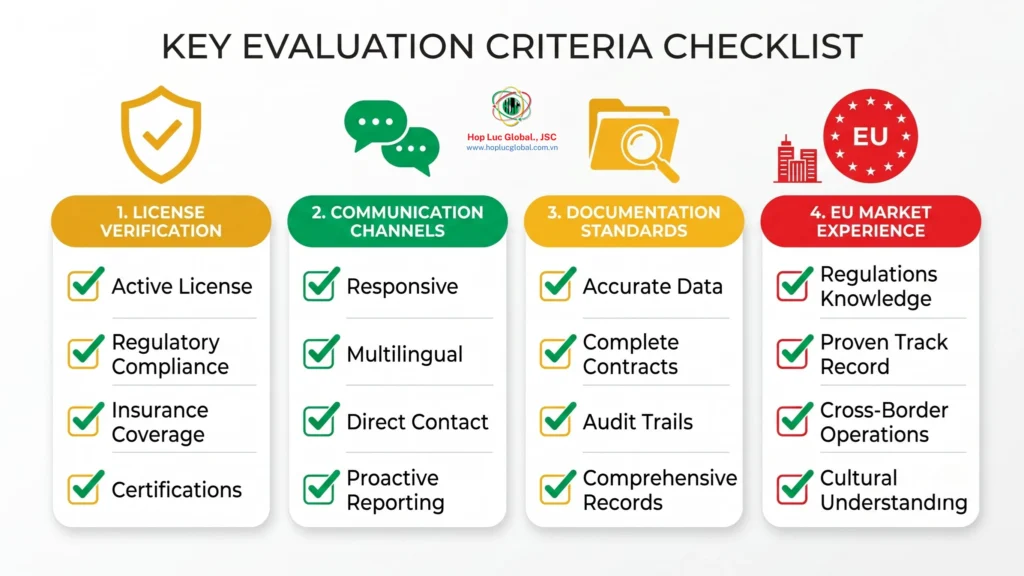
Start by verifying the agency’s legal standing in Vietnam. A valid manpower supply license—such as Hop Luc Global’s license 67/LĐTBXH-GP, issued by the Vietnamese authorities—is a baseline requirement. Beyond licensing, examine the agency’s transparency in communication: do they clearly explain their fees, candidate sourcing methods, and the recruitment process without resorting to vague promises? Look for demonstrable experience serving European employers and a genuine understanding that destination-country work authorization requirements vary and must be checked with the relevant authority. Strong partners will also demonstrate robust documentation coordination capabilities, from candidate dossier preparation to submission tracking.
Red Flags to Avoid During Supplier Evaluation
Be cautious of agencies that guarantee visa outcomes, work permits, or fixed deployment timelines. Such promises are unrealistic and often signal deeper compliance problems. Other warning signs include a lack of clarity about how candidates are sourced and screened, reluctance to share references from previous European clients, hidden fees buried in contracts, and poor communication during initial discussions. A professional partner will never shy away from explaining risks or setting realistic expectations.
Questions to Ask During Initial Partner Discussions
To assess a potential partner effectively, prepare a set of direct questions. Can you outline your recruitment and candidate preparation process step by step? How do you ensure role suitability and technical capability matching? What documentation support do you provide, and what factors influence the overall timeline? How do you handle changes in destination-country requirements or application delays? Can you describe your communication and reporting approach during the recruitment cycle? The clarity and honesty of the answers will reveal much about the agency’s operational maturity.
Structured Recruitment Process: From Candidate Preparation to Documentation Coordination
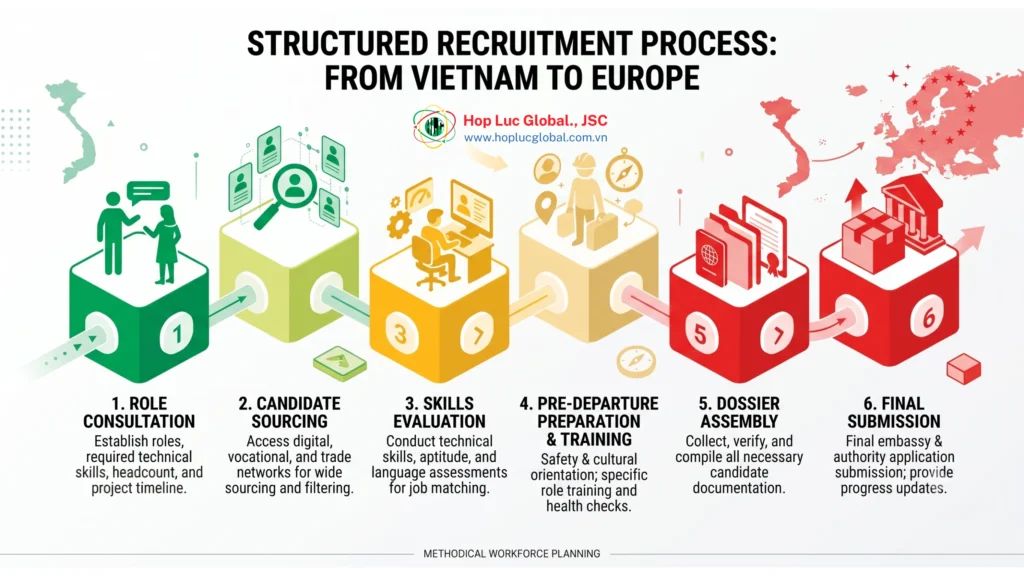
A well-defined recruitment process removes uncertainty and builds trust. Although each project is unique, the typical structured pathway follows a logical sequence.
Role Definition and Candidate Sourcing
The process begins when the employer shares detailed job descriptions, required technical skills, headcount projections, and target start dates. The recruitment partner then sources candidates through vocational school networks, trade testing centres, and professional databases, conducting preliminary screening for technical aptitude, basic language ability, and willingness to work abroad. This early filtering ensures that only the most suitable profiles advance.
Pre-Departure Orientation and Role-Based Preparation
Shortlisted candidates undergo practical skill assessments and, where necessary, targeted training modules to align with the employer’s equipment, processes, or quality standards. Pre-departure orientation covers workplace safety, cultural familiarisation, and basic destination-country work norms. Health screenings and document verification are completed at this stage. The entire preparation is role-based and tailored to the employer’s expectations; it does not claim to replicate every EU-specific certification, as such certifications often need to be obtained in-country. This preparation phase directly supports the value of Vietnam skilled labour for companies that need workers who are operationally ready and compliant-aware.
Documentation Coordination and Application Submission
Accurate documentation is critical. The supply partner compiles and verifies each candidate’s dossier—passports, qualifications, work certificates, health reports—and prepares the package according to the destination country’s specific embassy or authority requirements. Throughout, the employer receives transparent tracking and regular updates on submission progress. However, final approval of any work authorization or entry permission rests solely with the destination country’s authorities, and the recruitment partner’s role is to facilitate a complete, error-free submission.
Practical Timeline Considerations for European Employers
The overall process duration varies with role complexity, document readiness, and authority processing times—factors that no agency can control. Employers should view the timeline in phases: role consultation, sourcing and screening, skills verification, document processing, and authority review. Early engagement and clearly communicated target start dates enable the recruitment partner to plan backward and align activities with project schedules. This is not a quick-fix solution, but a methodical workforce planning exercise.
Workforce Planning and Employer Best Practices
Integrating international recruitment into overall workforce planning requires more than selecting a partner; it demands internal alignment and proactive risk management.
For broader labour market analysis and long-term workforce planning trends, employers may consult the OECD Employment and Labour resources .
Aligning Recruitment Timelines with Project Milestones
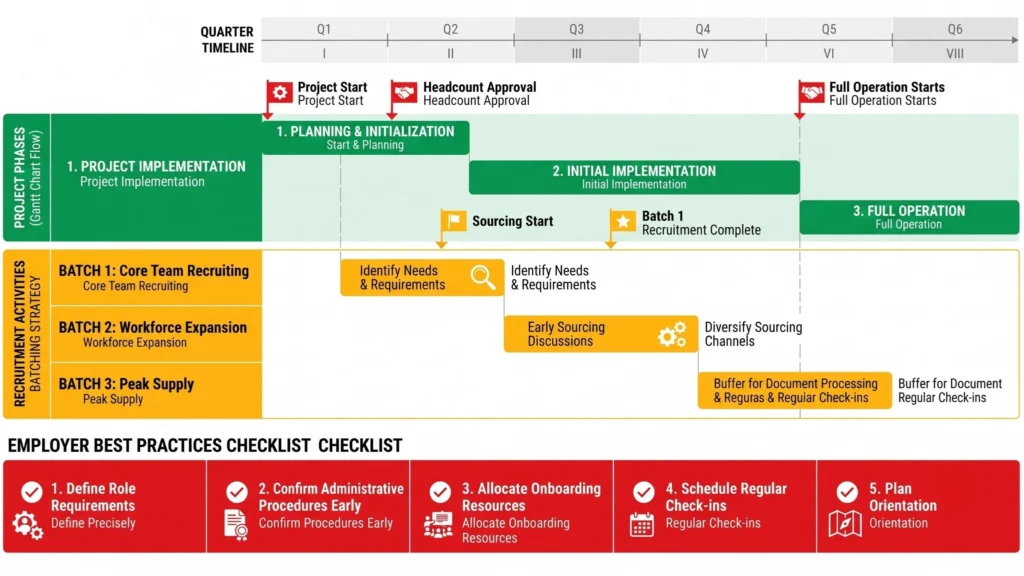
Map headcount forecasts directly to project phases. Define lead times for each recruitment batch, and initiate sourcing discussions well before peak demand periods. Flexible workforce plans that can accommodate changing project scopes or market conditions are essential. By treating international hiring as a strategic programme rather than a series of emergency orders, employers can better align Vietnam skilled labour supply for EU operations with business goals.
Risk Mitigation Through Proactive Workforce Planning
Diversify sourcing channels to avoid over-reliance on any single market. Establish clear internal communication between HR, operations, and project management so that recruitment partners receive consistent specifications. Build a buffer into timelines to account for documentation processing variability, and schedule regular performance reviews to refine candidate selection. International recruitment carries inherent uncertainties, but structured planning transforms these from unpredictable disruptions into manageable variables.
Employer Checklist for Successful International Hiring
- Define precise job specifications and realistic headcount targets.
- Confirm any destination-country-specific administrative procedures or requirements early, consulting with the appropriate authority.
- Allocate internal resources for onboarding support, including supervision, housing, and language assistance.
- Schedule regular check-ins with the recruitment partner during sourcing, documentation, and post-arrival integration.
- Plan for cultural orientation to support worker retention and team cohesion.
Partnering with Hop Luc Global for Long-Term Workforce Solutions
Hop Luc Global Joint Stock Company is a licensed Vietnam-based manpower supply agency focused on supporting European employers and recruitment partners. With license 67/LĐTBXH-GP, tax code 0110103022, and an office at Lot 01, TT6 – 2B, Thi Cam Street, Xuan Phuong Ward, Hanoi, Vietnam, the company operates with full legal compliance. Its target business markets include Lithuania, Latvia, Greece, Croatia, Finland, Estonia, Romania, Bulgaria, Poland, Hungary, and other Schengen countries. Visit the Hop Luc Global homepage or learn more about Hop Luc Global to understand the company’s approach.
Who We Are and How We Work
Hop Luc Global’s structured recruitment model is built on transparency, role-based candidate preparation, and thorough documentation coordination. Every engagement begins with a deep understanding of the employer’s technical requirements, project timeline, and workforce planning objectives. The company does not promise unattainable outcomes; instead, it offers a clear, compliance-aware process that respects the authority of destination-country institutions. By focusing on early communication and realistic planning, Hop Luc Global helps European employers move from uncertainty to an actionable workforce strategy.
Taking the Next Step with Hop Luc Global
European employers are encouraged to share role requirements and target start dates early—not as a commitment, but as a starting point for a structured discussion. The initial conversation focuses on understanding project needs, assessing feasibility, and outlining a sourcing roadmap. Throughout the recruitment cycle, Hop Luc Global maintains regular progress updates and transparent communication, ensuring that the employer remains informed and in control.
Frequently Asked Questions
What makes Vietnam a reliable source of skilled labour for European employers?
Vietnam offers a young workforce with strong vocational training, practical industrial experience in manufacturing and construction, and a growing track record of supplying workers through structured recruitment pathways. Reliability comes from methodical candidate preparation and transparent processes, not from exaggerated claims.
How does Hop Luc Global prepare candidates for roles in Europe?
Candidates undergo skills assessments, role-based training aligned with employer needs, pre-departure orientation covering safety and work culture, health checks, and document verification. Final work authorization remains subject to approval by destination-country authorities.
Can Hop Luc Global guarantee visa approval or deployment timelines?
No. Hop Luc Global follows a rigorous documentation coordination process, but decisions on work permits, visas, and entry permissions are made exclusively by destination-country authorities. Timelines are indicative only and cannot be guaranteed.
Which industries commonly recruit Vietnamese skilled workers?
Manufacturing (welders, CNC operators), construction (carpenters, steel fixers), logistics (forklift operators, warehouse staff), and technical maintenance (electricians, mechanics) are the most common sectors. Actual availability depends on employer specifications and current candidate pools.
How long does the typical recruitment process take from Vietnam to Europe?
Timelines vary widely based on role complexity, document readiness, and authority processing. Phases include consultation, sourcing, skills verification, document preparation, and submission review. Early planning is essential to align with project schedules.
What should employers look for when evaluating a Vietnam manpower supply agency?
Key criteria include a verified manpower supply license, transparent fee structures, demonstrated experience with European employers, robust documentation support, and honest communication that avoids unrealistic guarantees.
How can we start a workforce planning discussion with Hop Luc Global?
You can share your role list and target start date via the contact page or by emailing contact@hoplucglobal.com. The initial consultation is obligation-free and focuses on understanding your workforce needs.
Successful workforce planning begins long before recruitment starts. Companies that integrate Vietnam skilled labour into their long-term staffing strategy are generally better positioned to respond to changing production requirements and labour market conditions.
Ready to secure your technical workforce?
- Transparent compliance checks and documentation coordination
- Role-based candidate preparation tailored to your requirements
- Pre-screened Vietnamese talent ready for EU employer needs
or email directly at contact@hoplucglobal.com
Phone: (+84)24.6328.4768
Office: Lot 01, TT6 – 2B, Thi Cam Street, Xuan Phuong Ward, Hanoi, Vietnam