For EU employers, manpower export to Europe begins with workforce planning rather than a candidate shortlist. European employers facing persistent recruitment gaps often consider international hiring to protect production schedules, maintain service capacity, and support upcoming projects. Yet manpower export to Europe involves more than finding candidates with relevant experience. Employers must coordinate recruitment with national employment rules, immigration documentation, and realistic workforce planning.
In manpower export to Europe, a poorly defined hiring plan can create problems long before workers arrive. Missing job information, unclear responsibilities, or late document checks may interrupt recruitment and increase operational costs.
Vietnam offers an additional source of technical and general workers for European businesses. Through structured recruitment coordination, Hop Luc Global helps employers establish candidate requirements, assess suitability, and prepare for the relevant administrative stages. This practical approach forms part of the broader Vietnam manpower export model, which connects employer demand with organized international recruitment.
Manpower Export to Europe: Key Takeaways
- European employers should assess destination-country employment and immigration requirements before committing to an international recruitment schedule.
- Candidate suitability depends on job-specific skills, working conditions, language expectations, and practical assessment results.
- Recruitment planning must distinguish employer responsibilities, Vietnamese recruitment coordination, and decisions reserved for public authorities.
- Early documentation review and realistic onboarding preparation can reduce avoidable disruption without guaranteeing a deployment date.
Manpower Export to Europe and European Labor Shortages
To evaluate manpower export to Europe, employers should first identify how labor availability affects daily operations across European industries. The Eurostat job vacancy statistics provide an official reference for assessing unmet labor demand across European markets. Manufacturing plants need dependable staffing for production shifts. Construction contractors must coordinate workers with project phases, while hospitality businesses face concentrated recruitment needs during busy periods.
These situations share a common challenge: an employer may need additional personnel before local recruitment produces enough suitable candidates.

Why Recruitment Gaps Affect Business Continuity
An unfilled position can influence several connected activities. A missing machine operator may reduce production flexibility. Insufficient construction personnel can complicate subcontractor scheduling. In hospitality, limited staffing may place extra pressure on existing teams during peak occupancy.
Before planning manpower export to Europe, employers need to understand which vacancies directly affect operational capacity.
On paper, recruitment begins with a vacancy announcement and a candidate shortlist. In practice, employers may discover that job descriptions lack the technical detail needed for meaningful international screening. Correcting these gaps early can save time during later interviews.
Where Vietnamese Workers Fit into Manpower Export to Europe Planning
Within manpower export to Europe, Vietnamese workers can be considered for manufacturing, construction, mechanical trades, food processing, logistics, and hospitality positions, subject to individual qualifications and destination-country rules.
Vietnam workers for European employers are most useful when recruitment starts with a defined role rather than a broad request for available personnel.
An employer should specify actual duties, required experience, working conditions, and the intended start period. These details help recruitment teams distinguish essential skills from abilities that candidates may develop through preparation.
The wider question is not simply whether candidates are available. It is whether they match the work.
Technical Skills Assessment for Manpower Export to Europe
Manpower export to Europe requires evidence of candidate suitability. Job titles alone rarely provide enough information to determine whether an applicant can perform safely and effectively in a particular workplace.
For European employers, the assessment method should reflect actual responsibilities.
Manufacturing, Construction, and Mechanical Trades
Manufacturing employers may need personnel with experience in production environments, machine operation, assembly, or quality-related tasks. Construction projects can require different competencies depending on the trade, equipment, and working environment.
Mechanical roles deserve particularly careful screening.
For example, a welding candidate’s experience should be evaluated against the employer’s required welding process, position, materials, and assessment criteria. Previous employment does not automatically establish competence against a particular technical specification.
In manpower export to Europe, practical testing, when requested, helps employers compare demonstrated performance with the written job requirements.
General Workforce Roles and Language Expectations
Other positions may place greater emphasis on reliability, physical job requirements, teamwork, or familiarity with routine operating procedures.
Hospitality recruitment provides a useful example. Housekeeping, food and beverage service, and maintenance involve different levels of customer interaction and technical responsibility.
Language expectations also vary. A customer-facing position may demand stronger spoken communication than a role involving clearly demonstrated production tasks.
Consequently, manpower export to Europe and Vietnam labour supply to Europe should follow position-specific selection criteria. Employers should identify which requirements are mandatory before selection and which can reasonably form part of pre-departure preparation.
Manpower Export to Europe: Country-by-Country Regulatory Factors
For manpower export to Europe, employers operate within different national employment and immigration systems. Shared European frameworks do not mean that every country follows an identical procedure when recruiting workers from outside the European Union.
This distinction is central to manpower export to Europe.

Central and Eastern European Recruitment Considerations
Markets such as Lithuania, Latvia, Estonia, Poland, Hungary, Romania, and Bulgaria require employers to consider their own national rules before organizing recruitment abroad. The EURES labor shortages and surpluses report can inform occupation-level planning, but it does not replace national permit and immigration checks.
A useful preliminary review covers:
- Whether the intended employment arrangement is permitted.
- Which party must submit each application or supporting document.
- What employer and candidate evidence the authorities require.
- Whether the proposed employment conditions satisfy applicable rules.
These questions help define the recruitment plan without assuming that one country’s process will work elsewhere.
An employer familiar with recruitment in one destination should not automatically transfer its documentation checklist to another. Requirements vary by destination country and should be checked with the relevant authority.
Southern and Northern European Market Differences
Greece and Croatia may present opportunities connected to hospitality, food-related activities, and other employer needs. Finland and the Baltic markets may involve different industrial or service-sector recruitment priorities.
Industry demand alone does not establish immigration eligibility.
An employer considering Vietnamese recruitment must first identify the intended job, employment arrangement, location, and responsible contracting parties. Only then can the relevant national requirements be reviewed.
The same principle applies when a recruitment partner operates across several European markets. Each destination needs its own compliance assessment before manpower export to Europe proceeds.
Compliance with Destination Country Requirements
International recruitment involves administrative responsibilities on both sides of the employment relationship.
Employers may need to establish the legal basis for hiring a third-country national and prepare company-related documentation. Vietnamese recruitment partners may coordinate candidate records and other agreed recruitment activities.
Candidates must also provide accurate personal and qualification documents.
In practice, these workstreams rarely advance at identical speeds. Employers should allow reasonable scheduling flexibility while each responsible party completes its tasks.
The competent authorities retain control over applicable permit and visa decisions. A complete file supports review but does not guarantee approval.
Candidate Assessment and Orientation for Manpower Export to Europe
Candidate preparation for manpower export to Europe should connect recruitment decisions with the conditions workers will encounter after arrival.
A technically suitable applicant may still need information about workplace rules, communication expectations, and the realities of living abroad.
Practical Screening and Employer-Led Assessment
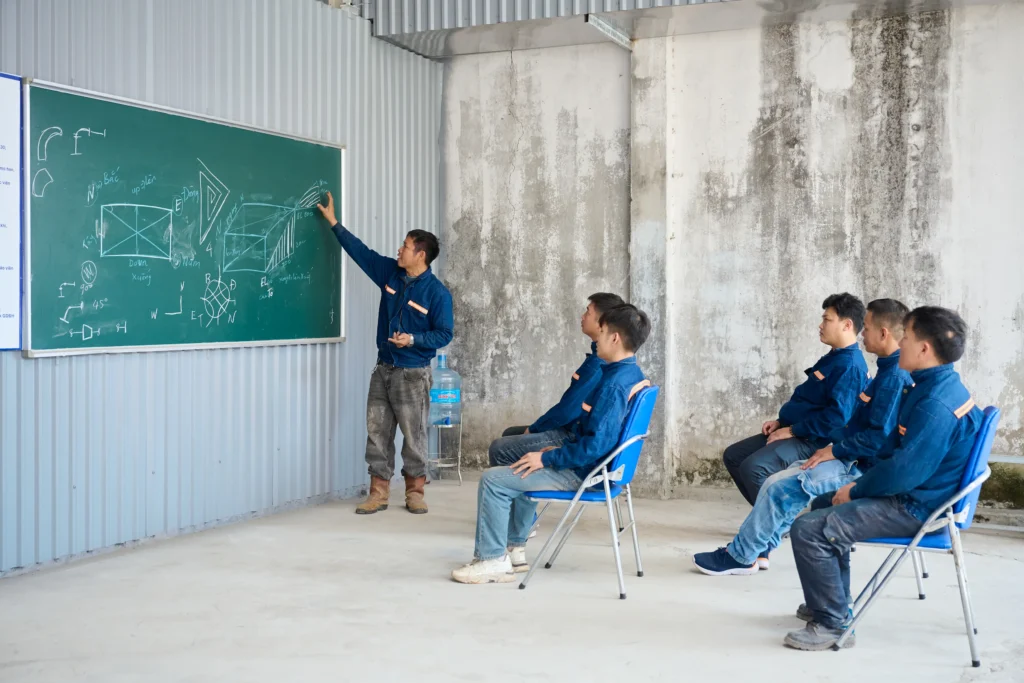
Vietnam recruitment for European companies works best when employers define assessment criteria before candidates enter the final selection stage.
A structured review may involve:
1. Confirming relevant work history and qualifications.
2. Checking the candidate’s understanding of the position.
3. Arranging interviews or practical tests where required.
4. Recording results against the employer’s stated criteria.
For technical occupations, employers may participate directly in trade assessments or review recorded evidence, depending on the agreed process.
Assessment arrangements should reflect the particular order. No single testing format establishes suitability for every destination or occupation.
Orientation Education Before Overseas Employment
Hop Luc Global operates an Orientation Education Facility in Noi Bai Commune, Hanoi City. The facility supports relevant preparation activities according to recruitment and project requirements.
Orientation may cover workplace conduct, cultural adaptation, communication expectations, and job-related safety awareness.
For manpower export to Europe, the curriculum should reflect the destination and occupation.
A hospitality employee may need preparation for service communication, while an industrial worker may require greater attention to site procedures and supervisor instructions.
On paper, pre-departure preparation appears to be a final administrative stage. In actual recruitment, employers benefit when important expectations are explained earlier, allowing candidates to make informed decisions before departure.
How Hop Luc Global Coordinates Manpower Export to Europe for EU Employers
Hop Luc Global supports international employers and recruitment partners through role-based sourcing and coordination of agreed recruitment activities.
For manpower export to Europe, the objective is to connect a clear employer brief with a practical candidate selection and preparation process.
Licensed Administrative Management and Legal Framework
According to the company’s supplied registration records, Hop Luc Global Joint Stock Company holds Enterprise Registration Certificate No. 0110103022 and License No. 67/BNV-GP for sending Vietnamese workers abroad under contracts.
These details form part of the due-diligence information employers should examine when assessing a recruitment partner. Current documents and their scope should be checked before a commercial agreement is finalized.
For manpower export to Europe, clear responsibility allocation is equally important.
Employers, recruitment partners, candidates, and relevant authorities have different roles. Contract terms should identify who prepares documents, coordinates applications, communicates updates, and manages agreed costs.
Operational Coordination from Selection to Departure
Manpower export to Europe begins with an employer’s written requirements and a clearly agreed recruitment scope.
Hop Luc Global can coordinate candidate sourcing, preliminary screening, interviews, and project-specific preparation within the agreed service scope.
Where required, technical assessments and orientation activities can support the employer’s evaluation before departure.
The recruitment schedule should reflect candidate readiness alongside destination-country administrative requirements.
International recruitment from Vietnam also requires ongoing communication between the recruitment team and the European employer. When job conditions change, both parties should review whether the candidate requirements or supporting documents need adjustment.
After arrival, any continuing coordination should follow the applicable contract and project arrangements.
Frequently Asked Questions Regarding Manpower Export to Europe
What should employers prepare before contacting a Vietnamese recruitment partner?
Employers should prepare a written recruitment brief covering job duties, headcount, required experience, workplace location, employment conditions, language expectations, and the intended start period.
Why do European recruitment schedules vary between countries?
National immigration requirements, employer documentation, application procedures, and authority processing conditions differ. Candidate preparation and document readiness can also affect the overall schedule.
What makes a recruitment partnership easier to manage?
Clear requirements and written responsibilities matter most. Employers should establish assessment criteria, communication contacts, documentation duties, and the process for handling changes during recruitment.
Frequently Asked Questions
Which European countries can source workers from Vietnam through Hop Luc Global?
Hop Luc Global focuses on markets including Lithuania, Latvia, Greece, Croatia, Finland, Estonia, Romania, Bulgaria, Poland, and Hungary. Recruitment feasibility depends on the destination’s applicable requirements.
What is the expected timeframe for deploying Vietnamese workers to Europe?
1. Confirm the destination and job requirements.
2. Review applicable authorization procedures.
3. Build a schedule allowing for authority processing and possible delays.
How are candidates evaluated for technical roles like welding or machine operation?
1. Define the employer’s technical criteria.
2. Screen relevant candidate experience.
3. Arrange practical assessments where required.
4. Review results with the employer.
What legal licenses does Hop Luc Global hold for sending laborers abroad?
According to the supplied company records, Hop Luc Global holds Enterprise Registration Certificate No. 0110103022 and License No. 67/BNV-GP for sending Vietnamese workers abroad under contracts.
What pre-departure training do workers receive before travelling to Europe?
Preparation may include job orientation, workplace conduct, relevant safety topics, and language support. Content and duration depend on the destination and employer requirements.
How does Hop Luc Global ensure compliance with Vietnamese and EU labor laws?
Hop Luc Global coordinates recruitment and relevant documentation within its agreed responsibilities. Employers must also satisfy destination-country requirements, while competent authorities make the applicable approval decisions.
Share your role list and target start date
Hop Luc Global coordinates role-based recruitment, candidate screening, and agreed documentation support. Employers remain responsible for applicable destination-country requirements.