European manufacturers and construction firms keep facing the same pressure. Local hiring cannot fill enough qualified workers for technical, operational, and project-based roles. The business cost is direct: production slows, project timelines shift, and existing teams carry more load. A structured Vietnam B2B recruitment service offers another workforce channel. It connects employer-defined job requirements with role-based candidate sourcing, screening, and documentation coordination. This article examines why Vietnam matters for EU employers, which sectors benefit, and how Hop Luc Global supports practical manpower planning without unsupported promises. Readers comparing this topic may also benefit from the broader overview in our Vietnam recruitment guide.
EU Labor Shortages and Opportunities from Vietnam
European employers in manufacturing, construction, hospitality, and agriculture continue to face workforce pressure across recurring operational roles. Eurostat job vacancy statistics provide a useful reference for assessing unmet labour demand and labour-market conditions before employers consider additional sourcing channels. The problem is not always a lack of applications; it can also be a lack of candidates who meet the actual job specification. Overseas sourcing can help when roles are clearly defined.
Vietnam has become a relevant workforce market for European employers. The country has a young working population and growing experience in industrial and technical occupations. A Vietnam B2B recruitment service can support employers who need structured access to Vietnamese manpower for suitable roles. This is not a universal solution. It works best for employers with defined requirements.
On paper, Vietnam sourcing may look like a straightforward supply channel. In practice, it requires clear role definitions, employer participation, and destination-country compliance checks. Employers who treat it as a workforce planning exercise get better results than those who expect a quick fix.
Key Industries Benefiting from Vietnamese Talent
Several sectors can benefit from Vietnamese manpower when role requirements align. Construction and manufacturing often lead demand for workers with practical trade skills, site experience, and operational discipline. Technical roles in welding, machinery operation, and industrial maintenance are common examples.
Hospitality and food production also present opportunities. These roles often require customer-facing communication, physical endurance, and shift flexibility. Agriculture and food processing need workers who can handle seasonal demand and repeatable tasks. Healthcare and caregiving are more regulated sectors. Employers considering these roles must verify qualification requirements for the destination country.
The key is role specificity. A Vietnam B2B recruitment service should screen candidates against employer-defined criteria rather than sending broad candidate lists. Vietnamese workers are not automatically suitable for every European occupation. Essential requirements should be separated from trainable skills early in the process. Employers who choose to partner with a Vietnam labour agency often find that clearer briefs produce better candidate shortlists.
How a Vietnam B2B Recruitment Service Works
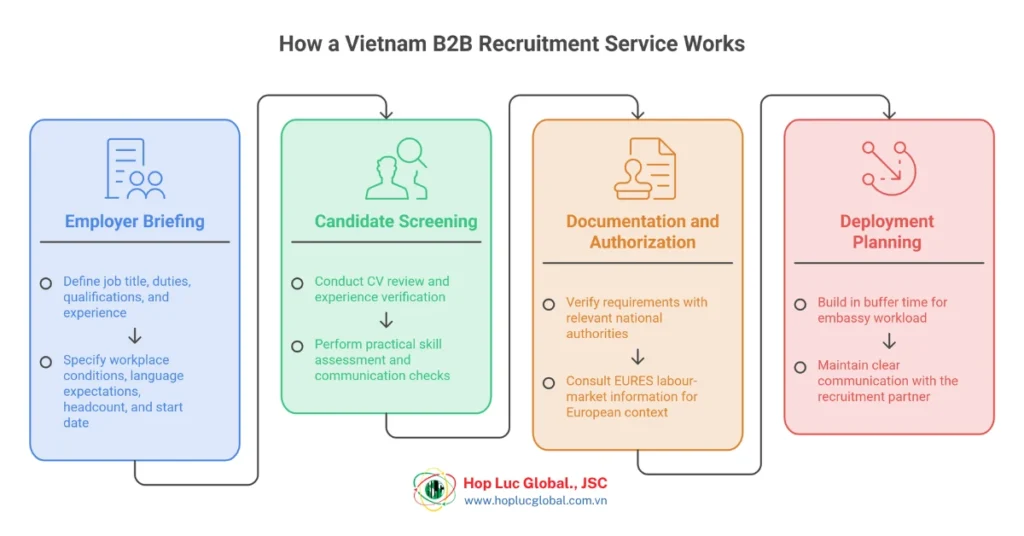
A Vietnam B2B recruitment service starts with a clear employer brief. Job title, duties, qualifications, experience, workplace conditions, language expectations, headcount, and target start date all shape sourcing. Without this clarity, candidate referrals become less accurate.
Screening follows the brief. It may include CV review, experience verification, practical skill assessment, and communication checks. Employer review remains essential before preparation advances. A Vietnam B2B recruitment service can coordinate these steps. It cannot replace employer due diligence.
Documentation and work authorization are separate from recruitment support. Requirements vary by destination country and should be checked with the relevant authority. Employers can also review EURES labour-market information for current European employment context, while country-specific work authorization requirements should be confirmed with the relevant national authority. No agency can guarantee approval outcomes for visas or work permits. Employers should plan around authority review rather than assuming a fixed deployment date.
On paper, the process looks linear. In practice, embassy workload, incomplete documents, and changing requirements can shift timelines. Employers should build in buffer time and maintain clear communication with the recruitment partner. When you work with a Vietnam recruitment partner, planning visibility matters more than fixed promises.
Choosing a Trusted Manpower Partner
Selecting a partner starts with company verification. Employers should check the legal name, website, operating location, and documented business profile. Hop Luc Global Joint Stock Company is a Vietnam-based manpower supply agency serving European employers and recruitment partners. Its verified profile lists license 67/LĐTBXH-GP, issued on 2023-10-26. Employers should confirm the current scope of any license with the company before relying on it for a specific activity.
When comparing a Vietnam B2B recruitment service, process transparency matters more than speed claims. Employers should ask how candidates are sourced and screened, how unsuitable referrals are handled, and how communication and documentation are coordinated. For broader fair-recruitment context, employers can review the ILO fair recruitment principles and guidelines. A credible partner should also explain where employer and authority responsibilities begin.
Employers should avoid partners that promise approval outcomes, fixed deployment dates, or guaranteed candidate availability. These claims are not within a recruitment agency’s control. Structured process quality is a better predictor of a useful B2B relationship.
Hop Luc Global’s EU-Focused Approach
Hop Luc Global works with European employers and recruitment partners from Vietnam. The company’s verified target markets include Lithuania, Latvia, Greece, Croatia, Finland, Estonia, Romania, Bulgaria, Poland, Hungary, and wider Schengen markets. These are business target markets. They are not proof that every recruitment activity is automatically available in each country.
Hop Luc Global takes a requirement-led approach. Employers share their role list, headcount needs, and target start date. The company coordinates Vietnam-side recruitment activities around that brief. Candidate suitability, communication, and documentation coordination remain central to the process.
Hop Luc Global does not control destination-country authority decisions. Employers must confirm current requirements with the relevant authority before committing to a recruitment pathway. The company supports the recruitment process without replacing employer responsibility.
Practical Considerations for Successful Integration
Successful integration starts before the first working day. Employers should plan role-based preparation, workplace orientation, and clear communication from the start. Vietnamese workers benefit when supervisors understand practical workplace expectations and safety procedures.
Language expectations should be realistic. Some roles may require baseline communication skills. Others may allow for trainable language development. Employers should identify what is mandatory for safety and what can be improved over time.
On paper, integration looks like onboarding paperwork. In practice, it is about daily communication, team fit, and operational clarity. Small gaps in these areas can reduce productivity faster than technical skill limitations. Employers who treat integration as an ongoing process, not a one-time checklist, get stronger results.
Frequently Asked Questions
What are the main benefits of a Vietnam B2B recruitment service for EU companies?
Vietnam overseas manpower provides an additional sourcing channel for defined technical, industrial, construction, hospitality, and agricultural roles. Employers gain access to a workforce pipeline that can be screened against specific job requirements rather than relying only on local applicants.
Which industries commonly benefit from Vietnamese workers?
- Manufacturing
- Construction
- Hospitality
- Agriculture
How does the recruitment process for vietnam overseas manpower typically work?
- Employer shares role list and requirements.
- Partner sources and screens candidates.
- Employer reviews suitable profiles.
- Documentation coordination proceeds after review.
What should employers consider when choosing a manpower agency?
- Verify legal name and website.
- Review screening methodology.
- Confirm communication process.
- Clarify responsibility boundaries.
How can companies prepare for successful worker integration?
Companies should plan role-based preparation, realistic language expectations, and clear supervisor communication before workers arrive. Integration works best as an ongoing operational process rather than a one-time checklist.
Are there important compliance factors to consider?
Yes. Destination-country work authorization requirements vary and should be checked with the relevant authority. Recruitment support cannot replace employer-side verification or authority decisions.
Assess your workforce needs
Send your headcount plan and role requirements to begin a requirement-led discussion.
Email: contact@hoplucglobal.com | Phone: (+84)24.6328.4768 | Website: https://hoplucglobal.com.vn/