European HR directors and operations managers often struggle to distinguish a genuine B2B recruitment partner from a supplier that only sends candidate lists. The cost shows up later: unsuitable referrals, unclear screening records, and documentation gaps that stall workforce planning. A structured vietnam recruitment agency can reduce that friction by connecting employer-defined job requirements with a transparent candidate assessment process. This article explains what to check before partnering, how candidate screening should work, and why Hop Luc Global supports EU employers through a requirement-led approach. Readers comparing this topic may also benefit from the broader overview in our Vietnam recruitment guide.
What a Vietnam Recruitment Agency Should Provide EU Employers
What a Vietnam Recruitment Agency Should Actually Provide
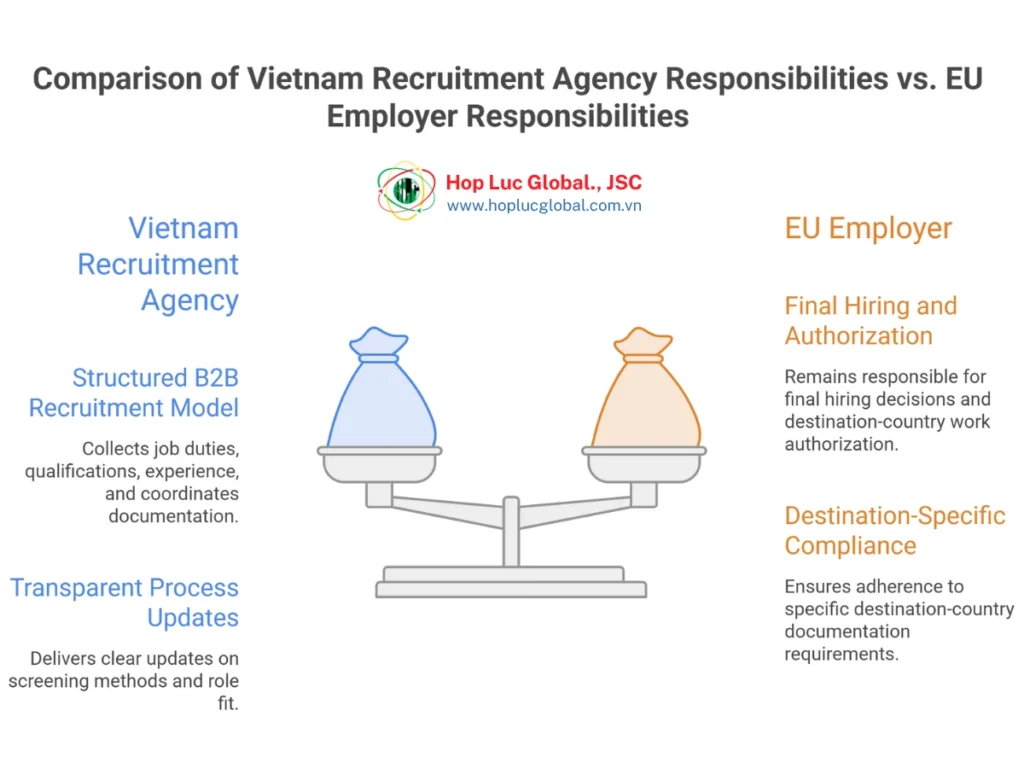
A professional vietnam recruitment agency should treat employer requirements as the starting point. That means collecting job duties, qualifications, experience, working conditions, language expectations, and target start date before sourcing begins. Candidate sourcing, screening, communication, documentation coordination, and preparation should follow from that brief. Recruitment support does not replace final hiring or destination-country work authorization, which remain with the employer and relevant authorities.
What Employers Should Expect in Communication and Documentation
Clear communication matters more than speed claims. Employers should expect structured updates on candidate profiles, screening methods, and role fit. A Vietnam employment agency for Europe should also coordinate documentation at a process level while making clear that exact requirements vary by destination. Employers should treat transparent communication as a sign of an organized partner rather than a marketing advantage.
Why European Employers Consider Recruitment from Vietnam
Workforce Gaps in Recurring and Project-Based Roles
Some European employers use Vietnamese manpower for recurring roles in manufacturing, construction, hospitality, agriculture, and technical services. Hiring difficulty in these areas can affect production, project schedules, and staffing continuity. A Vietnam staffing agency can provide an additional sourcing channel, but Vietnam is one option within workforce planning, not a guaranteed solution for every vacancy.
For current European labour-market context, employers can review Eurostat labour-market data and use the latest country-specific information when assessing workforce planning needs. Any statistics should be checked against the exact dataset and publication date before being cited.
Role Suitability and Employer-Defined Requirements
Suitability depends on job specifications. Employers should define qualifications, experience, practical skills, and workplace expectations before evaluating candidates. Vietnamese candidates are not automatically suitable for every European occupation. A Vietnam recruitment agency for EU employers should therefore ask detailed questions about role requirements instead of promising broad candidate availability.
How to Evaluate a Vietnam Recruitment Agency Before Partnering
What to Verify in Company Information and Operating Model
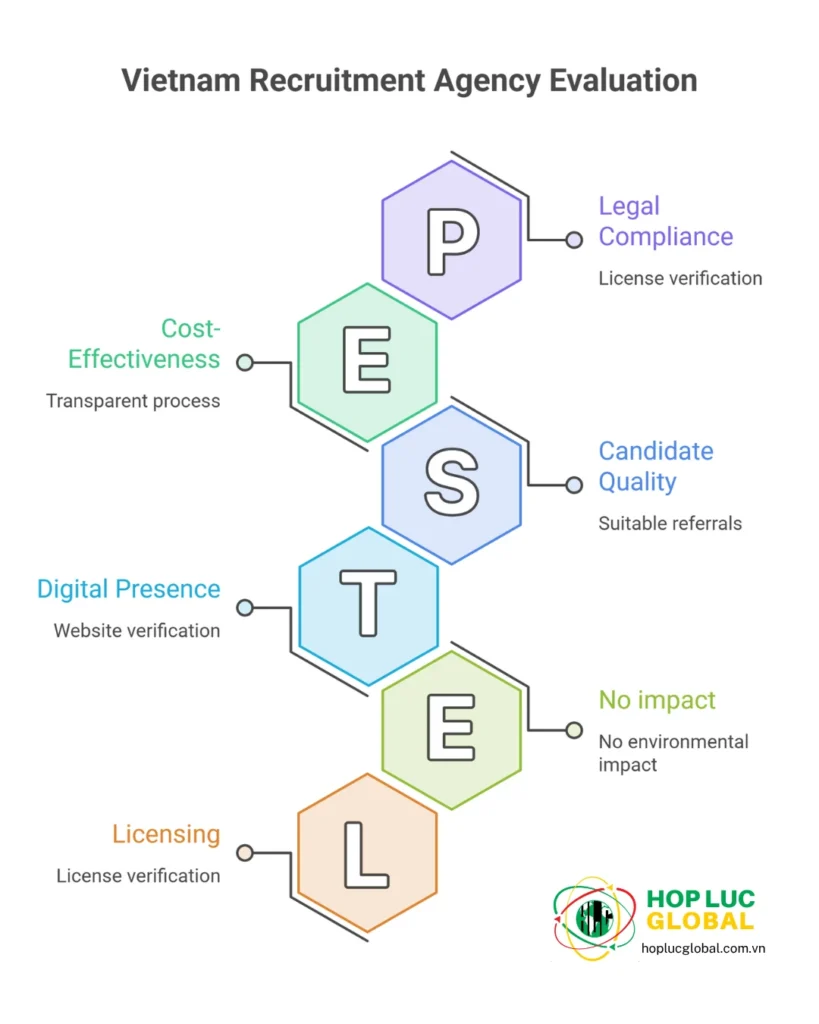
Employers should confirm legal name, operating location, website, and documented company profile before engagement. Hop Luc Global’s legal name is Hop Luc Global Joint Stock Company, a Vietnam-based manpower supply agency serving European employers and recruitment partners. Its verified profile lists license 67/LĐTBXH-GP, issued on 2023-10-26. Employers should confirm the current scope and wording of any license with the company before relying on it for a specific activity.
Process Transparency as a Core Selection Criterion
A transparent process is more useful than a list of promises. Employers should ask how requirements are collected, how candidates are screened, and how communication is documented. Unsupported claims about speed, volume, or outcomes should be treated with caution. A clear operating model helps employers compare partners and reduces the risk of unsuitable referrals.
What the Recruitment Process Should Look Like from Employer Brief to Candidate Preparation
Employer Brief, Role List, and Target Start Date
A structured process begins with a clear role list. Employers should prepare job title, duties, technical requirements, experience, language expectations, working conditions, location, and target start date. A target start date supports planning but does not create a guaranteed deployment date. A Vietnam recruitment consultant for EU employers can then use that brief to guide sourcing and screening.
Candidate Sourcing, Screening, and Documentation Coordination
Once the brief is clear, candidates should be sourced and screened against the defined criteria. The Vietnam recruitment agency should be able to explain how each screening stage relates to the employer’s role criteria. Employers should expect practical assessment for technical roles rather than CV review alone. Documentation coordination should be explained at a process level. Employer review remains essential at every stage before preparation begins.
How to Assess Candidates for Skills, Experience, Communication, and Workplace Fit
Technical Skills, Practical Experience, and Role Suitability
Technical and construction roles require practical skill assessment. Employers should evaluate experience with relevant equipment, processes, and site conditions. A Vietnam staffing agency should present candidates based on role criteria, not volume. No agency should claim that every Vietnamese worker meets every European skill requirement.
Communication, Language, and Workplace Adaptability
Communication and language expectations should be defined early. Employers should separate essential requirements from trainable skills. Workplace adaptability matters for shift patterns, team environments, and safety procedures. Role-based assessment gives a more accurate picture than a generic candidate profile.
Compliance, Documentation, Ethics, and Destination-Country Requirements
Documentation Coordination and Employer-Side Verification
A recruitment agency can coordinate documentation, but it does not control authority decisions. Employers must complete their own destination-country checks. Requirements vary by destination country and should be confirmed with the relevant authority. A responsible agency makes this division clear rather than implying approval is automatic.
For EU-level context, employers can also consult the European Commission and then verify the specific requirements that apply in the destination country. EU-level information should not be treated as a substitute for national procedures.
Ethical Recruitment and Transparent Communication
Ethical recruitment practices matter to EU employers. Transparent communication about worker welfare and recruitment steps builds trust. Employers should ask how candidates are prepared and how concerns are handled. Specific fee-policy claims should be confirmed separately with the company.
For broader international guidance, employers can review the ILO guidance on fair recruitment when assessing ethical recruitment practices. International guidance should be distinguished from destination-country legal requirements.
How Hop Luc Global Supports EU Employers in Vietnam Recruitment
A Vietnam-Based Manpower Supply Partner for European Workforce Needs
Hop Luc Global is a Vietnam-based manpower supply agency serving European employers and recruitment partners. Its verified target markets include Lithuania, Latvia, Greece, Croatia, Finland, Estonia, Romania, Bulgaria, Poland, Hungary, and wider Schengen markets. A Vietnam-based partner can coordinate employer requirements with Vietnam-side recruitment activities.
A Requirement-Led Approach to Candidate Coordination
Hop Luc Global focuses on role clarity, candidate matching, communication, and documentation coordination. The agency supports the recruitment process without replacing employer responsibilities or authority decisions. Employers should evaluate the company based on verified information and process quality rather than unsupported performance claims.
Questions to Ask Before Choosing a Vietnam Recruitment Partner
A Practical Partner-Selection Checklist
Employers should ask how requirements are collected, how screening works, how communication is managed, and where authority responsibilities begin. The answers reveal whether the agency operates as a structured partner or only as a candidate supplier. Employers should also ask how unsuitable referrals are handled. These questions help determine whether a vietnam recruitment agency is suitable for a long-term B2B recruitment relationship.
Preparing for a Requirement-Led Discussion
Before contacting a Vietnam employment agency for Europe, employers should prepare workforce gaps, job descriptions, target locations, approximate hiring needs, and preferred start dates. This information helps the agency assess whether Vietnam sourcing is suitable. The first discussion should focus on requirements, not general availability claims.
Frequently Asked Questions
What should EU employers expect from a Vietnam recruitment agency?
Employers should expect a structured B2B process covering requirement collection, sourcing, screening, communication, documentation coordination, and preparation.
How can employers verify a Vietnam recruitment agency before partnering?
Check legal name, website, operating model, license information, documented processes, and communication practices before engagement.
What information should an EU employer prepare before contacting a Vietnam recruitment agency?
Prepare a role list, job duties, qualifications, experience requirements, workplace conditions, target location, and target start date.
Can a Vietnam recruitment agency guarantee visa or work authorization approval?
No agency can guarantee approval. Recruitment support is separate from destination-country authority decisions.
Which European employers may consider Vietnam recruitment?
Employers with suitable technical, industrial, construction, hospitality, agricultural, healthcare, caregiver, or other defined roles may evaluate Vietnam as one sourcing option.
How does Hop Luc Global support EU employers?
Hop Luc Global is a Vietnam-based manpower supply agency supporting European employers through requirement-led candidate coordination and documentation support.
How long does the Vietnam recruitment process take?
Timelines depend on employer requirements, candidate suitability, documentation, authority review, and destination-country procedures.
Assess your workforce needs
Share your role list and target start date to begin a requirement-led recruitment discussion.
Email: contact@hoplucglobal.com | Phone: (+84)24.6328.4768