European employers across manufacturing, construction, and engineering sectors face a persistent challenge: finding enough qualified technicians and engineers to keep operations running. As local labour pools shrink and competition for talent intensifies, many are looking beyond the EU for sustainable workforce solutions. Vietnam technical manpower has emerged as a compelling option, offering a deep pool of skilled professionals, competitive cost structures, and a structured recruitment pathway. This comprehensive guide walks you through everything you need to know – from understanding the skills gap to selecting the right partner and ensuring long‑term success.
The European Technical Skills Gap: Why Employers Are Looking Beyond the EU
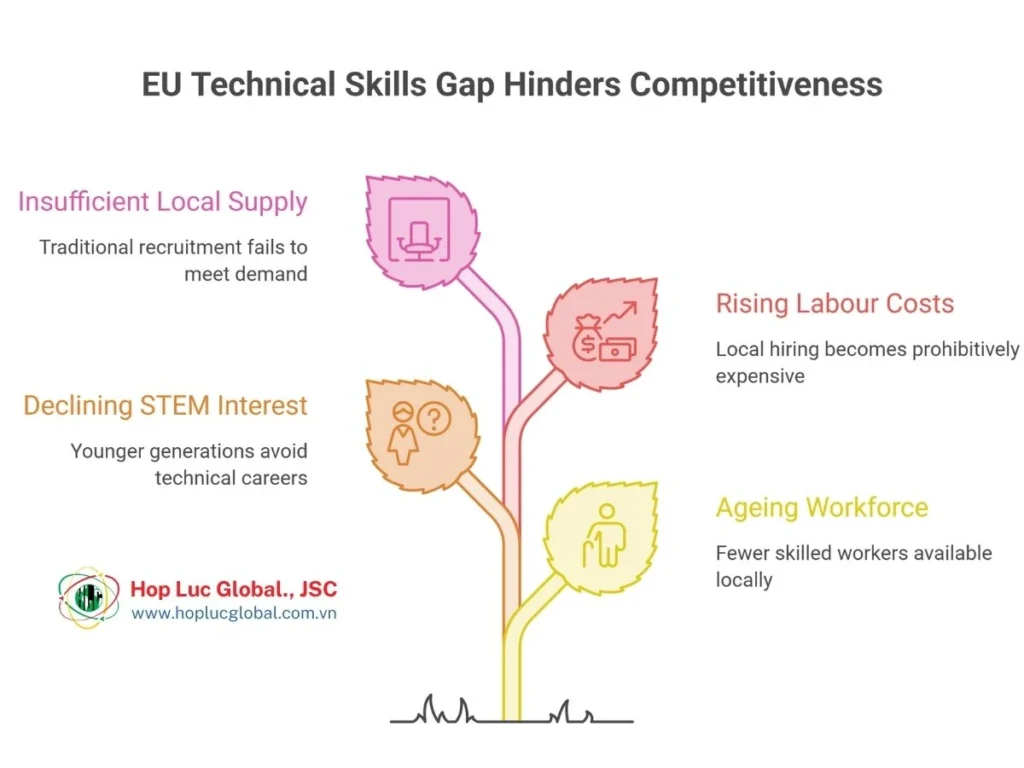
Current Labour Shortage Trends in Technical Roles
Across the EU, vacancies for mechanical fitters, electricians, welders, CNC operators, and automation engineers remain persistently high. Reports from bodies like Eurostat indicate that job vacancy rates in manufacturing and construction have stayed elevated for several years, with many positions remaining unfilled for months. This shortage leads to project delays, increased overtime costs, and lost productivity – all of which erode competitiveness. Employers are realising that traditional local recruitment strategies are no longer sufficient to meet demand.
Why Local Recruitment Is No Longer Sufficient
The root causes are demographic: an ageing workforce, declining interest in STEM careers among younger generations, and a shrinking pool of candidates with the required technical skills. At the same time, wage pressures and rising social charges make local hiring increasingly expensive. Many companies have tried raising salaries or offering signing bonuses, but these measures often fail to deliver the volume or consistency needed. For HR directors and plant managers, the question is no longer whether to look abroad, but how to do so effectively and compliantly.
The Strategic Case for Vietnam as a Technical Talent Pool
Vietnam offers a unique combination of factors that make it an attractive source of technical manpower. Its population is young, with a median age of around 33, and the country has invested heavily in vocational education and technical training over the past two decades. Each year, tens of thousands of students graduate from engineering and technical programmes, many with practical skills in fields like mechanical, electrical, welding, and industrial automation. English proficiency is growing, and Vietnamese workers have a strong reputation for diligence, adaptability, and a positive work ethic.
Moreover, Vietnam has a long history of labour export, with a mature regulatory framework overseen by the Ministry of Labour, Invalids and Social Affairs (MOLISA). This ecosystem provides a reliable and transparent pipeline for employers who partner with licensed agencies.
Vietnam’s Technical Workforce: Scale, Training, and Certification Standards
Technical Education and Vocational Training System in Vietnam
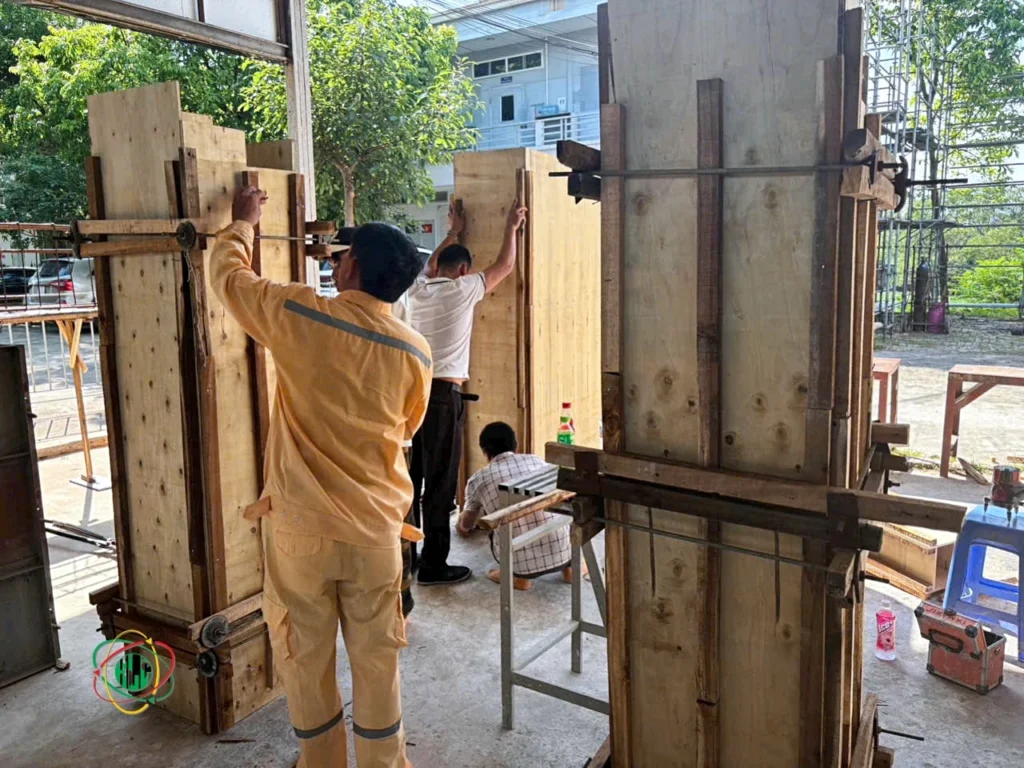
Vietnam’s technical education system includes a network of vocational colleges, technical universities, and training centres that produce a steady stream of qualified candidates. Common specialisations include mechanical engineering, electrical systems, automation and robotics, welding technology, CNC machining, and industrial maintenance. MOLISA sets national training standards and issues certifications that are recognised across the country. While the quality of training can vary between institutions, licensed manpower agencies typically work with the best‑performing centres and conduct their own additional assessments to ensure consistency.
Pre‑Departure Technical and Language Preparation
Before a worker is deployed, they undergo a comprehensive pre‑departure programme that typically includes 160‑240 hours of technical upskilling, safety training, and language instruction (usually to A1 or A2 level in the destination country’s language). The curriculum is customised based on the employer’s specific requirements – for example, a food processing plant may require HACCP awareness, while an automotive supplier might need advanced welding certifications. This role‑based preparation ensures that workers arrive with the competencies needed to contribute from day one.
Quality Assurance and Worker Screening
A reputable manpower agency employs a multi‑stage screening process: initial application review, technical aptitude tests, practical skill assessments, health examinations, background checks, and in‑depth interviews. Accredited testing centres and certified assessors are often used to maintain objectivity. Employers receive detailed candidate profiles, including training records, certification copies, and assessment results, allowing them to make informed selections. This transparency is a cornerstone of trust‑based partnerships.
Legal Pathways for Vietnamese Technical Workers to Europe: EVFTA, Bilateral Agreements, and MOLISA Licensing
Overview of EVFTA and Its Relevance to Labour Mobility
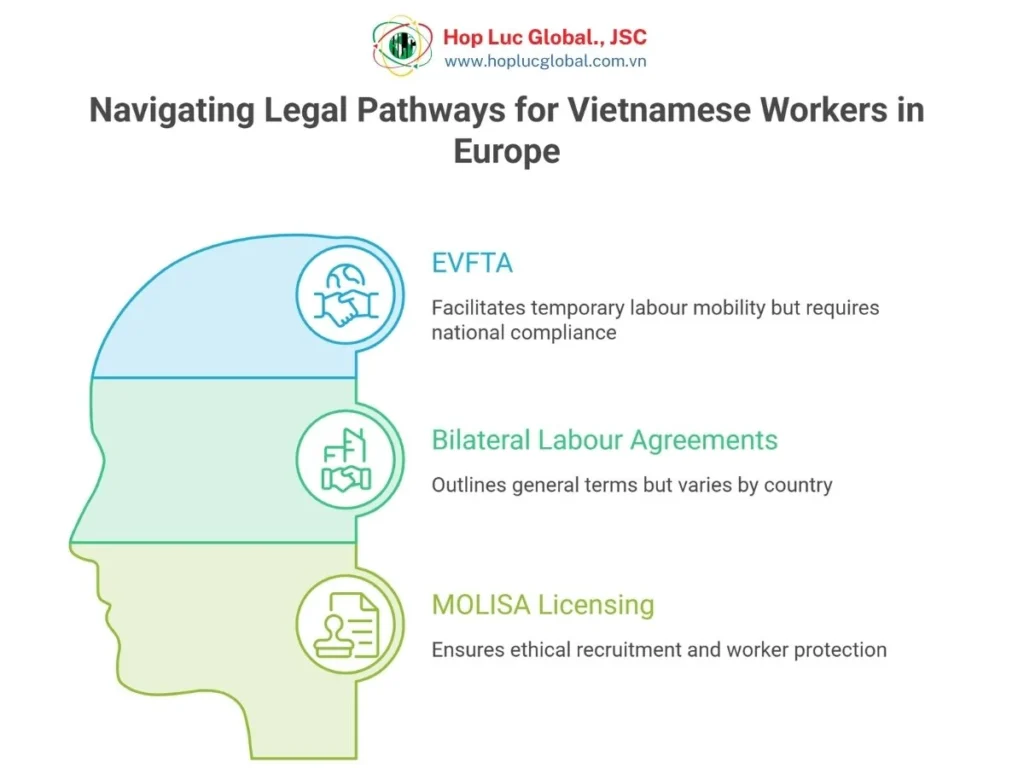
The EU‑Vietnam Free Trade Agreement (EVFTA) includes provisions on temporary labour mobility (Mode 4) for certain categories of workers, including technicians and engineers. While the agreement provides a framework, it does not bypass national work permit and visa requirements. Each EU member state retains authority over its own immigration procedures. The EVFTA is best understood as a facilitating instrument rather than a guarantee of entry. Employers should view it as part of a broader legal landscape that includes bilateral agreements and national legislation.
Bilateral Labour Agreements and Country‑Specific Requirements
Vietnam has signed bilateral labour cooperation agreements with several EU countries, including Germany, Poland, Romania, and others. These agreements outline the general terms for the exchange of workers, but specific rules – such as duration, salary thresholds, and documentation – vary by destination. For example, some countries require a labour market test, while others have simplified procedures for certain sectors. Because these details are subject to change and differ across jurisdictions, it is essential to verify current requirements with the relevant authorities in the target country.
MOLISA Licensing and Its Significance for EU Employers
MOLISA is the primary regulator for labour export in Vietnam. All agencies that send workers abroad must obtain a licence and adhere to strict operational standards, including ethical recruitment, worker protection, and financial guarantees. Hop Luc Global holds MOLISA licence number 67/LĐTBXH-GP, issued on 26 October 2023. This licence demonstrates compliance with Vietnamese law and provides EU employers with a baseline of trust and accountability. Working with a licensed agency reduces legal risk, ensures proper worker contracts, and helps avoid the pitfalls of unregulated intermediaries.
End‑to‑End Recruitment and Deployment Process for Technical Roles
Initial Consultation and Job Profiling
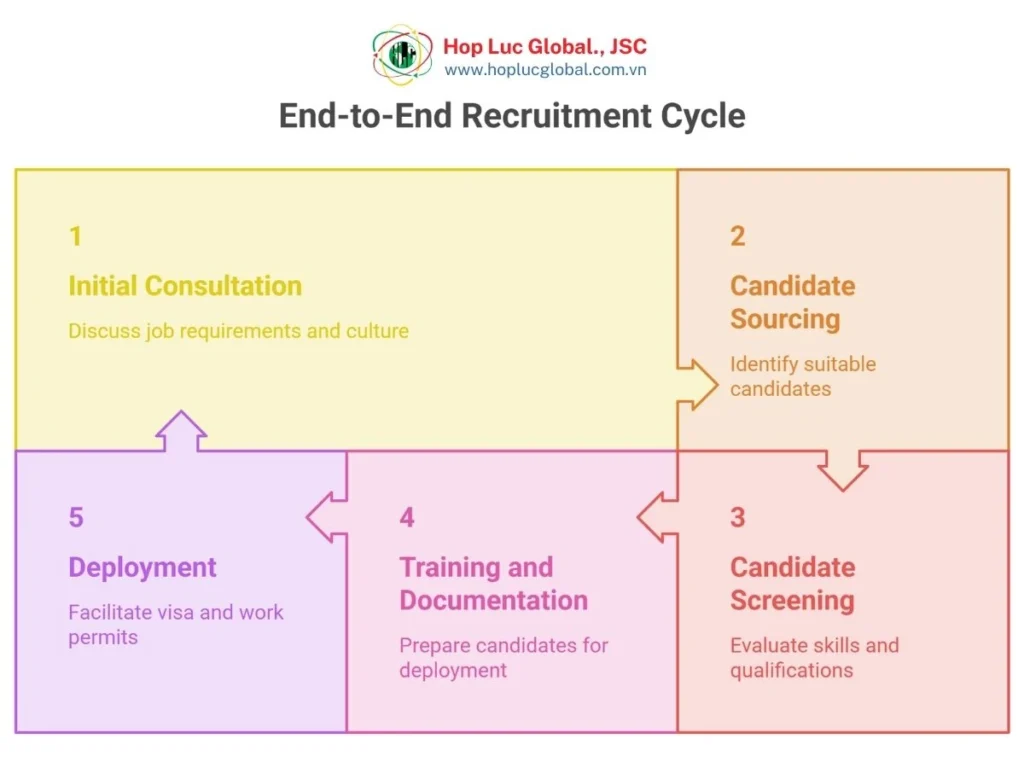
The process begins with a detailed discussion between the employer and the manpower agency. Key topics include job descriptions, required qualifications, experience levels, language needs, and desired start dates. The agency also gathers information about workplace culture, safety standards, and any specific certifications required. This consultation lays the foundation for a tailored recruitment strategy and helps both parties agree on selection criteria and assessment methods.
Candidate Sourcing and Screening
Using a network that spans Vietnam’s industrial provinces – including Hanoi, Ho Chi Minh City, Da Nang, and Hai Phong – the agency identifies candidates who match the employer’s profile. The screening process is rigorous: it includes reviewing applications, conducting technical tests (often with practical components), performing structured interviews, and verifying backgrounds. Shortlisted candidates are presented to the employer with comprehensive documentation, including training certificates and health records. The employer then has the opportunity to conduct additional interviews or request further assessments.
Training, Documentation, and Deployment
Once candidates are selected, they enter the pre‑departure training phase. This includes technical refresher courses, language classes, and cultural orientation. The agency also assists with compiling the necessary documentation for work permit applications, visas, and medical examinations. Throughout the process, the agency liaises with embassies and consulates to facilitate timely processing. While the duration of these steps depends on the destination country’s administrative timelines, a well‑structured agency will keep the employer informed and manage expectations realistically.
Total Cost of Employment: Vietnam vs. Local EU Hiring – A Transparent Comparison
What’s Included in the All‑In Monthly Cost for Vietnam Manpower
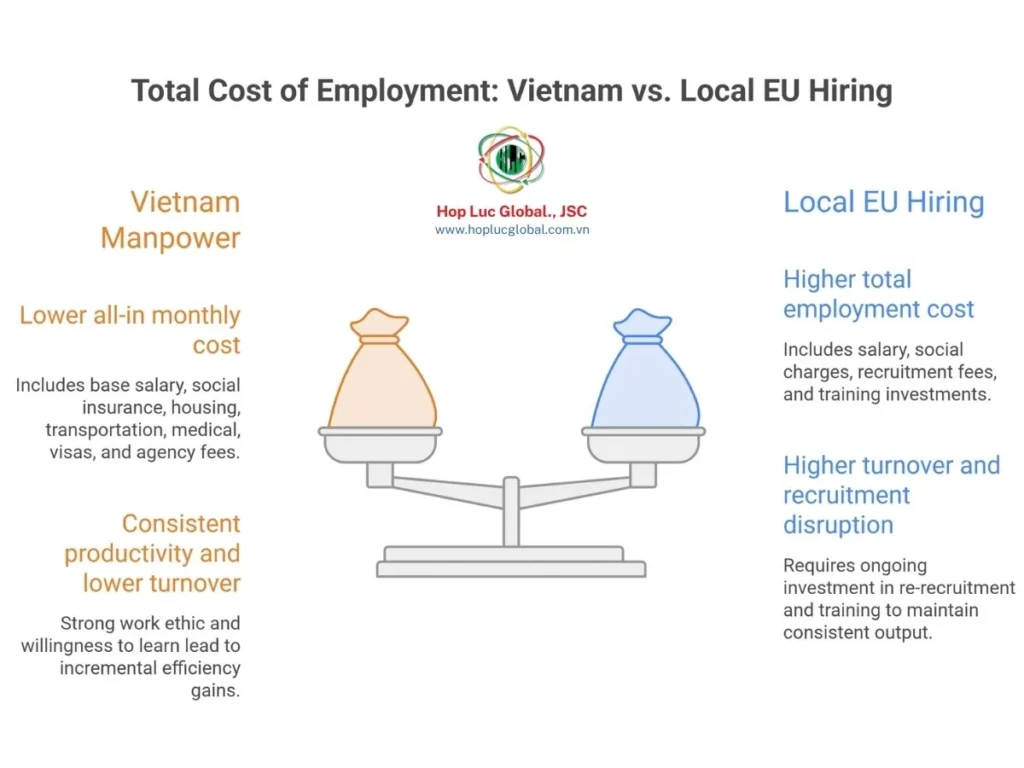
When evaluating the cost of employing technical workers from Vietnam, employers should consider the all‑in monthly cost, which typically covers: base salary (in compliance with Vietnamese and host‑country standards), social insurance contributions, housing allowance, transportation, medical insurance, visa and work permit fees, and the agency’s service charge. A reputable agency provides an itemised quote with no hidden fees. This transparency allows employers to compare total employment costs accurately against local hiring options.
Benchmarking Against Local EU Employment Costs
While exact savings vary by role and country, many EU employers find that the all‑in cost for a Vietnamese technician is significantly lower than the equivalent local total cost (salary plus social charges, recruitment fees, and training investments). However, cost should not be the only consideration. Quality, reliability, and retention are equally important factors that affect the true value of any workforce solution. Employers should weigh the total package, not just the upfront price.
Long‑Term ROI: Retention and Productivity Considerations
The long‑term return on investment of Vietnam technical manpower extends beyond the wage differential. Workers who are carefully selected, properly trained, and well supported tend to stay longer, reducing turnover costs. Lower turnover means fewer disruptions, less time spent on re‑recruitment, and more consistent productivity. Additionally, Vietnamese workers often bring a strong work ethic and a willingness to learn, which can lead to incremental gains in efficiency over time. While specific retention figures are not universally applicable, structured support systems can significantly enhance worker satisfaction and tenure.
Mini CTA: Get a preliminary cost estimate for your technical roles
How to Vet a Technical Manpower Agency in Vietnam: Checklist and Red Flags
Essential Credentials: MOLISA License and Physical Presence
Start by verifying that the agency holds a valid MOLISA licence. You can ask for the licence number and issue date – for example, Hop Luc Global’s licence is 67/LĐTBXH-GP, issued in October 2023. Additionally, insist on a physical office and training facility in Vietnam. A brick‑and‑mortar presence demonstrates a commitment to operations and accountability. Also check that the agency is registered for tax and compliant with local business regulations.
Track Record and Client References
Ask the agency for references from other EU employers, preferably in your industry. Inquire about their experience, the quality of workers provided, and the agency’s responsiveness to issues. While client names may be kept confidential, anonymised case studies or performance data can offer valuable insights. A transparent agency will be willing to share such information and may even facilitate a conversation with a current client.
Red Flags to Avoid
Be cautious of agencies that make unrealistic promises – for example, guaranteeing visa approvals or offering extremely short timelines. Other red flags include a lack of transparency in fees, unwillingness to share worker contracts, or the absence of a proper training facility. Also avoid agencies that pressure you to make quick decisions without adequate due diligence. A trustworthy partner will encourage thorough evaluation and provide clear, documented answers to all your questions.
Mini CTA: Download the ‘Vietnam Technical Manpower Employer Checklist’
Risk Mitigation: Retention, Cultural Integration, and Post‑Placement Support
Structured Onboarding and Orientation
To set workers up for success, a comprehensive onboarding programme is essential. This begins before departure with cultural and workplace norms training. Upon arrival, workers should receive orientation covering local labour laws, safety protocols, and company policies. Some employers implement a buddy system or mentorship to help new arrivals navigate the social and professional environment. These measures reduce anxiety and accelerate integration.
Continuous Support and Grievance Handling
Ongoing support is critical for retention and problem resolution. Many agencies, including Hop Luc Global, assign a dedicated liaison who serves as the primary point of contact for both employer and worker. Regular check‑ins – at 30, 60, and 90 days – help identify and address any issues early. A clear grievance procedure ensures that disputes are handled fairly and promptly, minimising the risk of escalation or premature departure.
Strategies for Long‑Term Retention
Beyond the initial months, employers can foster retention by offering career development opportunities, such as additional training or certification programs. Fair compensation, respect for cultural differences, and a positive work environment also contribute to worker loyalty. Regular feedback sessions and recognition of achievements go a long way in building a stable, motivated workforce. While retention is a shared responsibility, proactive measures by both employer and agency can greatly improve outcomes.
Next Steps: Starting Your Vietnam Technical Manpower Journey with Hop Luc Global
How to Initiate a Partnership
Beginning your engagement with Hop Luc Global is straightforward. Reach out via email at contact@hoplucglobal.com or through the contact form on our website. Share your technical role list, the volume of workers needed, and your preferred start date. We will respond within 48 hours with an initial feasibility assessment and a customised proposal.
What to Expect During the Initial Consultation
In the first consultation, we will discuss your workforce needs in depth, review any legal or compliance considerations relevant to your country, and outline a tailored recruitment and deployment timeline. We will also explain our quality assurance processes, training programmes, and post‑placement support. This is a collaborative effort to ensure that all expectations are aligned and that you have a clear understanding of the steps ahead.
Additional Resources and Support
As part of our partnership, we provide access to a range of resources, including detailed guides, compliance checklists, and regular updates on regulatory changes in the EU and Vietnam. Our team remains available for advisory support throughout the engagement, helping you navigate any challenges that arise. We believe in building long‑term relationships that deliver sustained value.
Frequently Asked Questions
What types of technical roles can be filled from Vietnam?
We cover a broad spectrum of technical positions, including mechanical and electrical technicians, welders, CNC operators, automation engineers, maintenance specialists, and industrial electricians. We also work with employers to fill specialised roles based on their unique requirements.
How long does the recruitment and deployment process typically take?
The timeline varies depending on the role, candidate availability, and the destination country’s administrative processing. A typical estimate is between three and six months from job order to arrival, but this is subject to authority review. We advise employers to plan ahead and allow for some flexibility.
What is the cost structure for hiring technical workers from Vietnam?
We offer an all‑inclusive monthly cost that covers salary, social insurance, housing, medical insurance, visa and work permit fees, and our service charges. Each proposal is itemised, so you know exactly what you are paying for. We do not have hidden fees, and we provide transparent quotes tailored to your specific needs.
Are Vietnamese workers proficient in English?
Many Vietnamese workers have basic to intermediate English skills, and we provide additional language training as part of the pre‑departure programme. For technical roles, language requirements are customised based on the destination country and the employer’s needs. We ensure that workers achieve the required level before deployment.
What legal assurances do I have as an EU employer?
By partnering with a MOLISA‑licensed agency like Hop Luc Global, you benefit from a regulated framework that ensures ethical recruitment, proper contracts, and worker protection. However, each EU country has its own work permit and visa procedures, which we help you navigate. We always recommend consulting local authorities for the latest requirements.
How does Hop Luc Global ensure worker retention?
We focus on thorough selection, role‑based training, cultural orientation, and continuous support. Our liaison team conducts regular check‑ins and addresses any concerns promptly. While retention ultimately depends on many factors, our structured approach minimises turnover and helps build long‑term relationships.
Ready to explore Vietnam technical manpower for your workforce needs?
Share your technical role list and target start date with us – we’ll respond with a custom sourcing plan within 48 hours.
Email: contact@hoplucglobal.com
Phone: (+84)24.6328.4768
Website: https://hoplucglobal.com.vn/
Office: Lot 01, TT6 – 2B, Thi Cam Street, Xuan Phuong Ward, Hanoi, Vietnam
Tax code: 0110103022 | MOLISA licence: 67/LĐTBXH-GP (issued 26 October 2023)